Reviewing the old school: Die Hard (1988)

So I wanted to do a Christmas movie this week since, y’know, Christmas. Took me a little while to decide which one, since there are quite a few of them (many of them actually pretty shit). Then I remembered I hadn’t watched the original Die Hard in a while, and the choice was made. I procured a copy, ordered a curry and sat back to watch what remains one of my favourite action movies ever.

Released in 1988, the film stars Bruce Willis as John MccLane, an NYPD cop visiting his estranged wife at her work Christmas party (in an incomplete skyscraper in Los Angeles). Then a bunch of mostly European thieves masquerading as terrorists take all the party guests hostage. Hijinks ensue.

But you should already know all this, because you should have already seen this movie by now. In all honesty this should be on that 1001 Movies to See Before You Die list if it isn’t already. It’s a classic action film that holds together incredibly well nearly three decades later (holy shit Die Hard turned 27 this year). The fight scenes are appropriately brutal, the set pieces are spectacular and the coincidences never feel as contrived as they do in a lot of other films (including, if I’m being honest, Die Hard 2). The music, as well, is fantastic. It’s something I hadn’t really paid much attention to until I rewatched it this week, but it manages to add tension in the necessary scenes and avoids the unnecessary synth-rock that’s left the soundtracks to so many other movies from the 80s so dated. Best of all it manages to keeps a Christmas theme going throughout the film.

It’s little stuff like that which makes this movie so much fun and the it never treats the audience like an idiot. It talks through particular scenes without feeling like it’s spoon-feeding us through Bruce Willis’ conversations with the Hans Gruber (the villain), Al Powell (his lifeline on the outside) and himself (you’re only crazy if there’s someone around to hear you). It also has a surprisingly high opinion of intelligent characters. John MccLane is not an idiot. He’s good at improvising and working through problems. Alan Rickman’s Hans Gruber is witty and charming, very capable of getting his hands dirty, able to think clearly, rationally and keep an eye on the prize throughout. Idiotic behaviour, however, usually results in the death of that idiot, as we see with Ellis and the FBI agents Johnson and Johnson (no relation). Going in guns blazing doesn’t work, and I wish more action movies would take this lesson to heart.

There are flaws, of course. Holly Gennaro, played by Bonnie Bedelia, has little to do aside from being someone for John MccLane to save. Reginald VelJohnson’s character Sergeant Al Powell tells a story about shooting an unarmed 13 year old boy, meant to garner sympathy for the cops, comes off a little sour given recent events (and probably should have given contemporary events as well). Some guns never seem to run out of bullets until it suddenly ‘matters’. The territorial police commissioner trope, furious about property damage and glass, is a little overdone. As is the henchman who just will not fucking die.

But it’s easy to overlook these flaws. Especially ’cause this movie gave us Alan Rickman. I mean, yeah, Bruce Willis was also a fairly fresh face known for his TV and commercial work propelled to Hollywood fame by this film, but he didn’t play Severus fucking Snape in the Harry Potter films. Without Die Hard Rickman may have remained a relative or complete unknown. And that would have been tragic.

So, yeah, watch this film if you haven’t already. But I expect just about everyone likely to read this already has, so, watch it again I guess? Yeah, watch it again.

Have a Happy Christmas (or Chanukah or Winter Solstice or just a grand public holiday for the many people who don’t celebrate it). Let’s see if I can think of a good New Year movie for next time.

Reviewing the old school: Troy (2004)

Mate, there is so much wrong with this film. I think the worst part is that it could have been so much better if they’d actually used the source material properly. Y’know, with all the gods and magic and not trying to make us sympathise with Paris of Troy. Seriously, you read the Iliad? You know what we’d call that guy in the modern parlance? A date-rapist. Doesn’t matter that he had help from the Goddess of Love instead of roofies, he still fucks Helen without her conscious consent. That ain’t right.

I don’t get why they cut all the supernatural stuff out of the story. It certainly wouldn’t have made the movie any worse, and it certainly could’ve made the story a whole lot more interesting (imagine Sean Bean’s Odysseus having a D and M with Athena, the Goddess of Just War and Wisdom herself, on the beach beside his ship, or perhaps Ares, the God of War, stalking the battlefield with a leering smile at all the carnage). Could’ve been epic. And it’s not like we’d have a problem with the whole ‘Gods and goddesses interfering with the lives of mortals’ thing. I mean, The Mummy and it’s sequel came out five and three years before, respectively, and they did pretty well with the whole weird foreign supernatural thing. Hell, bloody Disney went and covered the same sort of ground as Troy, but including the divine intervention, with its animated film Hercules (and the great spin-off series about his high school years).

Maybe they were worried that if there was too much Deus Ex Machina going on we wouldn’t be able to take Brad Pitt’s flowing golden hair or Eric Bana’s tinted curls seriously. Maybe they were worried that they’d have to make Orlando Bloom the bad guy who dooms his whole city because he just couldn’t keep it in his pants when he met a hot girl who wasn’t interested. Maybe I’m giving the rest of the film too much credit and it would still be shit anyway.

Probably that last one, but the point still stands.

The acting isn’t great. Brad Pitt and Eric Bana ham it up with that weird pseudo-English accent that non-English actors are expected to put on whenever they’re in a historical period earlier than the 1600s. While Brad Pitt never seems to take it seriously (understandably), Bana actually seemed to get better as the film went on and I think he was the right choice for Hector, noble and doomed and the only one with the common sense to say “let’s just give Helen back to the Greeks, Paris will get over it and even if he doesn’t it isn’t worth going to fucking war over.” There’s a lot of great actors in this film, and they do their damned best with the material. Special props to Brian Cox who plays the role of the villainous, prideful, megalomaniacal Agamemnon with a surprising amount of subtlety. Sean Bean’s Odysseus seems woefully underused. I mean, they don’t even kill him. How you can put Sean Bean in your movie and have him play the one character that everyone knows is gonna survive?

The direction and editing are an overlong mess. It’s a two and a half hour long film and not nearly enough of that is filled with the kind of character moments to actually make us care. Some of it just seems painfully unnecessary. Case in point, the film opens with a map of the Aegean. No voice over, no music, no intro credits. Just a fucking map on the screen for like thirty seconds to a minute. Maybe that minute could have been spent fleshing out Ajax a little more, so we actually give a shit when he dies. Patroclus’ character could’ve been fleshed out a little better as well. I think fantastically named director Wolfgang Petersen was trying to channel old classics, the grand Biblicals and biopics like Ben HurSpartacus and Julius Caesar but it just doesn’t work. It’s too slow and not nearly as epic as we’d come to expect by then.

For all its flaws, and it has a lot of flaws (a lot of flaws) I absolutely love this film. My mates and I can basically communicate in movie and television quotes. Simpsons make up the bulk of our source material, with the two Hot Shots! films, the two Airplane (Flying High!) films, Gladiator and Lord of the Rings trilogy filling out the rest of our situational conversations. Troy occupies a special place for us as being the soundtrack for some of our most (or, I suppose, least) memorable nights of drunken debauchery. Someone refusing another beer would be met with a bellow of “Drink you lazy whore! Poles are sobering!” (several of my friends being of Polish origin). Midway through the night you’d likely hear a cry that “The taxi waits for us, I say we make him wait a little longer!” Someone skoling back beer after beer would be cheered on with “The man wants to die!” There was more than one occasion where we’d take Achilles’ speech at the prow of his ship before hitting the beach of Troy and adjust the wording, to fit our school and desired outcome “…my brothers of the schooner… do you know what’s waiting on the other side of the bar? Immortality! Take it, it’s yours!” I watch this film and I’m not thinking about the acting or the plot or the story, the dramatic lines are triggering memories of long nights and close friends.

So yeah. It’s a bloody terrible movie, but I love it dearly. Still, don’t watch it. It’s not worth it and might sour you on a couple of great actors. Read the Iliad and Odyssey instead. They’re classics for a reason.

Reviewing the old school: Nausicaa of the Valley of the Wind (1984)

I’ve struggled a bit writing this. I hadn’t watched this film in a while, and it seemed like a decent choice for an old movie review. It’s bloody fantastic. Problem is, to be honest, just about everyone probably already knows that. It’s Hayao Miyazaki, often cited as the first of Studio Ghibli’s long run of amazing films (even if the company hadn’t technically started yet). Of course it’s good. Of course it’s been praised, dissected, critiqued and analysed by a million others before. What can I possibly add to the discussion? Fucked if I know, but maybe if I ramble on for a bit I’ll think of something.

So, Nausicaä of the Valley of the Wind (or Kaze no Tani no Naushika). The story takes place on a post-apocalyptic world a thousand years after industrial human society had been destroyed in the “Seven Nights of Fire” (this being a Japanese film, titanic organically grown robots with surprisingly uncreative names were involved). Much of the planet has been claimed by the Toxic Jungle, that releases poisonous spores into the air within and around, and is gradually claiming human settlement after human settlement. Nausicaä is a princess of the kingdom known as The Valley of the Wind (hence the title of the film). Far and away one of the hardest bastards in the film (there is one other character who kicks as much arse and he needed to be voiced by Patrick Stewart to do it), she’s also a committed pacifist with a talent for calming, charming and redirecting the deadly insects that protect the Toxic Jungle rather than following the trend in other human kingdoms to kill everything remotely threatening with fire. Aside from a dying a father, everything’s going pretty sweet in the valley until an enormous airship from a neighbouring kingdom, Tolmekia, crashes into the valley and just ruins everyone’s day. Partly because it was carrying spores from the toxic jungle. Partly because it was carrying a foreign hostage who died after the crash. Partly because it was carrying the… embryo… of one of those giant robotic killing machines that I mentioned destroyed the world earlier, that the Tolmekians want back. Anyway, several hopeful anti-war and environmentalist lessons later, everything turns out relatively alright.

It is a beautiful film. The animation is smooth and hold up well for a thirty-one year old film. The art-style makes intimate moments seem grand and grand moments feel intimate, as well as finding the beauty in in what are honestly some fucking horrific-looking beasts. There’s this scene early in the film, when Nausicaä is searching a cave for resources and she discovers the shell of an enormous insect called an ohm. Like, really bloody enormous. It’s presented like a religious experience, a pilgrim entering a cathedral and seeing light fall upon an altar. A lot of blue and white in this moment. A few minutes later the beast that left the shell behind is a nasty, snarling monster chasing after that character voiced by Patrick Stewart (an unforgivable offense in my book, but Nausicaä’s a far better person than I am). Red eyes and a black shell, stark in the desert outside of the cave. Another minute later and the monster has been calmed and is heading home with a surprising grace. Red has been turned back to blue.

Given this focus on colour, the cinematography, the characters and the message that humanity’s best chance of not killing itself is strong anti-war and environmentalist leadership (not to mention the post-apocalyptic setting), I kept comparing Nausicaä of the Valley of the Wind to, of all things, Mad Max: Fury Road. No, seriously. There’s a tonne of parallels there that I don’t have the time to go through in order to get this up before a self-imposed deadline, but if I ever meet George Miller I’d be inclined to ask how much of an influence Hayao Miyazaki is on him. I might even write a much longer post on the subject sometime in the future. We’ll see. I’m not saying that if you enjoyed Fury Road you’d enjoy Valley of the Wind. Except I actually am. And vice versa.

So, have I added said something interesting in all of this? Maybe. That last bit sounded good, even if it was a bit short. Fuck it, that’s good enough. Point is, if you haven’t seen Nausicaä of the Valley of the Wind before, you should definitely watch it. If you have seen it before, well, you should watch it again.

Leave a comment. Thoughts are always appreciated, ideas for future Old School Reviews will be politely considered.

Reviewing the old school: Young Einstein (1988)

I like the odd bit of alternate-history fiction. Usually the more serious stuff, where you take a particular historical conflict and basically go “then the aliens attacked” or “but actually there were magicians there too” or “suddenly, time travel!” Serious stuff. Young Einstein (written, directed by and starring Yahoo Serious – probably not the name he was born with) takes a more comedic route by asking its own grand question: what if, instead of Germany, Albert Einstein was born in Tasmania to Aussie apple farmers?

Well, for one, he still develops the Theory of Relativity in this version of reality, but its first application is to split a beer atom in order to carbonate his dad’s pint. Having succeeded in creating bubbly beer (something apparently impossible to do without causing a small atomic blast) Albert packs his bags and heads to Sydney via Uluru (dammit Jim he’s a physicist not a map-reader!) in order to patent his idea. He runs into (and falls in love with) the lovely Marie Curie (played with some fantastic expression by Odile Le Clezio) who has gone to study physics at the University of Sydney (USYD represent!) for some reason, has his idea stolen by foppish villain Preston Preston of the Perth Prestons (played by John Howard – the actor not the Prime Minister – who is wonderfully pompous, cowardly and greedy), invents rock’n’roll music, then uses rock’n’roll music to diffuse an atomic bomb (saving the lives of thousands, including an apparently still kicking Charles Darwin).

Yeah, you shouldn’t think about it too hard. Or at all. Very little of it makes a whole lot of sense. The plot doesn’t. A fair bit of the physics related dialogue doesn’t. But I like it. And if you don’t think about it too much you might like it as well.

As bonkers as it is, Young Einstein does have a colloquial charm. John Howard hams it up fantastically as Preston Preston in what I’d be willing to call one of his best and funniest roles. The idea that everyone would give so much of a fuck about putting bubbles into beer that the scientific community would give out a Nobel Prize for the effort is so bloody Australian it was probably born in New Zealand. Once he gets out of Tasmania, Yahoo’s young Einstein manages to mix the traditional Aussie stereotype of the self-reliant bushman out of his depth in the big city with the broader stereotype of socially-oblivious genius more easily than you’d expect. The plot might not make any fucking sense, but the fact that everyone seems to rather like the kid does.

Thing is, I can’t bring myself to recommend this film to anyone. It took me a little bit to decide why, mind you, but I can’t. Not to an Aussie audience, not to a foreign audience. The problem is it hasn’t aged well.

So much of the humour is, essentially, a piss-take of what people from outside Australia thought the country was like. Weird puppet Tasmanian devils that can take bites out of metal shovels, wallabies hopping around the Sydney Uni campus and (as mentioned above) indicating that a trip from Tassie to Sydney would require hopping on a train in the red centre. Thing is this may have been how people viewed us nearly thirty years ago but other people have done a better job of having a go at these stereotypes since then, and (if nothing else) the number of Australians traveling around the world (yours truly included) and people who have travelled to Oz has dispelled a lot of the more ridiculous of the myths made fun of in Young Einstein. A fair few of the jokes are winks and nudges at the Australian audience going “how funny is it that dumb-arse foreigners think this is what we were like!” Now we’d just point out that the rest of the world just thinks we’re a bunch of drunken, sports-mad brawlers with a talent for killing spiders and sharks in between smashing back tinnies.

As a result a lot of the humour falls flat. This isn’t helped by the fact that some of the more noticeable cultural references aren’t all that recognisable (I might know that a shot of Einstein riding a horse down a steep slope is a reference to The Man from Snowy River but I doubt that any of my siblings would).

Honestly mate I watched this film for nostalgia purposes. I remember watching this film as a kid. There’s this point at the end where everything’s about to explode and everyone’s losing their shit. Einstein, calm as you like, takes a bite out of an apple and says “Just a moment Marie, I’m having an idea.” I love that calm thoughtfulness. The problem with the rest of the film might be that it’s too goofy. Everything from the high-pitched inflection of the narration to the costuming to the sound effects is played for the easiest kinds of laughs. But this one line, played perfectly straight, eating an apple, it embodies my own sense of humour and how I try and handle a stressful situation. Funny what sticks with you.

So yeah, I like this movie. Is it great? Not really. Should you watch it? Probably not. Hell, I wouldn’t even recommend a rewatch if you’ve seen it before. But if you do, remember to take it for what it is. It’s a relic of what we all thought you thought about us back in the day, true or not. And it’s a bit of clean, stupid fun.

Try harder, or why I’m loving Bitch Planet

There’s a really excellent comic series running right now by the name of Bitch Planet. Written by Kelly Sue DeConnick and drawn by Valentine De Landro it takes place in a future in which ‘non-compliant’ women are sent to the Auxiliary Compliance Outpost, nicknamed (you guessed it) Bitch Planet. It’s a clever feminist satire of 70s exploitation films. The art style and colours (done by the excellent Cris Peter) are deeply reminiscent of grainy film and a tacky science fiction aesthetic, cleverly placing the female cast in positions where they are sexualised in the context of the world without sexualising them for the readers. The characters are likeable and real, representing not just a cross-section of race, body-types and sexualities, but also personalities and motivations, coming together for an opportunity to strike back at the patriarchy that governs their world. And man, fuck the patriarchy that governs their world. With a brick. Sideways.

What really exemplifies this series for me, however, is how fucking disgusted with myself I feel after I read them. Just really goddamn gross. And yeah, that is a good thing.

The scary part of this particular dystopian future (like many great dystopian futures) is just how familiar it feels. Body-shaming, slut-shaming, sexuality-shaming, racism, stereotypes, pseudo-scientific explanations for why man is superior to woman, a belief that the sole purpose of females is to serve men perpetuated by the media and popular culture instilling little doubt in the younger generations about this ‘truth’. This is the world we live in now. The world of Bitch Planet simply codifies it into law and makes non-compliance (being fat, gay or promiscuous) punishable with prison sentences and even death (shit, it’s not even hard to think of countries where this is actually a reality). The villains of the piece, Father and the other old men who rule, are unpleasant caricatures scarily reminiscent of the good old boys who fill governments and governing boards the world over. And good god how I wish for the protagonists, the bitches of Bitch Planet, to punch their smug, misogynist faces in. The part that gets to me, however, is that they might not.

Right from Issue #1 it was made clear that any victory would be bitter-sweet and failure was the more likely outcome. That undercurrent of failure being more than possible has continued through the series all the way to this weeks Issue #5 and doesn’t look like it’ll be ending soon. You feel like no matter what they do, no matter how hard they try, those above will simply change the rules to keep themselves there and there is nothing that these heroic women will be able to do to stop it.

Just like it often feels in the real world. The real world where women are blamed for being the victims of sexual assault, harassment and violence, then punished with more of the same. The real world where a woman has to work twice as hard to be in the same position as a man and still earn less pay. The real world where a woman’s reproductive rights (and their universal rights to bodily integrity) are constantly under attack by backwards moralists and their pocket legislators. The real world that I am a part of. And part of the problem.

I’m a big believer in the old saw that art mirrors life and society, and when I read Bitch Planet I see a pretty ugly reflection. I can’t read this and not feel like I’m not doing enough to change this reality. Change this reflection. I’m not doing enough to make this world we live in a better place for my sisters, my cousins, my daughters if I ever have them, my friends. Shit I’m not even sure what I should be doing, just that I’m not currently or not doing well enough. Not trying hard enough.

That’s what’s great about Bitch Planet. It’s a simple reminder to try harder. And that’s what I’ll do. It’s what we should all do. Because the world of Bitch Planet is not a great place to be.

So I’d definitely give it a recommend giving it a read. It’s fun, exciting, horrifying and tragic all at the same time. Most importantly it’s a reminder to keep trying harder.

Worth not stepping on: Thoughts on Ant-Man

Not the easiest thing to do anyway.

One of the most unfair criticisms leveled against Ant-Man (the latest superhero film from the good folk over at Marvel), well before the film was released, was that it was a movie no one asked for or wanted. I recall one re-blog that did the rounds on Tumblr when the titular blogging site had a “Ask the cast of Ant-Man” going on, “How does it feel starring in a movie no one asked for?” or something along those lines, receiving plenty of the internet equivalent of snickers and backslaps at such a brilliant witticism. Personally I found it all a bit fucking disingenuous. I mean, I understand where a lot of these detractors were and are coming from. I too would have really liked to see a MCU film with a female or POC lead a lot sooner than they’re coming (and am bloody stoked for the Captain Marvel and Black Panther films, both due in 2018). And, hell, there has been a pretty large voice crying out for a Black Widow led film (though it seems a lot of that’s cooled off a bit since the arguably disappointing character arc and dialogue in Age of Ultron).

But it feels like this ignores three key points. First, I’m sure there were plenty of people who were overjoyed to see the Ant-Man film. I mean, the guy had to have had some fans (and there must of been a few disgruntled fanboys and girls crying foul when Tony Stark constructed Ultron in the MCU instead of Hank Pym). Second, films are regularly made that aren’t asked for. We frequently don’t know what we want. Shit, I didn’t know how much I wanted a Captain America movie til it was made and looked awesome. In fact we’re normally overjoyed when a film is made that isn’t a sequel (even if it is part of a larger franchise or broadly shared universe, like the Pixar films). Third, why can’t we have both? Marvel studios and their Disney overlords are an enormous empire with plenty of talent to choose from, the millions to spend and an audience that is still eating out of the palm of their hands. Getting a She-Hulk, Spider-Woman or Falcon movie out between AoU and Ant-Man would not have been impossible. Blaming Ant-Man for being made when other possibly great films aren’t just doesn’t sit well, ’cause it is not the film’s fault that they weren’t made.

Mind you, it doesn’t much matter. The film still topped the Friday box office and will likely do very well this weekend. It’s had pretty decent reviews by critics and the public. I also doubt very much the pre-release criticism had anywhere near the attention on social media that the abso-bloody-lutely delightful advertising campaign for the film managed to spark (tiny bilboards? Brilliant!) Most people who’d read this would probably even be surprised that this non-issue came up at all, anywhere. It’s a criticism I wanted to quickly address, however, because the aim was right even if the target was wrong.

I went and saw Ant-Man Friday with one of my housemates. It was good. Sharp dialogue, plenty of physical humour, a creative and satisfying climactic battle. Paul Rudd is funny in his non-threateningly charming way, with a strong emotional range that leads to a light-hearted pay-off. Corey Stoll’s character Darren Cross (eventually the Yellow-Jacket and villain through the entire film) is appropriately menacing and more than a little crazy, with his abandonment issues and desire for Hank Pym’s (Michael Douglas) respect (though I can’t help but feel he’s a bit of a copy-paste of Iron Man 3‘s Aldrich Killian). Evangeline Lilly is competent as Hope van Dyne, Hank Pym’s sort-of estranged daughter. But the father/daughter relationship could have used a lot more fleshing out. There’s supposed to be an enormous rift between the two but we never really see it (both characters coming off pretty one dimensional in the process) and the predictable confession and forgiveness scene doesn’t have any serious punch. Some of the best laughs come from Michael Peña’s role as Luis, the fast-talking, surprisingly-cultured ex-con/still-a-bit-crooked best friend of Ant-Man. He plays the role of comically stupid without ever appearing incapable, incompetent or unlikeable, and that is a true skill (and mark of a well-scripted character).

I can’t bring myself to give the kind of glowing recommendation to see it in the cinema that I gave to Guardians of the Galaxy. It falls into following too-predictable-cliches and  too-recognizable-tropes for that.The training montage, for instance, where the highly competent female supporting lead teaches the bumbling male how to do the role she should be doing. Thankfully it doesn’t go all the way (Hope is still a more competent hero at the end of the film, and Scott is given the role of Ant-Man over her because he’s expendable rather than ‘The Special/Chosen/Prophesied one). It’s a good film though. Funny. Clever. Worth watching. I think the best way to put is that you won’t regret it if you see it in the cinema. At the very least it’ll get a few laughs.

Parental guidance, or why I loved Mad Max: Fury Road

Max and Furiosa, sketch

As always, heads up that there are some spoilers ahead. Y’know what? Go see the movie first. Go see it. It’s brilliant.

There’s a scene around the middle of the Mad Max: Fury Road that I think sums up what makes the film so great. The appropriately named War Rig (a jury-rigged armed, armoured and supercharged oil tanker), carrying (the also appropriately named) Furiosa, Wives, a changed Nux and a less reluctant Max, has become bogged down in the wet soil and sand of what we might assume is a desolate former swamp. Behind them the war lord in charge of the Bullet Farm (an ally of primary antagonist Immortan Joe) and only one in possession of a vehicle with the treads necessary for traversing the treacherous terrain quickly, is closing in. Bullet Farm. It’s a clever name that draws upon an offhanded remark by one of the wives, the Capable I think it was, that one of her relatives used to call bullets “antiseeds. Plant one and watch something die.”

The sun set some time before, casting the world in a blue filter that marks a striking contrast against the reds and yellows of the wasteland during the daytime and forcing the (again, appropriately named) Bullet Farmer to probe the darkness with a bright white spotlight (and randomly directed shots from his enormous arsenal). Planning to slow down the progress of their pursuer Max kneels down with a scoped rifle, takes aim at the spotlight, fires, misses. Again, he takes aim, fires, misses. Is informed that he only has two shots left for that rifle. For a third time, he takes aim, fires. For a third time he misses. One shot left.

Before he can take it, before he can hit or miss, Furiosa comes up behind him. Max glances at her, back down the scope, then hands her the rifle. We, the audience, already know she’s a brilliant shot with this weapon. We saw her using it to pluck motorcyclists out of the air like clay pigeons as they jumped over the War Rig, then use it to pick off an approaching straggler well in the distance. What makes this scene something special, why it is such a fantastic demonstration of the evolved relationship between the characters and their combined strength is that Max doesn’t get up. He remains kneeling, allowing Furiosa to rest the stock of the rifle on his shoulder as she takes aim at the approaching spotlight. He doesn’t need to be told, he just does, and while he’s obviously not entirely pleased by the thought of having a gun fire right next to his ear, when Furiosa says “Don’t breath,” he doesn’t. She pulls the trigger. The spotlight shatters into the face of the Bullet Farmer. The ambient noise of the film is replaced by the high-pitched whine of Max’s dying ear cells (there’s a reason you might not be happy about someone firing a gun right next to your ear). He doesn’t complain, just gives his head a shake.

A lesser character in a lesser film, with a lesser writer or director, would have felt the need for their male title to try and reassert some dominance and masculinity after being used as a prop by the female lead. Maybe with an offhanded remark about how he “was just about to do that” himself, maybe claim that some blunt force trauma to his head which occurred in an earlier fight (while saving the lady’s arse, of course) had thrown off his aim. Not Max though, and not Fury Road. He doesn’t say much at all. Just gets up and joins the others in getting the War Rig moving again. Cause we’re not watching Max’s story, we’re watching Furiosa’s story from Max’s perspective. It is Furiosa’s ambition, strength and desire that propel the story forward and drives the action. Max’s role is to support her in this, keep her moving forward, and at the end point her in the right direction to achieve those ambitions.

It reminded me of my parents. The supporting relationship, I mean, not the gun play. Both of them have their own plans, dreams and ambitions. When one needs to do something to achieve their goals, the other is there to provide the moral and physical support necessary to do it. Of course a big part of those ambitions was raising me and my siblings right. Making sure we achieve what we want to achieve.

The movie is a master-class in ‘show, don’t tell‘ and it’s what makes this film such an absolute joy of stoic characters and insane action. One of those important things is the relationship between Max and Furiosa. It is Furiosa’s desires and ambitions that are ultimately achieved, but I believe she could not have achieved them without Max’s help. Right here I want to be very clear that this is not a statement against Furiosa. Some would call her the best female action hero since Ripley in Alien and Aliens. I would call her better. She’s smart, fierce and amazingly capable. As I said, she drives the action, the plot and the motivations of the other characters. Furiosa is the knight errant rescuing the princesses from the tower, but Max is her squire. An important part of a more important character’s story, providing an extra pair of hands to maintain their steed, an extra fighter when she’s driving, a driver when she’s fighting, the hardened reinforcement to keep moving forward when she desperately wants to turn around but knows it would be folly (you know the scene if you’ve seen the film… “under the wheels”) and in the very end the herald announcing the end of her quest and displaying the trophy of her victory. In return for helping the hero on her journey Max receives the things he lacked travelling alone through the wasteland. Respect. Companionship. Hope. A cause worth fighting for beyond survival. Identity. Someone to witness who he was, who’d also understand what he was. Empathy. The Wives.

Fuckin’ hell, I cannot stress just how important the wives are to both Furiosa and Max. I’d call those two each other’s moral compasses, but it is the Wives who are the north that both end up trying to reach. A few commentators and reviews of Furiosa have missed the fact that in her first face-to-face meetings with both Max and Nux she tries to put them both down. Unsurprising, considering the context in which she meets them (threatening her and the women she is protecting with a shotgun and sneaking through the Rig to kill her, respectively). In both cases, it is the Wives that influence her actions during and afterward. It is the fact that Max, a feral dog after years in the wasteland with only his hallucinations for company, only bares his teeth (and nicks their ride, admittedly) even after Furiosa presses that shotgun against his head and pulls the trigger. He doesn’t harm the girls beyond what could easily be argued was necessary for his own survival, and so she sees the potential in trusting him to protect the Wives in the next scene. Between this she is ready to gut Nux but the Wives stop her. They call him a confused boy and his death as unnecessary. After this, it is the empathy of one of these wives that sees a scared, lonely and confused Nux (who knows he cannot possibly rejoin the society that was his whole identity, his whole existence) change sides and fight to protect the women who showed him compassion. In the end he does not desire to ride through Valhalla, shiny and chrome, he wants to be remembered by someone who genuinely cared about him.

As for Max, well, by the end of the movie he may not be sane but his experience with the Wives has reacquainted him with a sense of justice that he thought was dead at the beginning of the story. He sees Furiosa, who wants to do more than protect them, and grows from that. She wants to give the girls a chance to grow, live, make their own decisions, be more than just property, live up to their true potential. Is it Maternalism? Maybe. Probably. It certainly contrasts pretty sharply against the toxic paternalism and patriarchy of Immortan Joe and his hyper-masculine death cult. But isn’t that what all good parents want regardless of gender? For their children to live, thrive, and reach their own potential? To be happy? I bloody think so.

That’s what I think this movie is about. Two parents helping, learning from and supporting each other to give their adopted children a chance that they never had (or in Max’s case, was never able to give to his biological child… if we assume this is the Max from the original). A victory of Parentalism over Paternalism and Patriarchy. That is wonderful.

It also has a guy playing a flame-throwing guitar on the back of a giant doof wagon. That is also wonderful.

Go see Mad Max: Fury Road. It is wonderful.

A good, honest, hardworking jackass, or why I loved Emergence: Dave Vs the Monsters

As always with my reviews, spoilers ahead. Not too bad, but a few.

One of my least favourite tropes in film, television and literature in general is that of the tortured badass searching for (or receiving) a chance at redemption. Y’know the type. Some ex-cop (always a bloke) who left the force after he accidentally shoots an innocent woman or fails to save a child (or shoots an innocent child, fails to save a woman), drowning himself in a depressive spiral of substance abuse and random women (bonus points if they’re hookers) working as a PI until that one case comes along to shake them out of it back onto the straight and narrow, or some such shit. But, goddamnit, before the incident happened they were the best damn whatever on the whichever, with a loving partner and 2.3 adorable kids. Or perhaps the character is the type to have spent so much time at work becoming the best whatever on the whichever that he’d neglected his family life, drowning out the guilt of a rightfully angry ex-partner and a couple of kids who went off the rails (or died) without a present and accountable father figure (it’s always a bloke) in a spiral of substance abuse and random women (bonus points if they’re hookers), working until they meet the little girl or boy who reminds them so much of their own neglected spawn that they’re able to shape up and be the spouse and parent they always meant to be. Don’t get me wrong, it’s made for some amazing and iconic characters over the years, but it too often seems to simply become a lazy way of providing a reason why this or that dark-loner-antihero still has a heart of gold despite all the bourbon and strange, and why he’ll suddenly go from being that filthy, drunken bastard to flawless action hero by the end of the movie/book/season. What I love about Dave Hooper – the protagonist of Emergence: Dave vs the Monsters, John Birmingham’s latest written adventure – is that he never stops being a selfish bastard.

The book never allows any allusions contrary to this fact. It starts with Dave in a helicopter on his way to his job as the safety boss on a BP oil rig off the coast of Florida that was in the midst of completing a record drill deep into the earth’s crust beneath the ocean (FORESHADOWING!). He’s hungover from an extended binge involving unholy amounts of grog, a pair of top shelf prostitutes flown in from Nevada and a lot of toppier shelfier blow probably not flown in from Nevada, paid for with a six month bonus that he himself admits should have been put towards paying his taxes or soon-to-be ex-wife (who he’d been habitually cheating on for years prior to their separation), with time he should have spent heading north for an access visit his two sons (that he hasn’t seen or spoken to in far too long). He stares out at the coast, dreaming of traveling to his boys instead of to the rig and finding a way to redeem himself in their eyes, while admitting to himself that he never would.

His world is flipped on its head when he arrives at the rig and discovers that it has been attacked by man-eating monsters from the under realms, gets lucky and kills the leader of the pack and in so doing is granted super speed, strength, senses, an increased metabolism, perfect physical form, the memories of the guy he killed and an enchanted splitting maul (basically a cross between an axe and sledgehammer used for splitting logs), gifts that will come in handy after he hooks up with a bunch of Navy Seals and helps deal with the monsters coming from the literal portals to hell that are starting to emerge.

In most other stories this would be considered by the protagonist as their chance at redemption, to become better people. Thankfully, Dave is not one of those protagonists. Throughout the novel he remains a selfish and conceited arsehole. He keeps important information from the men (and woman) planning for a war against the monsters out of fear they’d consider him crazy, despite all assurances otherwise that everything was already pretty batshit and they were pretty willing to listen to everything the inexplicable superhero had to say. His first concerns when providing a urine sample to the navy doctors trying to figure out what happened to him is whether or not they’d rat him out to his old employers at BP when they found all the blow in his system (they don’t find any traces, a result of his increased metabolism). Some of his first thoughts when he finally begins to get a grasp on the changes to his body are what chugging a bottle of spirits will do to him and how he’d react to snorting a line of cocaine, something he wants to try as soon as possible. He’s crude, occasionally has to catch himself before saying something racist (a problem he willingly admits to, thankfully) and more often lets it slip past, openly homophobic, a chauvinist who judges women immediately on how pretty they are and seems to allocate respect according to how unattractive they are or how unlikely they are to fuck him (case in point, if you read the book, his shifting thoughts on Professor Ashbury). Dave’s charming and friendly, definitely, quickly ingratiating himself with the other characters we meet in the book, but he’s still a twat, and at no point does he improve on any of these issues (though the book is part of a planned trilogy, so we’ll see what Dave’s like at the end).

Thing is though Dave still constantly and consistently does the right thing. When he learns that his oil rig is on fire his first thoughts are on getting down there and keeping his people safe. When he gets superpowers he doesn’t need to be threatened, bribed or otherwise convinced to help fight the monsters. It’s not part of some epic quest for redemption either. He just does the job that needs doing. Because if he doesn’t a lot of innocent people will die. Because it’s the right thing to do. Because he can.

The other characters are all competently written, though not all are as interesting as Dave is. If Birmingham has a flaw I’d say that he uses stereotypes to shorthand minor characters a little too often. Professor Emmeline Ashbury’s abrupt, direct, wonderfully profanity laden attitude is explained away by the fact that she has Aspergers. Professor Compton with his neckbeard, stature and constant whine is a fedora short of an internet meme, meant to immediately generate the ire of us lefties, feminists and SJWs as well as ignite our resentment of the sheltered bureaucrat. It’s a shame because when he does put the effort in, he writes some fantastic characters (I’m particularly fond of a certain Polish soldier in one of his previous series). I’d argue that the main navy personnel we meet are the most interesting of the minor characters. CPO Zachary Allen and Captain Heath are great counterbalances to Dave’s planned and past debauchery. They’re straight up good guys, honest when their jobs allow it, courageous, tough, kind and loyal. We only ever see them through Dave’s eyes, so while their characters are never entirely fleshed out beyond an outline and a few acts within their chosen profession of destroying enemies of the state, they still provide a starkly noble image against that created by constant internal monologue of Dave’s ignoble thoughts and general arseholery. What they provide is a standard of action, so that when Dave does right we know it, we have a perspective from which to judge.

The monsters of Emergence are gruesome and violent, their thoughts are brutal, primal and animalistic, their social hierarchy based on size, strength, power, intelligence and a feudal code of honour. The only perspectives other than Dave’s we ever get to see through is that of the monsters he fights, so they’re experienced more than explained. Some will find this irritating, annoyed by the lack of worldbuilding, but I honestly think it’s unneeded and can name a few stories where the exposition dumps about a society are unnecessary and out of place (I love you Bioware, but did you really feel that explaining dwarven society, law and custom and lore to a dwarven noble or commoner would ever not seem awkward?). There are the occasional bits of exposition, but they always feel contextually appropriate and are never too long. The prose is similar. You never feel like a character is using language that they never would, or that they’re misusing a pop culture reference (mind you, if I have one issue it’s that sometimes it feels like there’s too many references in too short a time). At the same time the story is graphic, going into every gory detail of every scene, though like the occasional bit of exposition it always seems appropriate and never out of place. The monsters are vividly detailed, though only when there’s time or need and only from Dave’s perspective (after all, what possible points of reference could a completely alien being use to describe itself?) The fights are usually quick but filled with chewed entrails and exploding heads. I enjoyed it, but I wouldn’t recommend it to anyone squeamish.

Honestly I purchased this book expecting to really enjoy it. I’ve been a big John Birmingham fan for a lot of years now, starting back with his Axis of Time trilogy and going on to his non-fiction work. His books are serious, but always contain an undercurrent of black humour that isn’t for everyone. I remember watching an interview in which he remarked that he still had right wing Americans complain about naming the aircraft carrier from a near future US Navy the USS Hilary Clinton (“after the toughest wartime president in history”), because they didn’t understand that it was just him taking the piss (of course this interview was before it looked like such a prediction might come true). Emergence is not the lighthearted adventure that the simple and very descriptive title implies. But it is self-aware. It knows exactly how unlikeable Dave Hooper is and there’s a subtle wink’n’nudge as it points out exactly how bad the hero is.

Dave Hooper is an arrogant, racist, lazy, selfish, homophobic, chauvinistic, cheating, lying, substance abusing bastard. He spends half the book whining about his lot in life and half of the rest whining about other people whining. He’s never so bad, however, that you want to see him lose. He’s never so bad that you want to see him beaten down, injured or dead like some other protagonists I won’t mention now (SCHADENFREUDE!). He’s never so bad that he stops being the hero.

That’s the clever part about the character. I didn’t like Dave, but I still wanted him to win.

On Crank, its electric sequel, Saints Row and Sunset Overdrive

Scan SO, SR, Crank Edited 23:3:15

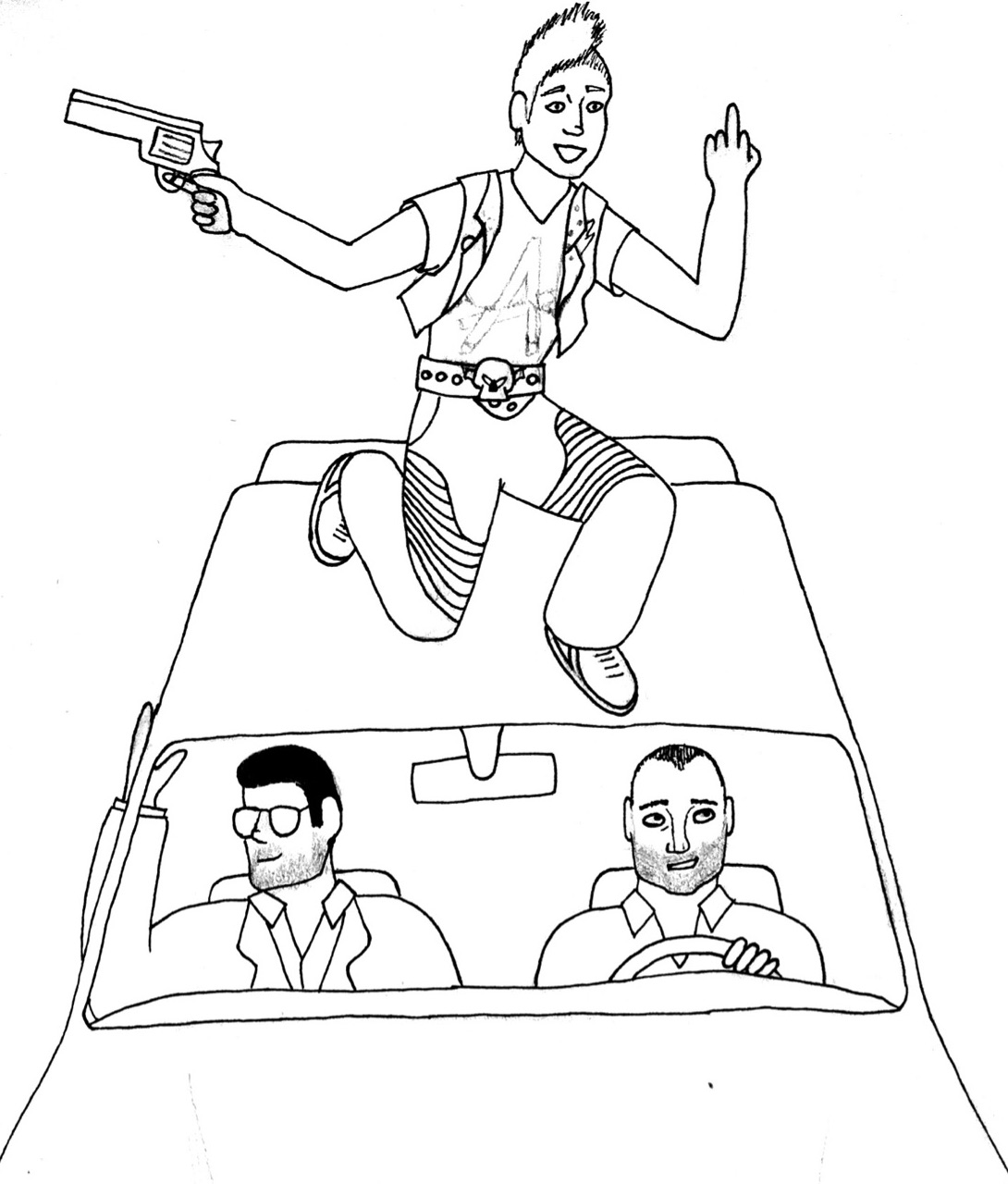
Late one night a few years ago I was awake with one of my sisters channel surfing, looking for something to watch. General tiredness at that moment and the passage of time now mean that I have no idea how it happened, but we ended up finding and watching through to the end Crank: High Voltage, the 2009 sequel to 2006’s original Crank, both of which starred Jason Statham as a hit man with heart problems trying to both survive and get revenge. The film was absolutely batshit crazy, with more than a few moments when my sister and I exchanged a look communicating a mutual feeling of “whaaaat the fuck?” While my sister always refers to it afterwards as “that shitty movie we watched” I quite enjoyed the fucking ridiculousness of it all. Just as importantly it was something of a bonding experience for us. So when I saw the original and the sequel recommended by Netflix nostalgia and memory meant that I had to watch both films again.

At no point am I going to call either film a great movie. The dialogue in the first film relies too much on profanity and in the second relies too much on profanity and bad cockney rhyming slang rather than anything easily defined as wit, and both films are a bit to quick to jump towards racial, sexist and homophobic slurs. The acting often swings past simply campy towards bad, the rare CGI effects are lousy (though the practical effects are fun and look great), and you are constantly required to suspend your disbelief. The plots are simplistic, predictable and far to reliant upon exposition dumps. But, throwing a constant stream of ridiculous balls-to-the-walls action at the audience, the films are ridiculous good fun. In the first movie the protagonist is told explicitly that if he stopped moving he would die and the entire film takes this advice to heart, constantly dreaming up wacky scenarios and throwing out crazy stunts to keep our attention lest we be distracted by something shiny if the action slows down.

And both movies know exactly how ridiculous they are. Jason Statham plays, well, the same character he always plays (the characters might have names in the movies he plays, but have you ever referred to them as anything other than Jason Statham?) but he plays it with a surprisingly subtle straightness. As if he, like the audience, recognises exactly how batshit crazy everything happening around him is but just rolls with it regardless, forcing us watching to do the same. In doing so both movies also show that they know exactly how much like a video game they are. In the same way that a gamer simply accepts whatever thin plot is used to justify the mechanics required to keep the game fun and interesting (if they bother with a plot justification at all), Statham’s Chev Chelios responds to the various plot points with an “alright then.”

It goes further though. There are direct allusions to video games of course (the beginning of High Voltage is an 8-Bit version of the end of the first film) but as a gamer it was within the tone and pace of the action that I noticed it most. The way that Statham realises the need to keep his adrenaline pumping in the first film (followed by a confirmation from his doctor) is reminiscent of a tutorial level, and it is not hard to imagine an ‘Adrenaline Meter’ hovering in one corner of the frame as we watch him outrun the police driving through a shopping mall, or collecting power ups as he seeks out “High Voltage” signs and stickers in the second film. His habit of cutting through levels of grunts and seriously outclassed mooks before getting into a ‘boss fight’ was choreographed in such ways that I was half expecting the button prompts of a Quick Time Event to start flashing on the screen. Then of course there’s the ‘level’ like scenes, so that across the two movies we get moments akin to the ubiquitous stealth section, driving level, rooftop level, warehouse level, nightclub level, platforming section, (a very God of War-like) romance ‘achievement’ (NSFW, neither of them), escort mission, etc. Everything except a water level (which I expect will be the focus of the eventual third film in the franchise, Crank: Dehydration). Even the opening scenes showed a striking resemblance to common video game tropes (how often has a protagonist awoken in their home – or a strange location – before being given an info dump so the player knows the basic context? Or, maybe even more commonly, woken up in a mysterious hospital bed after catching brief semi-conscious glimpses of being operated on?)

Ultimately the Crank films are movies that try to act like video games, surprising given that it is often the other way around. Even more surprising given that I’d say it’s successful. I think where Crank and High Voltage succeed where other movies meant to look or feel like video games fail is that rather than attempt to simply replicate a particular visual style or theme these two maintain a very video game like tone, pace and structure. What semi-surprised me was that, while watching both films, I thought of two games in particular: Saints Row: The Third and Sunset Overdrive. Semi-surprised because, as I thought about it before beginning writing this, I didn’t think of more ‘cinematic’ games like the Grand Theft Auto series.

But it makes sense. Like the Crank films, Saints Row and Sunset Overdrive are cartoonish, humorous, unrealistic, immature, and varying levels of self-aware. SR‘s Boss (the player character) is, like Statham, pretty relaxed about the insanity they get up to, not questioning the inherent ridiculousness of, for example, driving a tank out an airplane and landing on an island covered in zombie gas. Or discovering massive cloning facilities while fighting their way up a massive skyscraper (before riding a giant sphere down said skyscraper directly onto the head of their enemy). SR:3 is self-aware enough to know how crazy everything is, but simply goes “why the fuck not?” and rolls with it. SO takes it further, frequently breaking the fourth wall or joking about the implausibility of various game tropes like long distance communication (“Don’t question how we deliver the story!”) or death (“You might [die]. I’ll probably just respawn over there!”) or plot (“How convenient…”). Given the sorta punk rock soundtrack and focus on keeping moving or dying in SO it wouldn’t surprise me if it’s channelling a bit of Crank itself.

More importantly, both games encourage constant movement and action to remain fun and exciting. SR:3 actively encourages the player to car-surf, drive on the wrong side of the road, perform aerobatic stunts, blow up the game universe’s version of the Smart Car, and stylistically bludgeon or machine gun through anything that gets in your way. Like the original Crank, SO tells you to never stop moving, because if you stop you die. While you jump, grind, bounce and wall-run through the city you’re relatively safe, something further reinforced by the awarding the player points for travelling stylishly. Staying on the ground, attempting to stop and use cover, or some other common mechanic in more ‘realistic’ shooters is a quick way to get overwhelmed and die. Both games provide a large sandbox environment, enough plot and context to provide an excuse to go batshit crazy, then encourage you to do just that.

The result is that they hold your attention. They keep you playing, trying different things, beating scores, beating down enemies. SO was the first Triple A video game my other sister finished in years (perhaps ever), simply because it was the first game that managed to draw her full attention for long enough to complete it. She’d stopped playing SR:3 simply because SO had just come out. If I was introducing someone to gaming these two are amongst the games I would use to do so.

That’s why the two Cranks work so well in my mind, they’re films driven by the mechanics of the world, accept that fact, and see how much fun shit they can do with it. That’s why, in my mind, they might not be great films but they’re great fun and great examples of how to make a film like a video game.

“Oh, did my accent throw you off?” Or why I’m loving Borderlands: The Pre-Sequel

Borderlands: The Pre-Sequel is a lot of stupid bloody fun. A lot of fun. The combat is quick and frenetic, the air boost (a double jump mechanic) is a nice addition that adds another dimension to the battlefield, the enemies are varied enough to keep things interesting (though repetition is inevitable) and the loot is, as expected, plentiful. There are flaws, of course. Clearing the same areas over again to complete side quests can be a slog, as can be navigating ‘platforming sections’ around insta-death lava. The campaign feels a little short (something that will probably be ‘fixed’ with DLC). A few characters skip being fun and go straight to being annoying (for example I think the internet so far has come to the agreement that Pickle sucks, though I don’t have anything against the kid personally, but hey I loved Tiny Tina right from the beginning). The Borderlands series lives and dies on its sense of humour though (crude, full of pop-culture references and not everyone’s cup of tea) and The Pre-Sequel delivers not just in spades, but in Australian spades (which are generally poisonous, covered in sharp teeth and usually aquatic).

This isn’t surprising given that the game was developed by Canberra based company 2K Australia, and just about every review I’ve read makes mention of it. Locations like ‘The Grabba’ (which many a cricket fan will notice as joke on The Gabba), references to a ‘First Fleet’ arriving on the already occupied moon Elpis (also part of Australia’s colonial history), outlaw bosses called Red Belly (who wear armour based upon the bush ranger Ned Kelly), a quest that’s an ode to ‘Banjo’ Paterson given by an NPC named Peepot and the absolutely hilarious talking shotgun ‘Boganella’ (I think I’ve already explained what a bogan is) give the game a distinct cultural flavour.

Given my own self-superior Australian nationalism (that I’m sure has come through in previous posts) it’s not surprising that I’d enjoy seeing such a strong Australianess (that is now a word) in a mainstream game, but what I really love about The Pre-Sequel is that they got it so right. I think the fact that Australian writers were writing Australian stereotypes kept the referential humour on the right side of the line between funny and cringe-inducing. Part of this is because they don’t rely on the typical icons and symbols to create that Aussie image. There’s no glaring Harbour Bridge, Opera House or Bondi Beach equivalents, creating a Space Sydney for a few iconic money-shots (and it would be Sydney, since what the fuck does anyone remember about Melbourne’s skyline?). There’s not any space crocodiles, kangaroos and emus. Nor is there a Kraggon Hunter or Shuggarath Dundee. The real joy, however, comes from the fact that they actually talk like Australians do. I’m not talking about the slang either, especially since there’s more than a little would be considered ‘old-fashioned’ at best (can’t remember ever hearing someone use the word ‘bonzer,’ even ironically, but I hope it makes a comeback – it’s a lotta fun to say). What I’m talking about is that the Aussie NPCs have a consistent grammatically Aussie way of speaking.

I think I counter example first might help me explain what I mean a little better. A few years ago I was a reading some science fiction novel I picked up on the kindle store for 99 cents or some other small amount. I can’t remember which one exactly, and that isn’t important right now. What is important is that it was written by an Yank, with a couple of Yank protagonists that encountered a working class, salt-of-the-earth, old-fashioned slang spouting Australian. Anyway, the character used a word that stuck with me because it was inconsistent with the slang and background he’d been using up to that point. That word was ‘tussle’. Sounds a bit ridiculous, I know, but when this largely forgotten character said he’d been hurt in a fucking ‘tussle’ I… winced… maybe… I forget, but I definitely reacted. Because this hard-swearing, hard-drinking, outback-living stereotype would never use a word like ‘tussle’. He’d say he was in a ‘punch-up’. Or if he’s really fair dinkum (heh) he might’ve called it a ‘blue’. Hell, he might’ve just called it a fight. But no bloody way would he call it a goddamn ‘tussle.’ Same as there’s no bloody way we’d “throw another shrimp on the barbie,” since we say ‘prawn’ not ‘shrimp’ (and as much as we love seafood you’re far more likely to see a piece of lamb and a few snags on an Australian barbecue).

Y’see using correct sounding slang isn’t enough, you need to use the right words, grammar and cultural quirks. That’s what makes the NPCs in The Pre-Sequel so refreshing, especially Janey Springs (I’d assume named after Alice Springs) who is the most vocal of the Aussie vocals. Little things like that Janey uses ‘ruddy’ instead of ‘bloody’ and the matter of fact way she tells us “Yep, gonna hurt lots” when we act as a human spark plug, the speed with which Red and Belly speak with each other (we tend to speak very quickly), a Scav using the adjective ‘sick-arse’, the name ‘Scav’ itself (The Pre-Sequel’s version of Bandits from the previous games) which is just shortened from ‘Scavenger’ (shortened words being the bulk of Australia’s additions to the English language), an echo recording of a graphic designer (complaining about incorrect font used on the Oz kits) who appropriately sounds like a Bondi Hipster

I’m not foolish enough to imagine that the “foreign writers don’t know how we talk!” problem is unique to Australia. I imagine that Belgians grind their teeth at their portrayal on French television, and God knows Aussie writers aren’t always kind to New Zealanders (even in The Pre-Sequel there’s a distinct-sounding, ‘bruv’-spouting Gladstone Katoa). But that’s for other people to worry about. I also know that I’d be enjoying this game without the Australianess, if Janey was flirting with Athena in an American accent or in Chinese. As I said in the first paragraph, it’s a lot of fun. But right now, if you ask me what I love most about this game I’d tell you it’s driving through Burraburra with a familiar accent telling me how much Kraggons suck. And they really do suck.

I’m hoping though that any future DLC will include an enemy called a ‘drop bear’. That would be awesome.