Keeping Faith in Dragon Age: Inquisition, Part Three: So what’s it all about then?

Sorry this took so long folks, but here is Part Three. Part One can be read here, Part Two here.

So, we’ve established that the developer of DA:I is the ‘god’ of the game and that appeals to the player character’s faith in-game are also appeals to the player’s faith in the game. How does this relate to the story, politics and lore of the game and the world within? Well, let’s talk a bit about faith first more generally, in real life and in the game.

A few years ago, back at university, I found myself doing a course with the rather self-explanatory title ‘Christianity in Medieval Europe.’ It was a good course that covered everything from the iconoclastic debate, various heretical movements, the inquisition, Christianity’s evolving relationship with Islam, academia and scholarship, and of course the history of the saints. By the end of the course there were two things that really struck me, however. First was how fun it was to be able to use the word ‘flagellate’ in casual discussions (and I got to use it a lot). Say it with me, flaj-ell-ate. Fantastic. Second was that we still have a very low opinion of medieval Christians, one that comes from some very modern yet very old-fashioned misinterpretations of the reasons for faith, ritual and religious institutions in the Middle Ages. The assumption tends to be that Medieval Europeans were a bunch of ignorant flat-earthers who answered every question with “God did it!” or “because the local priest told me that’s what the scriptures said happened!” and whose lives were, as a result of this stupidity and blind piety, “violent brutish and short” (to use an overused quote). The reality was that this, for the most part, was simply not the case. Unless of course you were a Viking. Then it was a life goal.

The reality was that they either knew the world was round or would have responded to an explanation as to how we knew with the tenth century equivalent of “Well, that makes sense.” The reality was that for those Medieval Europeans the church and religion had less to do with answering how the world works in what we’d now define as a scientific sense and more to do with where their place in the world was. Categorisation instead of explanation. This is us (because we hold these beliefs to be true and perform these rituals), that is them (because they hold those beliefs to be true and perform those rituals). Social cohesion through the creation and/or enforcement of social norms. This behaviour is correct and righteous, that behaviour is wrong and sinful. The power of the church came in its power to codify or legislate the social norms affected by the belief and faith of the populace, because it controlled the rituals and ritualised elements of that faith. To take a quote from Mary Douglas’ classic book Purity and Danger (which I’ve been messily paraphrasing), “As with society, so with religion, external form is the condition of its existence… As a social animal, man is a ritual animal… Social rituals create a reality that would be nothing without them. It is not too much to say that ritual is more to society than words are to thought.” The religious institutions established a particular world view, a particular reality, and our divinely ordained place within it. This did not make Medieval Europeans stupid, it made them human.

That is what the folk over at Bioware seem to understand, so when they cribbed heavily off of Medieval European history (and they did crib heavily) they were able to do so at a very deep, conceptual level. The Qunari, for instance, may not seem superficially similar to the Islamic world in the Middle Ages (there certainly aren’t any Arishoks running about saying “there is but one God and Koslun is his prophet”), usually seeming more Asian in influence (pulling from Buddhism, Confucianism, Taoism etc), but the Qun guides all parts of life and government in a way that would have impressed Muhammad (peace be upon him). The apparent stagnation of the Qunari  (they have gunpowder, but don’t seem to have advanced beyond basic artillery and bombs for centuries) is similar to the stagnation that eventually brought down the Ottomans. Similarly, the endless war between Tevinter and the Qunari is reminiscent of the Byzantine Empire’s piecemeal conquest by the technologically superior Muslims (their frequent battles for control of Seheron remind me of the various battles for Crete). The division of the Chantry between the Tevinter Imperium’s Black Divine and the rest of Thedas’ White Divine (based in Orlais) based on different interpretations of a specific passage (regarding magic), just how divine the prophet Andraste was, and a refusal to accept each other’s authority resembles the divisions between the Eastern Orthodox Church (and the Patriarch of Constantinople) and the Western Catholic Church (and the Bishop – Pope – of Rome). And of course Fereldan and Orlais are very obvious analogies of England and France (and their respective relationship with each other). Antiva is Italy, Nevarra is Spain, the Anderfels are Germany or Switzerland.

But all this is on a Macro level. On a micro level, they understand how people’s faith in god or the institutions that call upon his/her authority can be harnessed for good or ill. A lack of faith in the Chantry to protect them from the abuses of the Templars led to the Mage Rebellion. A feeling that the Chantry was taking them for granted led to the Templar Order also rebelling. Disillusionment amongst the soldiers fighting for the Empress or Duke in the Orlesian Civil War led to the rebellious ‘Freemen of the Dales’. The game’s main villain is able to gain so much support from Tevinter’s fringe nobility because he promised to halt centuries of decline and return the Imperium to its glorious and glorified past. It is understandable for Iron Bull to be a little disillusioned with the certainty of the Qun, even at one point joking about their religious leaders had been trying to explain why the Qunari hadn’t been able to conquer Thedas for centuries. Sera despises the institutions of the nobility and priests, and acts to get even with those who step on the little people, but recognises the futility of some grand revolution. Cassandra’s discovery of the Seekers’ secret history rocks her world view so severely because it disrupts her faith in the institution she’d pledged her life to. History is full of the disenfranchised striking out against the forces that had previously controlled their faith, and almost by default their lives.

The power given to the player in DA:I, the core story mechanic for much of the game, is not the magical Anchor on their hand but their control of the titular Inquisition. The Inquisition fills a vacuum of power, seeks to actually re-establish order and stability, and fix apocalyptic hole in the sky. It provides a new institution into which people are able to place their severely shaken faith. The player is able to then influence how that faith is harnessed, and shift the order of the world.

How this works in the story and why it all matters will be explained in Part IV. Just one more, than I’ll talk about a different game guys. Promise it won’t be as long coming.
Keeping Faith in Dragon Age: Inquisition, Part Two: a question raised, perhaps answered.

So, continuing on from last week, there is a god and its name is Bioware. At least as far the world within Dragon Age: Inquisition (and the other titles made by this particular developer) is concerned. What does this mean?

At a glance, not a lot. On one hand, academically, the idea of audience participation as an act of ritual or faith is not a new one, nor is the idea of art creator as god of that particular work. Just look at the cultural treatment of the Star Wars franchise and George Lucas’ role over it. I once heard the Original Trilogy compared to the Qur’an and the Extended Universe and Sequel Trilogy compared to the Hadiths. Not the best analogy in the world, but not the worst either. On the less academic hand, as I said last week, we tend to spend most of that glance slaying bears, wolves, demons and dragons. ‘Cause slaying dragons is fuckin’ wonderful.

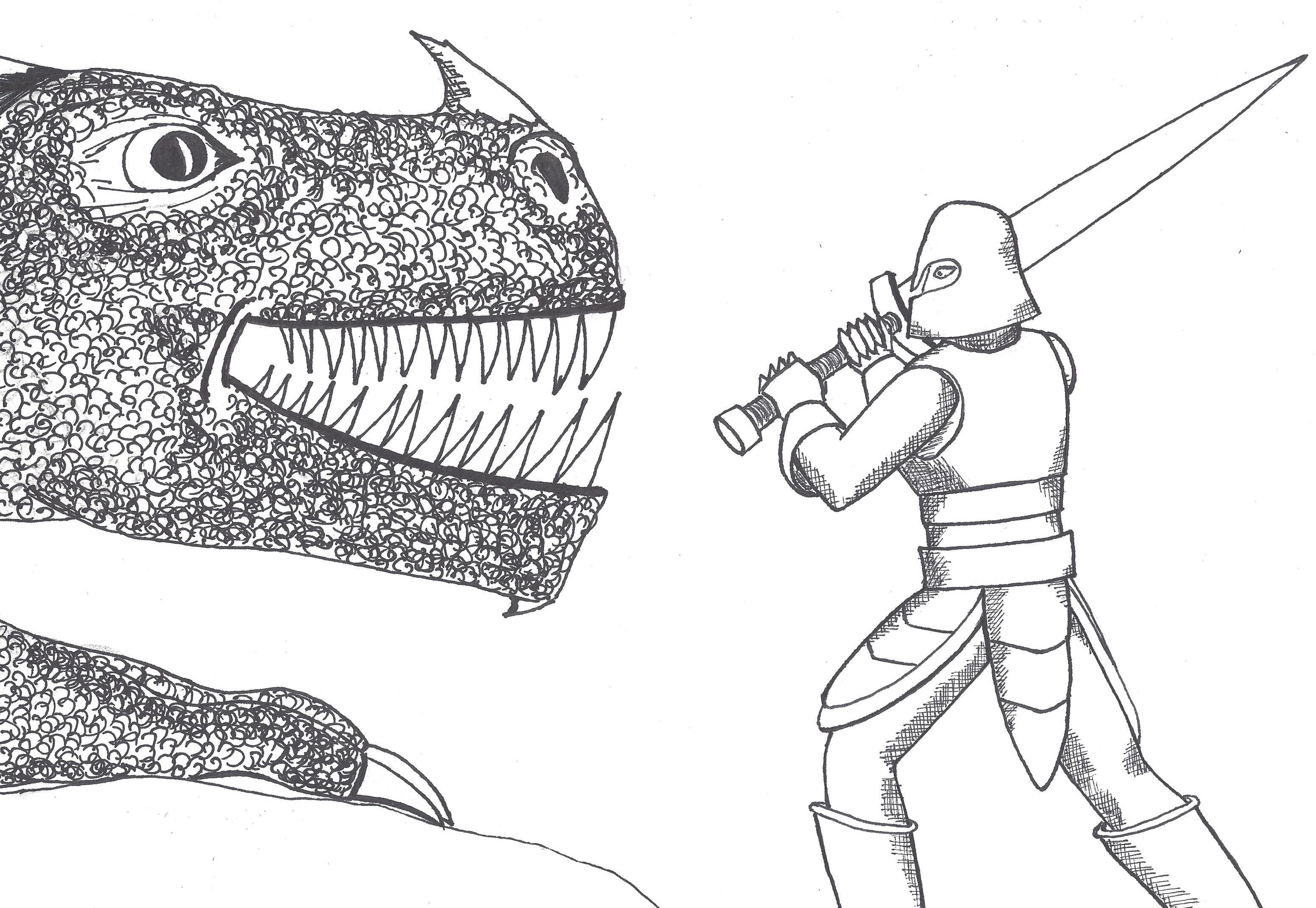
The Inquisitor did raise her mighty sword, and with a lion-hearted roar did issue her challenge, "Come at me bro!" And lo, the dragon came at her.
The Inquisitor did raise her mighty sword, and with a lion-hearted roar did issue her challenge, “Come at me bro!”
And lo, the dragon came at her.

But one of the things I’ve loved about DA:I‘s portrayal of belief has been the subversive* way that it compares the faith of its characters in the guiding hand of “the Maker” with the faith of gamers in the guiding hand of the developers. Let’s think about it this way: there are certain expectations that we as audience and participants have of the media that we consume, and we have faith that these expectations will be met. Within the above mentioned passive media these expectations can be as simple as expecting action in an action movie, singing and dancing in a Bollywood film, and spectacularly shot images meant to convey how depressing and meaningless humanity really is in anything by Lars von Trier. In superhero comics and cartoons we expect the villain to get away at the end of the episode (not least so the series can continue). In detective fiction we expect an answer as to “who’dunnit?” (even if we don’t always expect justice). When watching a horror movie we expect the protagonists (for want of better word) to do stupid things like split up, forget to charge their phones and generally not seek help from anyone useful so that the villain has the opportunity to pick them off in whatever gruesome manner they prefer. Our expectations are used by creators as shorthand to avoid lengthy and unnecessary exposition, and as tropes to drive the narrative forward. Video games have an additional layer of expectations laid on top of them, again often separated by genre and developer, in the form of mechanics.

In RPGs like DA:I (and other games by Bioware for that matter), we have certain expectations about how the mechanics will deliver the narrative. We expect an antagonist with impossible power and dreams of conquering/destroying the world. We expect a number of companion characters and allies who fill out certain archetypes and react accordingly to the story and the player’s decisions. We expect our avatar to either be given some power or weapon that for some reason is the only method of defeating the antagonist, or given the task of achieving/retrieving said weapon or power, through happenstance, destiny or the will of god. But Bioware’s writers were aware of this and used it to further drive the narrative.

Most self aware games, like most self aware media in my experience, tend to be examples of satire, mockery, or (at their artistic best) deconstruction. Horror films have Scream. Video games have the Saints Row franchise, which revels in the inherent ridiculousness inherent in common video game tropes with a straight face and the occasional knowing wink. Or Sunset Overdrive, which openly points out and laughs at the flaws of video game logic. DA:I isn’t satire, and I wouldn’t call it a deconstruction without some serious mental gymnastics, but it is fairly self-aware. Your avatar is given a mark, ‘the anchor’, right at the beginning of the game, that is the only threat to the game’s villain. Even when you learn that the anchor is just old magic, and that the reason it fused with you was simple accident and happenstance, the characters most defined by their faith (such as Cassandra) point out how convenient it was that you just happened to be in the exact right spot at the exact right time to become exactly what was needed. So convenient that it’s not a particularly difficult leap to assume that some divine planning was in play. Because it was.

I know I’m starting to sound repetitive right now, but I can’t stress the fact enough. The writers planned every twist, every coincidence and the consequences of every choice. The lore, the history, the rules, the science of the world. The artists designed and drew, the programmers made it a virtual reality. No matter the details of my character’s history that I’ve ‘headcanoned’ it is still limited by the decisions and narrative given by the game’s designers. Her destiny is still predetermined. We, the players, know that. We have faith in that. So when the characters and story appeals to our character’s faith in a fictional god or religion, they are in fact appealing to the player’s faith in the game. Exhausted and wounded (spoiler alert) after your first encounter with the game’s antagonist, the Elder One, your army defeated and your camp at Haven destroyed, the character Mother Giselle tells your character to have faith that all is not lost, to have faith that things will get better. She is also telling you, the player, to have faith in the game and its designers. Of course they aren’t going to end it there, of course you’re going to get stronger and wiser and ultimately defeat the villain of the piece. That’s how linear video game story mechanics work.

So, again, what does this mean? It makes the game’s narrative more compelling, whether we roleplay a religious character or not, since it compares our faith in the game with the faith of the NPCs driving the narrative. It makes the characters and their struggles more relatable, since their faith in the Maker’s plan is reflected by our own. It makes for a strong, compelling story that explores themes like the place of institutionalised religion in politics and power, race relations, and, of course faith, with confidence that everyone understands exactly what they’re trying to get across.

If I can string together a coherent post on the subject, there might be a part three next week.


*I’ve been trying to cut down on using that word, but I can’t think of a better one at this exact moment.

Keeping faith in Dragon Age: Inquisition, Part one: Let me frame the discussion

How would you react if you knew for certain that god existed? Or destiny? Let’s say a god that doesn’t care whether you’re moral or immoral, faithful or unfaithful, sing its praises or curse its name, you’ve received its mark regardless and you have a destiny in front of you. Would you piously tell anyone who asked or listened about your knowledge and faith? Would you simply shrug your shoulders and give an inconclusive, agnostic non-answer? Or would you loudly tout your ‘atheism’, laughing behind your eyes at those that agree or disagree alike? It’s a question that comes up often in Role Playing Games (RPGs) like Dragon Age: Inquisition. It’s part of the fun though we rarely put it that way, at least partly because over-thinking the philosophical implications of such a decision takes up time that could be better spent slaying cultists, giants and dragons. I do love slaying dragons.

DA-I Lana drawing 1 edited
“Right, who’s next?”

Faith is a key theme running throughout the game, being a major motivating factor for many of the main characters (unsurprising given that the Inquisition of the title is an offshoot of the world’s major religious institution populated primarily by the faithful). Cassandra is a holy warrior whose faith in her god (the Maker) is strong, but her faith in his Chantry is shaken. Leliana struggles to reconcile her belief (so strong in Dragon Age: Origins) in a loving Maker with the fact that he has allowed so much chaos and destruction loose on those loyal to him (including the death of her friend and mentor, the Divine). The Iron Bull’s faith in the Qun is already shaken before he meets the Inquisitor from having lived outside of its teachings for so long, and if certain choices are made he doubts his own ability to keep from becoming a mindless savage without it, losing faith in himself. Sera, Varric and Dorian’s lack of faith in the old institutions of their respective governments, class systems and religions drove them to join and remain with the Inquisition, a catalyst of change, but their views and certainties of the world are rocked by the truths revealed by the identity of the game’s overarching antagonist (effectively a powerful mage who became Satan). The player character him or herself spends what can be defined as the extended prologue with everyone assuming he/she was personally saved from a cataclysmic death by blessed Andraste, god’s missus. Even after we find out that the glowing green mark on our avatar’s hand is due to magic and coincidence rather than overt divine intervention many of our followers make the rather valid point that covert divine intervention is not ruled out, since you just happen to be exactly what is needed when it is needed. Several outright ask the player what they believe is on their hand and what they believe exists in the DA:I equivalent of heaven. How the player responds to this is up to them.

The first thing you do in DA:I is pick your race (elf, human, dwarf, Qunari), your class (warrior, rogue or mage) and your appearance. You are given the barest outline of a personal history to explain how you happen to be at the centre of a magically exploding temple. It is assumed you either know the game world’s law or will be paying close attention to the codex entries you find. After that, it’s up to you to decide the personality of your avatar, your Inquisitor, how they act and react, how they get along with the other characters in the game, and what they believe. The characters are left purposely blank for this exact reason, so that the player can fill in the spaces.

Take my Inquisitor pictured above (badly, I stuffed up the shadowing and drew the eyes too high, but that is why we practice). Lana is a Dalish elf warrior who prefers swords to axes, and axes to hammers or mauls. She has a scar over her left eye from a fight with a Tal-Vashoth bandit in which she almost lost it. She generally tries to get along with people, but her attempts at diplomacy often come off as clumsy or ill-thought, not helped by the fact she has a fierce temper with little mercy for those that cross her. Regardless Lana gets along with her companions well enough. There were a few tensions initially with Dorian, the Tevinter mage, after a few ignorant comments got her Dalish blood boiling. She does her very best to stay on Sera’s good side, seeing the playful city elf as a sort of little sister. She does her very best to try and like Solas with his large head full of dreams, but finds his pseudo-intellectual condescension irritating. She finds some of Cole’s actions worrying, but appreciates good intentions. The two that she understands best however (at least at this point in the game), are Cassandra and Leliana, whose crises of faith perhaps best reflect her own as she struggles to reconcile her proud beliefs in the gods of the Dalish with what she has seen and been told about the circumstances of the mark on her hand (the anchor), which indicates at least some truth to the stories the Chantry tells about the Maker (who is perhaps not so different from the Dalish Creator god).

But that’s me filling in the blanks. Jump onto Tumblr or any other similar website and punch in the right search terms and you’re bound to see stories, comics, other fan-fiction and reviews where people have filled in their own. Some are militantly atheist, some are calmly agnostic, others have declared themselves arbiters of the Maker’s will.

Here’s the thing though: we as players know for a fact that god exists and has a plan for our characters. That god’s name is Bioware.

“Oh, did my accent throw you off?” Or why I’m loving Borderlands: The Pre-Sequel

Borderlands: The Pre-Sequel is a lot of stupid bloody fun. A lot of fun. The combat is quick and frenetic, the air boost (a double jump mechanic) is a nice addition that adds another dimension to the battlefield, the enemies are varied enough to keep things interesting (though repetition is inevitable) and the loot is, as expected, plentiful. There are flaws, of course. Clearing the same areas over again to complete side quests can be a slog, as can be navigating ‘platforming sections’ around insta-death lava. The campaign feels a little short (something that will probably be ‘fixed’ with DLC). A few characters skip being fun and go straight to being annoying (for example I think the internet so far has come to the agreement that Pickle sucks, though I don’t have anything against the kid personally, but hey I loved Tiny Tina right from the beginning). The Borderlands series lives and dies on its sense of humour though (crude, full of pop-culture references and not everyone’s cup of tea) and The Pre-Sequel delivers not just in spades, but in Australian spades (which are generally poisonous, covered in sharp teeth and usually aquatic).

This isn’t surprising given that the game was developed by Canberra based company 2K Australia, and just about every review I’ve read makes mention of it. Locations like ‘The Grabba’ (which many a cricket fan will notice as joke on The Gabba), references to a ‘First Fleet’ arriving on the already occupied moon Elpis (also part of Australia’s colonial history), outlaw bosses called Red Belly (who wear armour based upon the bush ranger Ned Kelly), a quest that’s an ode to ‘Banjo’ Paterson given by an NPC named Peepot and the absolutely hilarious talking shotgun ‘Boganella’ (I think I’ve already explained what a bogan is) give the game a distinct cultural flavour.

Given my own self-superior Australian nationalism (that I’m sure has come through in previous posts) it’s not surprising that I’d enjoy seeing such a strong Australianess (that is now a word) in a mainstream game, but what I really love about The Pre-Sequel is that they got it so right. I think the fact that Australian writers were writing Australian stereotypes kept the referential humour on the right side of the line between funny and cringe-inducing. Part of this is because they don’t rely on the typical icons and symbols to create that Aussie image. There’s no glaring Harbour Bridge, Opera House or Bondi Beach equivalents, creating a Space Sydney for a few iconic money-shots (and it would be Sydney, since what the fuck does anyone remember about Melbourne’s skyline?). There’s not any space crocodiles, kangaroos and emus. Nor is there a Kraggon Hunter or Shuggarath Dundee. The real joy, however, comes from the fact that they actually talk like Australians do. I’m not talking about the slang either, especially since there’s more than a little would be considered ‘old-fashioned’ at best (can’t remember ever hearing someone use the word ‘bonzer,’ even ironically, but I hope it makes a comeback – it’s a lotta fun to say). What I’m talking about is that the Aussie NPCs have a consistent grammatically Aussie way of speaking.

I think I counter example first might help me explain what I mean a little better. A few years ago I was a reading some science fiction novel I picked up on the kindle store for 99 cents or some other small amount. I can’t remember which one exactly, and that isn’t important right now. What is important is that it was written by an Yank, with a couple of Yank protagonists that encountered a working class, salt-of-the-earth, old-fashioned slang spouting Australian. Anyway, the character used a word that stuck with me because it was inconsistent with the slang and background he’d been using up to that point. That word was ‘tussle’. Sounds a bit ridiculous, I know, but when this largely forgotten character said he’d been hurt in a fucking ‘tussle’ I… winced… maybe… I forget, but I definitely reacted. Because this hard-swearing, hard-drinking, outback-living stereotype would never use a word like ‘tussle’. He’d say he was in a ‘punch-up’. Or if he’s really fair dinkum (heh) he might’ve called it a ‘blue’. Hell, he might’ve just called it a fight. But no bloody way would he call it a goddamn ‘tussle.’ Same as there’s no bloody way we’d “throw another shrimp on the barbie,” since we say ‘prawn’ not ‘shrimp’ (and as much as we love seafood you’re far more likely to see a piece of lamb and a few snags on an Australian barbecue).

Y’see using correct sounding slang isn’t enough, you need to use the right words, grammar and cultural quirks. That’s what makes the NPCs in The Pre-Sequel so refreshing, especially Janey Springs (I’d assume named after Alice Springs) who is the most vocal of the Aussie vocals. Little things like that Janey uses ‘ruddy’ instead of ‘bloody’ and the matter of fact way she tells us “Yep, gonna hurt lots” when we act as a human spark plug, the speed with which Red and Belly speak with each other (we tend to speak very quickly), a Scav using the adjective ‘sick-arse’, the name ‘Scav’ itself (The Pre-Sequel’s version of Bandits from the previous games) which is just shortened from ‘Scavenger’ (shortened words being the bulk of Australia’s additions to the English language), an echo recording of a graphic designer (complaining about incorrect font used on the Oz kits) who appropriately sounds like a Bondi Hipster

I’m not foolish enough to imagine that the “foreign writers don’t know how we talk!” problem is unique to Australia. I imagine that Belgians grind their teeth at their portrayal on French television, and God knows Aussie writers aren’t always kind to New Zealanders (even in The Pre-Sequel there’s a distinct-sounding, ‘bruv’-spouting Gladstone Katoa). But that’s for other people to worry about. I also know that I’d be enjoying this game without the Australianess, if Janey was flirting with Athena in an American accent or in Chinese. As I said in the first paragraph, it’s a lot of fun. But right now, if you ask me what I love most about this game I’d tell you it’s driving through Burraburra with a familiar accent telling me how much Kraggons suck. And they really do suck.

I’m hoping though that any future DLC will include an enemy called a ‘drop bear’. That would be awesome.

Kitty not a cat, Aldi and Dahl, turning the Valve

Couple things caught my eye this past week.

Weird stuff first, turns out Hello Kitty isn’t a cat. Seriously, not a cat. Because that would be ridiculous. It certainly makes the fact that she owns an actual cat herself a little less creepy. Adding to that, according to the complex mythology of the Hello Kitty world, turns out she’s a pom. Lives in the suburbs of London eating apple pie. I’m gonna call bullshit till we see the quality of her dental work, but that’s just me.

The folks running the Aldi Supermarket chain pulled copies of Roald Dahl’s classic kid’s book Revolting Rhymes from the shelf, because in the story of Cinderella the supposedly charming prince calls the poor girl a ‘slut’. Y’know, cause kids are fine with images of handsome princes chopping off the heads of people he doesn’t like, but say a naughty word and they’re guaranteed to end up delinquents and drug addicts and something else unpleasant that begins with D (for alliteration purposes). A lot of people seem to be having a go at Aldi for bowing to the pressure of a few wowsers, and I’m inclined to agree with them. Because it’s god-damned Roald Dahl. I pity the child that doesn’t get to enjoy his wonderful prose (revolting or otherwise) because mum freaked out over a word that rhymes with nut.

Third, the Australian Competition and Consumer (ACCC, the national consumer watchdog) is taking everybody’s favourite game publisher, Valve, to court over the returns policy of its popular digital distribution platform, Steam. More appropriately, they’re suing over its lack of a returns policy since Steam has long maintained a stance of not offering refunds or exchanges for games under any circumstances unless specifically required to by law.

Valve are saying that they’re cooperating with the Australian government, but I expect that a lot of people, and not just Aussies, are hoping for an ACCC win in this matter in the hopes that it might force the folks running Steam to change some pretty lousy terms and conditions. Australia is a multi-billion dollar market for games, and Steam has a market-share worth hundreds of millions. It might be bugger all when compared to the US, Japanese, Chinese and some European markets but it’s large enough to effect some change if the courts side against them. There’s been a lot of damn near unplayable and falsely advertised ‘games’ (notice the use of quotation marks) released under Steam’s Early Access and Greenlight programs, and I’ve heard a few people say that the possibility of returns might be the thing that finally forces some much needed quality control. Probably not, but one can dream.

Talking About the First World War

This week has seen the 100th anniversary of the Great War, that huge bloody turf fight between the great European powers and their respective empires (and Japan), which cost millions of lives, toppled kings and set the stage for an even bigger, bloodier conflict twenty-odd years later. Being someone with an interest in history, and given the nature of the dates, I found myself looking through a few of the books I have on the First World War where I came across my old copy of Erich Maria Remarque’s All Quiet on the Western Front. It is a book that, in my very humble opinion, is one of the greatest pieces of antiwar fiction ever written and should be required reading in every school on the planet. It also got me thinking about video games. Because that is how my mind works. Heads up, there are spoilers coming for the book and a few games.

There is a lot that can be said about the novel and its depiction of the cold, brutal, boring reality of the First World War, and it makes for a definite contrast with the depictions of conflict in most games. Remarque’s scenes of rat-killing, delousing, the joy of extra rations and the mind-numbing luck involved in not having an artillery shell land on your head are far removed from the canyon gliding in Call of Duty: Black Ops II, the saving of priceless art from scorched-earth-inclined Nazis in the original Medal of Honour, or essentially using a crashing satellite as a missile in Battlefield: Bad Company 2. Yes, those are more extreme examples of tonal difference than I could have used. But damn it, I’m making a point!

Tone and context are a big part of the difference (to be clear, I’m going to use both terms very broadly in the next few paragraphs) and often a big part of the problem. The need for games ‘to be fun’ is something that often at best creates a level of cognitive dissonance between what the narrative (again, using the term broadly) is trying to achieve and the gameplay. When talking about Call of Duty 4: Modern Warfare (I’d argue the highpoint of the series single-player campaign-wise), you can discuss how it is a stark statement about the nature of contemporary conflict, placing you in the centre of a US intervention in an unnamed Middle Eastern country and brutal civil war in the former Soviet Union, then punctuating acts of traditional movie heroism (saving a downed, female helicopter pilot and stopping nuclear missiles) with a good dose of futility (achieving the objective but failing to escape). Or you can talk about how much fun it was blasting terrorists from an AC-130 gunship and sneaking through Pripyat, next to Chernobyl, dodging or sniping enemy patrols. Medal of Honour: Allied Assault in one level drops the player character into the bloody battle for Omaha beach ala the opening scene of Saving Private Ryan. Of course you also single-handedly scuttle a u-boat and destroy a dangerous prototype ‘radar detector’, and end the game by destroying a German facility with a name that translates literally to ‘Fort Pain.’ The recently released adventure(?) game Valiant Hearts: The Great War (which I haven’t played yet but am planning to) is one of those very rare games actually set in the First World War (which is why I’m mentioning it), and has received high praise for its gut-wrenching story and characters. But it is not without criticism, because of tonal inconsistency (the villain is a caricature of an evil German baron, German flame-thrower tanks that didn’t exist, etc.) in the name of gameplay.

These are just a few examples and the issue of tone is well known in the industry and community, something that is effectively de-constructed in critical darling Spec Ops: The Line, which itself follows Joseph Conrad’s book Heart of Darkness and Francis Ford Coppola’s Apocalypse Now. But the reason we haven’t really seen a gaming equivalent of All Quiet on the Western Front is not just problems with tone, it is also context.

To be blunt, the Germans lost the First World War. Yes, yes, I know the whole ‘everybody lost’ cliché, and generally agree, but for all their losses and the massive, senseless cost for no real gain the remaining Entente powers could at least claim that the Germans broke first, that the Germans surrendered. It was Germany that had to disarm, cede territory, pay reparations and bear the guilt of starting the war in the first place. That is what is most striking about the book, the defeatism. Remarque wrote the book after the war was lost, knew why it was lost, knew that all the heroic sacrifice was ultimately meaningless, and knew the sense of isolation from the generation before that had proudly sent them to the mud and blood, and the generation after that would grow up in peace without being able to understand just how senseless it all was. The final chapter is of a man sitting in a garden hoping beyond hope not for news of a victory but for an end, any end, that he might survive and live a life beyond the numb violence he has known so long. Ultimately it is fool’s hope, as we learn in the final two paragraphs when we are told Paul Baumer, our narrator through the whole ordeal, succumbed to his wounds on an ordinary day on the front with nothing new to report.

If you’ll excuse the language, how the flying fuck do you turn that into gameplay? Games from the survival and horror genres probably come closest, unsurprisingly, but even then the objective based gameplay (kill x amount of zombies, sneak from point a to point b, find shelter for the night, avoid monster while looking for clues etc.) and the consequence of action or inaction gives the player a sense of control over their circumstances and survival (even in situations where defeat is inevitable) Baumer never felt he had. His life is controlled by the army, his survival is dictated entirely by chance, even his decision to join the army before being conscripted is forced by the expectations of society and figures of authority.

Maybe that old arcade game Missile Command did it best, a simple game about holding off wave after wave of nuclear warheads until, inevitably, your launchers and the cities you are meant to protect are destroyed. It is not a game you can win, only prolong. (I won’t go into to much more detail since the folks at Extra Credits already have). But while it makes for an incredibly powerful statement about nuclear warfare it might be harder for some to apply it to conventional conflicts. Perhaps we’ll see it in the upcoming title This War of Mine, which will be about civilians, non-combatants, surviving a war zone. It’s something that needs to be done, a question that needs to answered if it hasn’t already, because getting it right matters.

I suppose I need to now say why this matters. Well, there are two reasons I can think of.

The first is that I firmly believe that games are a narrative medium with an incredible power to deliver story and message, and this is a story worth telling and re-telling.

The second is that my younger brother doesn’t read a lot. Until recently he’s spent almost all his free time in two ways, playing soccer or playing video games. Over the past month I’ve forced him to start reading, buying him books and denying him access to the Xbox unless he reads at least a little every day, but I don’t think I’ll get him reading Remarque’s novel any time soon. The same goes for a lot of his friends, whose interest lay in sports and blockbusters, as I imagine has been the case since the invention of language. Thing is though, a lot of these kids are playing some very smart games. Bioshock Infinite dealt with class, racism, nationalism and religious fundamentalism within a smart science fiction setting of parallel universes and infinite possibility (hence the title). Red Dead Redemption is a story about the death of the frontier and an end to the mythical west beneath the inevitable, brutal march of progress. My brother’s played both of these games, and he’s asked questions about some of the topics portrayed in them. If we’re going to educate this generation about the horrors of the Great War, the wastefulness, and make them understand why it should never be repeated, it may as well be through a medium they’ll actually pay attention to.

There we are. I’ll post something more fun next week.

The news last week… that I cared about (6/7/14)

So, let’s talk about the news this past week. This is something I’m thinking about doing weekly, a sort of quick run down of the goings on in news and politics that caught my attention. Not a summary of everything, just a bit of commentary.

In Iraq and Syria, ISIL (the terrorist organisation formerly known as ISIS) has declared an Islamic Caliphate and demanded that Sunni groups including Al-Qaeda submit to their authority. The Iraqi army is claiming that they’ve started to push ISIL back (or is it now called ISIS, formerly ISIL? Or something else completely? I’m honestly not sure), something which the newly-minted Caliph and his followers are firmly denying. The rest of the world seems to be wondering when these morons will realise that simply declaring yourself an independent nation does not cause the bureaucracies, institutions, laws, tax-codes and fiscal mechanisms required to govern and maintain a country to spontaneously spring from the earth or fall from the heavens. It’d be funny if not for all the people they’ve killed, are likely to kill, and are currently having to live within the Caliphate’s unrecognised borders.

Moving to lighter news in Australia. Prime Minister Tony Abbot put his foot squarely in his mouth (again) while talking about the value of foreign investment when he described pre-British-colonised-Australia as “unsettled, or, um, scarcely settled.” This was followed immediately by the collective groans of people like me asking “Did he really just say that?”, by the hordes of left-wing stereotypes who seem to take great glee in pointing at the PM and Coalition and yelling “RACIST!” (SCHADENFREUDE!), followed by a whole lot of groans from Mr Abbot’s people also asking “Did he really just say that?” It was a stupid thing to say, one that he’ll cop some flak for until the next time Scott Morrison strings together a sentence longer than “I don’t comment on operational matters.” What really disappoints me though is that you can use Australia as an example of positive foreign investment in nation-building, British Imperial investment, without essentially declaring that the pre-European Aboriginal population doesn’t count. Mind you a big part of that argument involves casually shrugging your shoulders and saying “at least it wasn’t Spain.” I think I might go into more detail later this week.

In video games this week the conversation over whether developers, publishers and PR teams understand that women play games, and maybe would like to sometimes play as a woman too. First upcoming game Far Cry 4‘s creative director Alex Hutchinson making a point that half the game’s main antagonists and one of the main allies (as well as a good chunk of the nameless NPCs) are female. Hell, the game’s “packed to the gills with women.” For now, we’ll just call this lame as hell. Second was a Finnish Hearthstone e-sports tournament that only allowed male players, because the International e-Sports Federation has been segregating men and women in their competitions. The Finns (God bless’em) petitioned for this to be changed, and the IeSF (who did actually have their hearts in the right place, believe it or not) have changed it. And there was much rejoicing. Yay.


Anyway, I quite like this. It’s giving me a few ideas about what to write about and how to start organising the blog. Let’s do this again next week.