Reviewing the Old School: The Dish (2000)

This is a movie that’s worth it for the ending, but I’ll get to that in a moment.

The third film by Working Dog Productions (second if you don’t count documentaries, and honestly why would you?) and biggest box office success, The Dish was released back in 2000 is a comedy that tells the (‘inspired by true events’) story of the Parkes Observatory (a big bloody radio telescope located in the middle of a sheep farm about twenty kilometres from the town of Parkes) and its quirky Australian technicians in the lead up to the Apollo 11 moonlanding. As well as tracking and relaying signals and communications from the travelling spacecraft enroute to and from the moon, it would also act as the primary receiver of the television signals that allowed the whole world to watch Neil Armstrong and Buzz Aldrin’s first steps upon its dusty surface.

This is a character comedy first and foremost and the characters are, for the most part, great. Unlike Working Dog’s previous film (and previous review fodder) The Castle, which really only included actors who were notable in Australia (it was Eric Bana’s film debut for Christ’s sake), The Dish‘s leads included notable Kiwi Sam ‘I-was-in-Jurassic-Park’ Neil as Cliff Buxton and American Patrick ‘I-have-one-of-the-most-recognised-voices-in-film-and-television’ Warburton as NASA representative Al Burnett. And they’re good. Neil as Cliff is calm and full of authority, puffing on his pipe, in complete control, trying to keep the peace. It means that on the rare occasion that he does tell someone to quit their bitching or loses his cool there genuine emotional impact. Warburton is quiet but obviously concerned as Al, he feels the weight of the world on his shoulders as NASA’s man on site but tries very hard to keep the stress from showing. Tom Long as Glenn is fantastic, playing a socially inept and slow nerd stereotype, but with such sincerity (I use that word way too much in these reviews, but I can’t be bothered grabbing a thesaurus) that you don’t mind. He gets the girl in the end (or at least asks her out) and it’s not some bullshit about her seeing ‘the real him’ behind the shy chitchat (most commonly in movies after the girl breaks up with some jock dickhead and realises that what she really wants is a nice guy who treats her alright). The girl in question, Eliza Szonert as Janine, is obviously attracted from the beginning of the movie to Glenn’s genuine sweetness and kind nature. Roy Billing as Mayor Bob MacIntyre takes the role seriously and has excellent comedic and dramatic timing, as does Genevieve Mooy as his wife. The only main character that I had an issue with was Kevin Harrington as Robert ‘Mitch’ Mitchell. Harrington’s a decent actor, and Mitch decent for the most part, but his character is the one that’s meant to be creating or experiencing conflict with Al, the American outsider, and I just never quite bought it. Lines yelled when they should have been spoken I think. This may have been actor, director, script or some combination of the three, but as a central character conflict I thought it just didn’t work. Having said that Harrington has excellent timing and delivered some of the best lines in the film.

The film has a large cast, possibly a little too large. All due respect to the actor but Billy Mitchell’s character, Cameron the over-zealous army cadet with a crush on the Mayor’s over-zealous (small L) liberal daughter seems superfluous in hindsight. I expect he’d there to represent a view of the Australian military (even with Australia starting to withdraw forces from the Vietnam War), but he doesn’t provide enough laughs to justify as much presence as he has in the film. Yet all the named characters can be justified, and I can’t really think of any that I’d really want culled. It makes for a cluttered cast-page, but doesn’t really make the film any worse for it. Just longer. I also like how they make an effort to give even the minor characters a little depth. Take the above mentioned Janine. She’s not just “girl who drops off lunch that Glenn has a crush on,” she’s also the security guard Rudy’s sister and a really awful driver. It’s not much, but it’s more than a lot of scripts would have given a character like her.

Rob Sitch does a good job directing, and I particularly loved scenes where the titular Dish and the men inside are simply doing their jobs. The choice of music is excellent, using some excellent 60s hits that never distract from what’s going on in the film, but will get you tapping your foot while it’s happening.

The pacing felt a little off. There are two climactic points in the film. The first takes place around the middle when a blackout briefly knocks out the Dish’s power and the backup generators weren’t primed possibly. Because this is the 1960s, this wipes all the data from the computer and for a whole day they ‘lose’ Apollo 11. They then desperately try and figure out where it is, while “bullshitting” NASA (and the American Ambassador who comes to visit). It’s a fun, desperate scene for the various characters but it drains away any tension for the second climax, where high speed winds threaten the broadcast of the actual moonwalk. I’m not sure how this could’ve been improved, but it never really feels like it was quite as dangerous a risk as they say it was.

Is the movie funny? Yes, yes it is. Not in a laugh-your-arse-off kind of way, more like a quiet chuckle and knowing smile. There are some fantastic moments that really sum up the Australian atmosphere of the film, like cricket on the satellite dish, the frequent cups of tea, the omnipresence of sheep and lamb. The Prime Minister (played by Billie Brown and only ever referred to as “Prime Minister” because John Gorton was not our most memorable PM) only appears for a few minutes overall but does a great job of portraying the well-spoken pub-brawl nature of Australian politics for most of the century. (“We’ve got a saying in the party: Don’t fuck up…” “And?” “That’s it.”)

Less of the humour than you’d expect, however, comes from any juxtaposition between the Yanks on site and the local country Aussies. Al is definitely different, is unused to working in professional environments without dress codes, formalities and chains of command, but he’s never anything but polite and is one of the most respectful people in the film. Similarly the US Ambassador, played by John McMartin, is never mocking in his attitude towards the locals and is simply a NASA-enthusiast is just bloody excited to visit Parkes and watch the landing. And that segues nicely into what this film is about.

Y’see, The Dish is not about culture clash, it’s about vindication. There’s the obvious ones. Al’s presence is vindicated in the eyes of Mitch when he helps them bullshit NASA. Mayor Bob McIntyre is vindicated for lobbying to get the Dish built in Parkes in the first place. There’s the less obvious ones. Bob’s daughter Marie (Lenka Kripac) is a teenage feminist spitting out opinions against chauvinism and imperialism without any real idea what she’s talking about (today she’d have a blog on Tumblr), and she’s surprised when Al tells her that it’s been a delight meeting and talking with her. It’s a small thing, but you get the feeling it’s the first time someone has shown any sort of approval for having strong opinions. The second half of The Dish is full of these vindicating moments, culminating right at the end with the moon walk.

The ending is wonderful. Everyone is gathered around television sets watching Neil Armstrong take the first few steps on the moon’s surface. You feel the emotion of the moment, that feeling of witnessing something truly monumental occurring, one of the greatest achievements in human history. The culmination of years of work, expense, stress, terror and hope, broadcast for six hundred million people to see, with that purest of goals: To prove that humanity could do it.

This movie is not perfect. It’s funny and clever, but there’s a list of flaws that I don’t even have time to get into, but it’s worth it for that ending. That feeling of elation and that feeling of achievement. This is a film about the Australian contribution to the television broadcast, not about NASA or the astronauts. The Cold War, the Vietnam War and the Space Race are never mentioned in the film. This is a movie not about an American achievement but a human achievement. In that final few minutes it makes you proud to be a human.

So, yeah, it’s worth it for the ending.
Review the Old School: Kingdom of Heaven (2005)

Let me be absolutely clear about something right from the beginning. My most recent viewing was of the Director’s Cut. The glorious, three-hour-long Director’s Cut. Did this make a difference? No clue, I watched the original cut way back when it came out and I wasn’t about to rewatch the same movie just to find out what parts they cut out. I’m not that masochistic. I have a job. And other shit to write. Moving on.

Directed by Ridley Scott and released all the way back in 2005, Kingdom of Heaven stars Orlando Bloom as Balian (later de Ibelin), the blacksmith for a Lord in France who finds out he’s the bastard son of a well-regarded Crusader recently back from the Holy Land, Godfrey de Ibelin played by Liam Neeson, shortly after his child dies and his wife tops herself out of grief. At first seemingly angry that Liam Neeson is his father (God knows why), Balian soon decides to join dad in the family business of killing the enemies of the leper King of Jerusalem (voiced by Edward Norton). Him killing his half-brother priest may or may not have helped in the decision making. Dad doesn’t make it past Italy, unfortunately, but makes sure to make Balian his heir and a knight before carking it. Balian gets to the Holy Land, hijinks ensue. These included Balian bedding the King’s married sister Sibylla (played by Eva Green), sparing and impressing a Saracen Cavalier (played by Alexander Siddig), killing a decent number of Christians and Muslims, building a few wells and, of course, taking command of the defence of Jerusalem against Saladin’s overwhelming forces after the new King of Jerusalem (spoiler, Edward Norton dies) starts a war then promptly loses it, all while learning the true meaning of knighthood. Good times.

This is a good movie, but it’s far from a perfect one. Orlando Bloom plays the role surprisingly well. There were one or two moments where I felt he was channeling Legolas or Will Turner, but I’d blame some awkward and clumsy moments in the script more than anything (a moment before the final battle when he’s giving everyone a pep-talk stands out). His character was a little too perfect though. It was lampshaded at the beginning of the film that he’d fought for lords before joining his dad on horseback and in the engineers, had participated in the building of powerful siege weapons, but we see him the movie as one of the best fighters, a skilled tactician and an expert in irrigating deserts. I mean, is there anything this guy isn’t good at? Similarly the villains are cartoonishly bad. Or specifically Guy de Lusignan played by Marton Csokas, the man who would be king and fuck everything up. Don’t get me wrong, Csokas plays the role well enough, but he’s just such a fucking stereotype with no motivation beyond “I’m gonna start a war and kill me some Saracens.” This worked with Brendan Gleeson’s character, Reynald de Chatillon, the insane commander of the Knights Templar, but he’s played as the mad attack dog whose entire purpose is cutting down people who don’t deserve it for his twisted faith. Guy is supposed to be the one who stands to gain the most and lose the most, but we see no reason for him to be such an arsehole. He doesn’t seem to want to conquer, doesn’t seem to give any shits about the faith or crusades beyond providing him with support or troops. There’s some vague hope for winning glory on the battlefield, I guess, but it just seems shallow. Maybe I’m not reading enough into the character, but it seemed like he was acting the arsehole simply for the sake of being an arsehole who we can blame him when the Kingdom of Heaven all goes to hell, and the audience can say, “See? Should have listened to Balian.”

The direction is mostly good, Ridley Scott knows how to cut together an epic and visceral battle, the combat is clear, bloody and wider shots are used to great effect. Smaller skirmishes meanwhile are lonelier, more intimate affairs, but their setups (long shot of a single knight at an oasis) reminded me of showdowns in old westerns. There were a few moments where the editing made me cringe. One in particular, where Balian first meets the king of Jerusalem seemed badly and unnecessarily cut together. They start out talking over a chessboard then are suddenly looking at plans for a fort, which Balian gives his advice on, then awkwardly shifts to the king with him. It’s meant to feel like a long conversation but instead just feels like they decided to skip half a sentence. It’s weird and unnecessary. But not common. As for the music, well, the only time I really noticed it was during the big battles when I realised it was the same theme from The Mummy. Take that as you will.

Regardless, the cast is stellar. And I mean, really fantastic, putting excellent actors in even minor roles. Liam Neeson has a major role but doesn’t make it through a third of the film, Kevin McKidd has about three minutes of screentime before being killed off and is billed only as “English Sergeant” and Michael Sheen plays the priest I mentioned above. The one who gets stabbed by Balian not even ten minutes in. A special mention should go to The Hospitaller, played by David Thewlis. While remaining nameless, The Hospitaller actually manages to survive most of the film and plays a sort of mentor and father to Balian. He’s a man of faith if not religion, and acts as conscience for Balian in his harder moments with good humour and sincere kindness.

But the characters I really wanted to see more of were the Muslims. I remember when I first watched this not long after it came out for the first time on DVD feeling that the Muslims were treated unfairly, and they may have been. But rewatching it, I felt like this was one of the best possible portrayals of an Arab conquering Christians that we could’ve gotten out of 2005. The Christian folk who want peace always remark that it requires both the King of Jerusalem and Saladin to maintain the peace. Firuz, his retainer spared by Balian in the beginning of the film, is a good man and remarks that it was because Saladin was his teacher. Saladin, played excellently by Ghassan Massoud, does a solid job as the stoic general, who doesn’t really want to go through the trouble of taking Jerusalem but has his own fanatics to deal with. He shows disappointment when he meets a captured Guy, and good humour after treating with a worthy opponent. Not a perfect portrayal, but two years into the Iraq War and four years after 9/11 from an American director? Not bad. Not bad at all, and I wish we saw more of it.

Strange to think that this was directed by the same guy who’s now in so much trouble over fucking Exodus: Gods and Kings. What happened Ridley? You used to be cool.

Reviewing the old school: Thank You for Smoking (2005)

Do you remember this film? I didn’t remember this film until quite recently, and I can’t for the life of me think of why. Thinking back to when Thank You for Smoking was released all the way back in 2005, it was a pretty big deal. Not like in a blockbuster, Transformers or The Dark Knight kind of way, but, I mean, I was in fucking high school and I was hearing about what a brilliant film it was. That’s not normal, is it? I don’t think that’s normal. This film though, this film was special. This smart little indie film all about arguments and talking, without any explosions and only a little sex, had us teenage Aussie millennials talking or at least my circle of friends, and for good reason. Because my friends are weird. And it’s a great film. So why’s it so forgettable?

The film, fantastically written and directed by Jason Reitman, stars Aaron Eckhart as Nick Naylor, the chief spokesman for what is essentially big tobacco. Nick is suave, charming, good at what he does and loves his job. Since his job is convincing as many people as possible to smoke cigarettes, in most other films he’d probably be the bad guy. And he sort of is. But he’s so rationally proud of it that you can’t help but cheer for him and his cohorts to win over that bastard senator from Vermont who’s only thinking of the children. The film follows Nick at his highest (getting the film industry involved in making cigarettes cool – cooler – again) and lowest (an article is released revealing all the secrets he’d told to the writer, who he’d been sleeping with… also kidnapping and attempted murder) points while clearly explaining how political argument and debate work, the art of lobbying and the importance of making informed decisions.

The acting is fantastic. Aaron Eckhart owns the role of Nick Naylor, and you never for a moment doubt his sincerity or self-awareness. Katie Holmes as the above mentioned reporter who really shouldn’t be trusted with sensitive information plays her role with a casual, professional glee. JK Simmons and William H Macy carry their roles with skill, as always, as Nick’s boss and sorta nemesis respectively and deliver some of the best lines in the movie, as do Maria Bello and David Koechner as Nick’s best friends Polly Bailey and Bobby Jay Bliss (alcohol and gun lobbies respectively). Smaller roles are perfectly cast, like Robert Duvall as The Captain and Rob Lowe as Hollywood fixer Jeff Megall. Even Cameron Bright, the (at the time) child actor playing Nick’s son Joey does a great job (though there was one or two moments that felt a little flat). Jason Reitman did a fantastic job with this. The dialogue is well written and the editing switches from long, drawn out moments to rabid flashes expertly. The music is excellent, and I loved the song playing over the opening credits.

What’s great about this film is the moral ambiguity of its theme: mainly, to make your own informed choices and come to your own conclusions. Nick Naylor may be working for the ostensible bad guys, a big corporation that cares more about profits than human lives, but he does so with surprising moral conviction and (I think mostly because of his frank narration) far more honesty than what we’d normally expect. He definitely seems more honest than the manipulative Senator Finistirre. But what I love about this film, what I really love about this excellent piece of satire, is that it is incredibly self-aware. The information it is providing is nothing new, and it knows that it’s nothing new. Admits to it cheerfully and wittily. At the end, at the climax of the movie when Nick sits in at a hearing about putting a skull and crossbones on all cigarette packs he acknowledges that he knows cigarettes are bad for you. In fact everybody knows cigarettes are bad for you. Similarly, the audience already knows about what the film is apparently revealing. We know that big corporate powers use films and celebrities to sell their products. We know that they use misleading scientific studies to continue lying to the consumer. We know that they have huge teams of lawyers to tie down opponents in legal red tape. We know that they lie, cheat and bribe. And the film knows we know. Thank You for Smoking is not about revealing the dangers of the world. It treats us more intelligently than that. The film is about the power of argument and persuasion, and whether you’re right or wrong depends on how convincing you are. Nick Naylor is the hero of this film because he is the best at arguing. That’s all. Mind you I’m a fan of arguing (love a good fight), so maybe I’m just reaching my own conclusions (see what I did there?)

So, you remembering this film now? Maybe saying I’d forgotten this film is going a bit too far. I don’t know what made me think of it the other day, but I remembered it immediately, and enough where I was able to start thinking about what I was gonna write down before the rewatch. But it still feels like it should be far better remembered than what it is, up there with other political satires like Wag the Dog or… shit… I can’t think of any similar enough examples at this exact moment. Point is, if you haven’t you should watch this film. If you have, watch it again. It’s an easy film to over-analyse and under-analyse, and it’s a great piece of smart cinema regardless. Funny too.

Reviewing the Old School: The Castle (1997)

It’s not just a house, it’s a home. Just like how this isn’t just any old movie, this is and likely will remain one of the most iconically Aussie movies you can possibly watch. At least that’s the conclusion that one of my best mates and I came to watching it on Tuesday afternoon, hungover from Monday’s Australia Day revels and trying to sufficiently recover for round two in the coming evening.

Released in 1997, The Castle tells the story of the Kerrigan family, led by patriarch Darryl (Michael Caton), and their fight against the corporate powers trying to seize and bulldoze their home in order to build a new runway at the nearby airport (as in literally right next door). Told through the narration of youngest son Dale (Steven Curry) this film both reflected and informed Australian culture. On the one hand, the Kerrigans and their neighbours are a collection of stereotypes of bogan culture in the late nineties (and now). They own five cars, make casually racist remarks without any malice, have generally atrocious hair, have no wish to move outside of their insular little community, gamble, spend more time reading the trading post than the newspaper and think that the only show funnier than Hey, Hey it’s Saturday is The Best of Hey, Hey it’s Saturday.

On the other hand, it’s also informed Australian culture. If an Aussie says you should “tell him he’s dreaming” or remarks upon the “serenity” of a particular location, they’re referencing The Castle. And we reference it a lot. Seriously. Y’know how much I talk about the Borderlands games? There’s a location in the Pre-Sequel called ‘So Much Serenity.’ That’s a reference to The Castle. Shit, while doing HSC English it made up the Australian required viewing on a syllabus that included Nobel Prize winning poets. Few other films have had such a lasting effect on Aussie culture. It makes you ask the question: why has this moderately funny and heartwarming film remained so important in the national consciousness while other moderately funny and heartwarming films fallen out of it?

I think it’s because of the sincerity of the script and cast. I think that while it isn’t exactly the prettiest reflection, we do like what we see. The Kerrigans are working class, unworldly, uneducated, the eldest son is in prison, and all of them are good people without question. The Kerrigans hold to principles of mateship and community that are often pushed as being quintessentially Australian. Darryl’s first thought upon finding out that the airport is seizing homes is to run to their neighbour Jack’s house, the oldest on the block. Their lawyer, Dennis Denuto (played wonderfully by Tiriel Mora) spends much of the film terrified and out of his depth. He knows he can’t win, knows how badly they’ll lose, even remarks that he’s “shitting himself” when they have a fighting chance, but he jumps into the ring anyway because his mate’s in trouble and asked him for help. Even the ending is something sincerely, positively Australian. They don’t Erin Brockovich or Miracle on 34th Street their way to victory, pouring through pages of legal notes themselves until they find a loophole or performing some gesture that warms the heart of the judge that’ll save their homes, like in so many American films. They win because Darryl meets a retired deus ex machina… I mean QC who was an expert in constitutional law named Lawrence Hammill (played also wonderfully by Charles Tingwell) and they bond over shared pride in their children. It falls upon the idea that Australia is an egalitarian society, that mateship crosses boundaries of class, wealth and education, and that when you see a mate down on his luck you do every fucking thing possible to help him. Darryl is a good bloke, and in Australia we help good blokes.

Now, is that necessarily true? Maybe. Maybe not. But it’s part of how we like to think about ourselves. And the film plays it with a perfectly straight face. The acting helps. Everyone puts out a great performance, Michael Caton in particular bringing a lot of emotion to his character. Special props go to Stephen Curry as our narrator, youngest son Dale. Dale is a character who absorbs every detail and is bluntly obvious about things, and Stephen brings a fantastic and positive honesty to the role.

The script is excellent. The editing and camera work are solid. Rob Sitch, the director and one of the writers, know what he’s doing with this kind of comedy. The soundtrack was a bit forgettable. If there’s any flaws with the film, it’s that the few female characters occupy the background a little too much, and that the comparisons between the Kerrigans’ legal battle and the issues of Aboriginal land rights, the Mabo Decision and Terra Nullius varied between hamfisted and a little cringeworthy. They’re not huge flaws, especially when compared to other Australian films, but they’re worth mentioning (and if you think I’m underplaying them right now, drop a comment, the discussion would be great).

Anyway, long story short, great film. Iconically Australian. Definitely worth a watch even if you’re not from the land down under. At the very least it’s worth mentioning as being Eric Bana’s film debut.

Reviewing the Old School: Labyrinth (1986)

There was this moment on Tuesday when I actually managed to be in the kitchen at the same time as a bunch of my housemates. Odd working hours, a fucked up sleeping and eating schedule and a propensity on my days off to eat out for meals that aren’t breakfast make this a rarer occurrence than it is for a lot of other people I know. But there we were, chatting in the kitchen while waiting for our turn to use the kitchen-top/stove/table. Inevitably, the conversation turned to David Bowie’s very recent, very unfortunate passing. We talked about the music. And we talked about the movies. He had an impressive number of roles, but the one that I think best covers what David Bowie was and remains to many is Labyrinth.

“Of course,” said my French housemate after a moment of what I can only assume were internal translations, “it’s a classic.”

And, rewatching it again with her yesterday evening, I can’t help but agree.

Released in 1986 it tells the story of Sarah, played by Jennifer Connelly, whose brother Toby, played by Toby Froud (who actually now apparently works in creature effects and design), is kidnapped by Jareth the Goblin King, played by none other than Ziggy Stardust himself. She’s then given thirteen hours to solve the titular Labyrinth or lose her brother forever (as he will be turned into a goblin himself, and they just have the worst manners).

This is one of those films that, in my occasionally humble opinion, just ticks so many of the right boxes. The creature designs are as clever and hilarious as everything done by Jim Henson era Jim Henson Company (and again, directed by the man himself), but still maintain a level of nightmare fuel that means they still feel like a threat to our intrepid heroes. The set designs are whimsical but surreal, always familiar but always something else. Something other. The characters are fantastic. The self-aware coward Hoggle who finds courage through friendship, the yeti(?) Ludo who commands the stones themselves, Sir Didymus and his frightened mount. David Bowie just rocking it as the Goblin King. Camp enough to pull off what was a bizarre hairdo even in the eighties, but with genuine sex-appeal and enough gravitas to be menacing. Playing a character like Jareth is such typical Bowie, with his many stage names and changing personalities, and he does it so well.

I feel like the best character, though one easily lost in the background of colourful and unique characters is Sarah. She immediately regrets her wish when the Goblin King steals her little brother, but doesn’t spend any time moping. She sees the Labyrinth and simply goes, “well, better get started then.” She’s kind, but not to a fault. Clever, imaginative and has a great deal of common sense. She starts the film an aggrieved teenager (one that the audience can see has no real reason to feel aggrieved), like all teenagers, obsessed with the childish things from a perceived better age. By the end of the film, she’s grown up and moved on, with a clearer view of life and fairness (or that a lack thereof is inevitable but not insurmountable). She also realises that becoming a grownup doesn’t mean giving up all her childish things and ways. There are some things you must do alone (like, y’know…), but not everything. It’s a coming of age story, but a far more subtle one than you see in a lot of coming of age stories these days (especially the ones meant for young women with their “THIS SOCIETY IS A METAPHOR FOR HIGH SCHOOL AND THE PROTAGONIST IS SPECIAL AND UNIQUE JUST LIKE YOU” messages being about subtle as a steel-cap boot to the crotch). Sarah neither starts or ends the film perfect, but she better than what she was by the final scene.

And lastly, but definitely not leastly, there’s the music. Good god there’s the music. I don’t talk about music very often in these posts, that’s something I’m trying to fix because it’s so often a vital part of what makes films so great, even if they’re not musicals like this. The score of the film is atmospheric and dark, punctuated by songs that are wonderfully bright. And it is the bright songs that stay in your head after the film is over, and sit there, bouncing up and down excitedly. Songs like Chilly Down and Magic Dance. The soundtrack is fantastic, but it is those songs that stick with you (and play through the ending and credits), a conscious choice I expect. Just, listen. It’s great.

It’s a classic film, a combination of talents that resulted in something that can be watched and enjoyed by everyone even thirty years on. Give it a watch.

Dying to discuss: Or why I loved Star Wars: The Force Awakens

Did you know there’s a new Star Wars film in the cinemas right now? Of course you do. Aside from the massive multi-platform advertising campaign that can only be pulled of by a media super-power like Disney, it’s bloody Star Wars, arguably the biggest franchise ever with the kind of pop-culture influence that even a lot of actual wars could never compete with. I went and saw it last Monday. Highly recommend you go see it, even if for no other reason than so I can talk about it without spoiling something. Or everything. ‘Cause I really, really wanna. Talk about it that is, not spoil it. I’m not a bastard. Or am I? Maybe, sometimes.

It’s at this point that I’m gonna mention that I might be talking about events and characters in the film that probably count as spoilers. Nothing major but if you haven’t seen it yet and want to avoid all mention of the film before you do, well, you’ve been warned.

Yeah, so anyway, I get the feeling that this is gonna be one of those films we talk about for a while in a really good way. Y’see everyone who’s seen it agrees that this is a good film, but no one seems to agree on how good it is. A few people were disappointed, a few people were raving. I loved it, but Mad Max: Fury Road still stands as my favourite film of 2015. Thing is, there was a lot to talk about Mad Max as well.

What I mean is that there’s a lot to unpack with this film, a lot more going on than a shallow conversation would at first reveal. An example: one of the complaints I’ve heard is that The Force Awakens is essentially just A New Hope. Like it literally has all the same story beats. I’d argue though that this is a good thing. It keeps the film feeling familiar while the new characters and relationships (I’ve come to realise are actually the most important thing in a Star Wars story) means that it still feels fresh and new. It’s also a demonstration by the directors, writers and producers that they understand what made the original trilogy so great while setting the scene for their own (’cause I expect there will be parallels between Episode VIII and Empire Strikes Back, but I don’t think they’ll be as blatant as this one). Someone else had issue with villain Kylo Ren, that he was less ‘all powerful badarse’ and more ‘tantrum throwing bitch.’ Guy wasn’t a menacing character, especially following in the footsteps of Darth Vader. Meanwhile I think that’s the point. This guy wants to be Darth Vader so badly, but he isn’t and probably never will be. It seems to me that the film-makers themselves are pointing this out. After all, that’s a big fucking helmet to fill. But it’s also them saying that he’s a different villain. Yeah, he’s powerful, merciless, brutal and very, very dangerous, but he’s also morally conflicted and emotionally torn.

This isn’t even getting into theories about who and what are which. I’m of the belief that main character Rey, played fantastically by Daisy Ridley, is a descendant of Obi Wan Kenobi (the only other main character in either trilogy with an English accent, and with Ewan Mcgregor doing a quick bit of voiceover work telling her she’s taken the first few steps towards the Force).

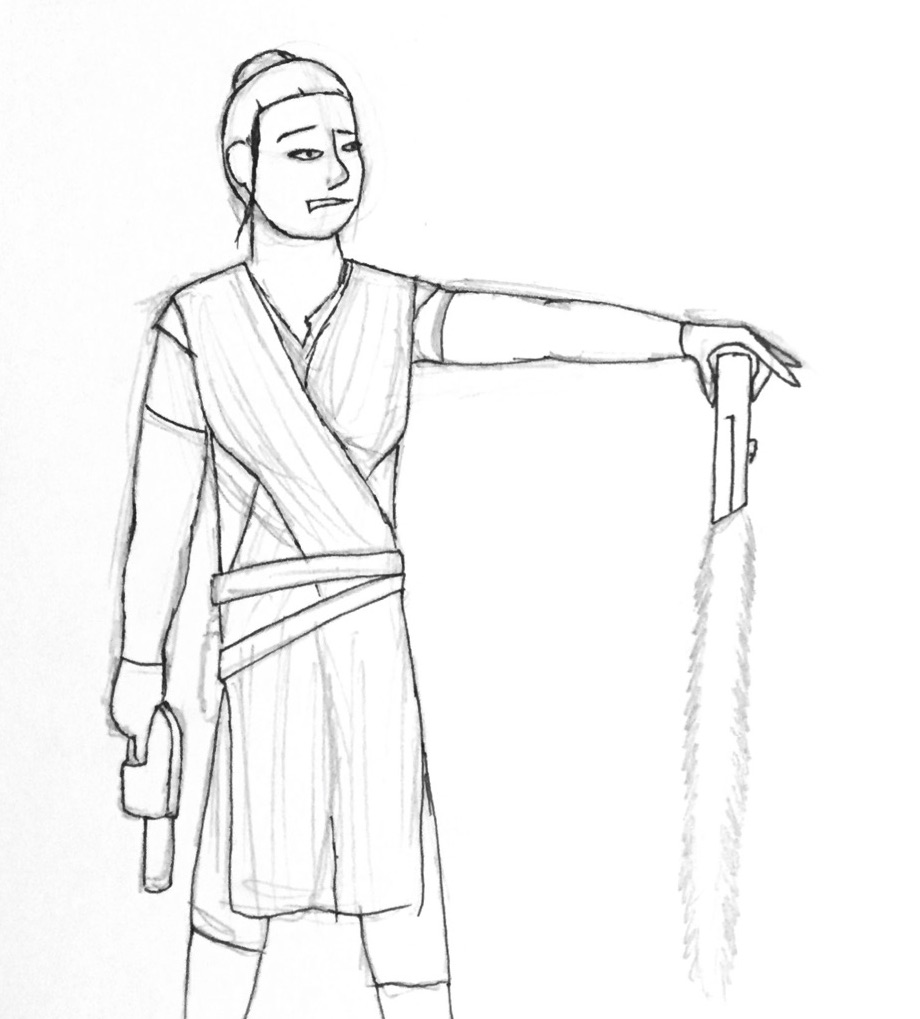
Listen, she's new to the whole "Force" thing. It's a lot to take in all at once.
Listen, she’s new to the whole “Force” thing. It’s a lot to take in all at once.

Shit, there’s stuff to talk about with all the characters. John Boyega as Finn, the Stormtrooper turned hero who may or may not be force sensitive (I don’t reckon he is, but we’ll see in the next few movies) but clearly forges a unique bond with Rey and Oscar Isaac’s Poe Dameron. Following that up, what do we think Poe’s role is going to be in the future? He didn’t have a huge amount to do in The Force Awakens, though he was established as a key character moving forward (guessing surrogate son for General Leia). To be clear, the whole thing is well acted (Adam Driver goes from calm to enraged excellently as Kylo Ren and even Harrison Ford seems to be enjoying himself) and I loved all the characters in different ways.

You get what I’m saying though, right? There’s a lot to talk about with this film. Love it or merely like it, I think we’ll be discussing the characters, the intricacies and the story mechanics for a while. And we’ll probably start doing so in about a week’s time.

Y’know, 2015 was actually a pretty good year for films worth talking about long after they’d finished their theatrical run. The above-mentioned Mad Max, for instance. Wonder what 2016’s gonna be like.

So, yeah, go see Star Wars. Be part of the conversation.

Reviewing the old school: Die Hard (1988)

So I wanted to do a Christmas movie this week since, y’know, Christmas. Took me a little while to decide which one, since there are quite a few of them (many of them actually pretty shit). Then I remembered I hadn’t watched the original Die Hard in a while, and the choice was made. I procured a copy, ordered a curry and sat back to watch what remains one of my favourite action movies ever.

Released in 1988, the film stars Bruce Willis as John MccLane, an NYPD cop visiting his estranged wife at her work Christmas party (in an incomplete skyscraper in Los Angeles). Then a bunch of mostly European thieves masquerading as terrorists take all the party guests hostage. Hijinks ensue.

But you should already know all this, because you should have already seen this movie by now. In all honesty this should be on that 1001 Movies to See Before You Die list if it isn’t already. It’s a classic action film that holds together incredibly well nearly three decades later (holy shit Die Hard turned 27 this year). The fight scenes are appropriately brutal, the set pieces are spectacular and the coincidences never feel as contrived as they do in a lot of other films (including, if I’m being honest, Die Hard 2). The music, as well, is fantastic. It’s something I hadn’t really paid much attention to until I rewatched it this week, but it manages to add tension in the necessary scenes and avoids the unnecessary synth-rock that’s left the soundtracks to so many other movies from the 80s so dated. Best of all it manages to keeps a Christmas theme going throughout the film.

It’s little stuff like that which makes this movie so much fun and the it never treats the audience like an idiot. It talks through particular scenes without feeling like it’s spoon-feeding us through Bruce Willis’ conversations with the Hans Gruber (the villain), Al Powell (his lifeline on the outside) and himself (you’re only crazy if there’s someone around to hear you). It also has a surprisingly high opinion of intelligent characters. John MccLane is not an idiot. He’s good at improvising and working through problems. Alan Rickman’s Hans Gruber is witty and charming, very capable of getting his hands dirty, able to think clearly, rationally and keep an eye on the prize throughout. Idiotic behaviour, however, usually results in the death of that idiot, as we see with Ellis and the FBI agents Johnson and Johnson (no relation). Going in guns blazing doesn’t work, and I wish more action movies would take this lesson to heart.

There are flaws, of course. Holly Gennaro, played by Bonnie Bedelia, has little to do aside from being someone for John MccLane to save. Reginald VelJohnson’s character Sergeant Al Powell tells a story about shooting an unarmed 13 year old boy, meant to garner sympathy for the cops, comes off a little sour given recent events (and probably should have given contemporary events as well). Some guns never seem to run out of bullets until it suddenly ‘matters’. The territorial police commissioner trope, furious about property damage and glass, is a little overdone. As is the henchman who just will not fucking die.

But it’s easy to overlook these flaws. Especially ’cause this movie gave us Alan Rickman. I mean, yeah, Bruce Willis was also a fairly fresh face known for his TV and commercial work propelled to Hollywood fame by this film, but he didn’t play Severus fucking Snape in the Harry Potter films. Without Die Hard Rickman may have remained a relative or complete unknown. And that would have been tragic.

So, yeah, watch this film if you haven’t already. But I expect just about everyone likely to read this already has, so, watch it again I guess? Yeah, watch it again.

Have a Happy Christmas (or Chanukah or Winter Solstice or just a grand public holiday for the many people who don’t celebrate it). Let’s see if I can think of a good New Year movie for next time.

Reviewing the old school: Troy (2004)

Mate, there is so much wrong with this film. I think the worst part is that it could have been so much better if they’d actually used the source material properly. Y’know, with all the gods and magic and not trying to make us sympathise with Paris of Troy. Seriously, you read the Iliad? You know what we’d call that guy in the modern parlance? A date-rapist. Doesn’t matter that he had help from the Goddess of Love instead of roofies, he still fucks Helen without her conscious consent. That ain’t right.

I don’t get why they cut all the supernatural stuff out of the story. It certainly wouldn’t have made the movie any worse, and it certainly could’ve made the story a whole lot more interesting (imagine Sean Bean’s Odysseus having a D and M with Athena, the Goddess of Just War and Wisdom herself, on the beach beside his ship, or perhaps Ares, the God of War, stalking the battlefield with a leering smile at all the carnage). Could’ve been epic. And it’s not like we’d have a problem with the whole ‘Gods and goddesses interfering with the lives of mortals’ thing. I mean, The Mummy and it’s sequel came out five and three years before, respectively, and they did pretty well with the whole weird foreign supernatural thing. Hell, bloody Disney went and covered the same sort of ground as Troy, but including the divine intervention, with its animated film Hercules (and the great spin-off series about his high school years).

Maybe they were worried that if there was too much Deus Ex Machina going on we wouldn’t be able to take Brad Pitt’s flowing golden hair or Eric Bana’s tinted curls seriously. Maybe they were worried that they’d have to make Orlando Bloom the bad guy who dooms his whole city because he just couldn’t keep it in his pants when he met a hot girl who wasn’t interested. Maybe I’m giving the rest of the film too much credit and it would still be shit anyway.

Probably that last one, but the point still stands.

The acting isn’t great. Brad Pitt and Eric Bana ham it up with that weird pseudo-English accent that non-English actors are expected to put on whenever they’re in a historical period earlier than the 1600s. While Brad Pitt never seems to take it seriously (understandably), Bana actually seemed to get better as the film went on and I think he was the right choice for Hector, noble and doomed and the only one with the common sense to say “let’s just give Helen back to the Greeks, Paris will get over it and even if he doesn’t it isn’t worth going to fucking war over.” There’s a lot of great actors in this film, and they do their damned best with the material. Special props to Brian Cox who plays the role of the villainous, prideful, megalomaniacal Agamemnon with a surprising amount of subtlety. Sean Bean’s Odysseus seems woefully underused. I mean, they don’t even kill him. How you can put Sean Bean in your movie and have him play the one character that everyone knows is gonna survive?

The direction and editing are an overlong mess. It’s a two and a half hour long film and not nearly enough of that is filled with the kind of character moments to actually make us care. Some of it just seems painfully unnecessary. Case in point, the film opens with a map of the Aegean. No voice over, no music, no intro credits. Just a fucking map on the screen for like thirty seconds to a minute. Maybe that minute could have been spent fleshing out Ajax a little more, so we actually give a shit when he dies. Patroclus’ character could’ve been fleshed out a little better as well. I think fantastically named director Wolfgang Petersen was trying to channel old classics, the grand Biblicals and biopics like Ben HurSpartacus and Julius Caesar but it just doesn’t work. It’s too slow and not nearly as epic as we’d come to expect by then.

For all its flaws, and it has a lot of flaws (a lot of flaws) I absolutely love this film. My mates and I can basically communicate in movie and television quotes. Simpsons make up the bulk of our source material, with the two Hot Shots! films, the two Airplane (Flying High!) films, Gladiator and Lord of the Rings trilogy filling out the rest of our situational conversations. Troy occupies a special place for us as being the soundtrack for some of our most (or, I suppose, least) memorable nights of drunken debauchery. Someone refusing another beer would be met with a bellow of “Drink you lazy whore! Poles are sobering!” (several of my friends being of Polish origin). Midway through the night you’d likely hear a cry that “The taxi waits for us, I say we make him wait a little longer!” Someone skoling back beer after beer would be cheered on with “The man wants to die!” There was more than one occasion where we’d take Achilles’ speech at the prow of his ship before hitting the beach of Troy and adjust the wording, to fit our school and desired outcome “…my brothers of the schooner… do you know what’s waiting on the other side of the bar? Immortality! Take it, it’s yours!” I watch this film and I’m not thinking about the acting or the plot or the story, the dramatic lines are triggering memories of long nights and close friends.

So yeah. It’s a bloody terrible movie, but I love it dearly. Still, don’t watch it. It’s not worth it and might sour you on a couple of great actors. Read the Iliad and Odyssey instead. They’re classics for a reason.

Reviewing the old school: Nausicaa of the Valley of the Wind (1984)

I’ve struggled a bit writing this. I hadn’t watched this film in a while, and it seemed like a decent choice for an old movie review. It’s bloody fantastic. Problem is, to be honest, just about everyone probably already knows that. It’s Hayao Miyazaki, often cited as the first of Studio Ghibli’s long run of amazing films (even if the company hadn’t technically started yet). Of course it’s good. Of course it’s been praised, dissected, critiqued and analysed by a million others before. What can I possibly add to the discussion? Fucked if I know, but maybe if I ramble on for a bit I’ll think of something.

So, Nausicaä of the Valley of the Wind (or Kaze no Tani no Naushika). The story takes place on a post-apocalyptic world a thousand years after industrial human society had been destroyed in the “Seven Nights of Fire” (this being a Japanese film, titanic organically grown robots with surprisingly uncreative names were involved). Much of the planet has been claimed by the Toxic Jungle, that releases poisonous spores into the air within and around, and is gradually claiming human settlement after human settlement. Nausicaä is a princess of the kingdom known as The Valley of the Wind (hence the title of the film). Far and away one of the hardest bastards in the film (there is one other character who kicks as much arse and he needed to be voiced by Patrick Stewart to do it), she’s also a committed pacifist with a talent for calming, charming and redirecting the deadly insects that protect the Toxic Jungle rather than following the trend in other human kingdoms to kill everything remotely threatening with fire. Aside from a dying a father, everything’s going pretty sweet in the valley until an enormous airship from a neighbouring kingdom, Tolmekia, crashes into the valley and just ruins everyone’s day. Partly because it was carrying spores from the toxic jungle. Partly because it was carrying a foreign hostage who died after the crash. Partly because it was carrying the… embryo… of one of those giant robotic killing machines that I mentioned destroyed the world earlier, that the Tolmekians want back. Anyway, several hopeful anti-war and environmentalist lessons later, everything turns out relatively alright.

It is a beautiful film. The animation is smooth and hold up well for a thirty-one year old film. The art-style makes intimate moments seem grand and grand moments feel intimate, as well as finding the beauty in in what are honestly some fucking horrific-looking beasts. There’s this scene early in the film, when Nausicaä is searching a cave for resources and she discovers the shell of an enormous insect called an ohm. Like, really bloody enormous. It’s presented like a religious experience, a pilgrim entering a cathedral and seeing light fall upon an altar. A lot of blue and white in this moment. A few minutes later the beast that left the shell behind is a nasty, snarling monster chasing after that character voiced by Patrick Stewart (an unforgivable offense in my book, but Nausicaä’s a far better person than I am). Red eyes and a black shell, stark in the desert outside of the cave. Another minute later and the monster has been calmed and is heading home with a surprising grace. Red has been turned back to blue.

Given this focus on colour, the cinematography, the characters and the message that humanity’s best chance of not killing itself is strong anti-war and environmentalist leadership (not to mention the post-apocalyptic setting), I kept comparing Nausicaä of the Valley of the Wind to, of all things, Mad Max: Fury Road. No, seriously. There’s a tonne of parallels there that I don’t have the time to go through in order to get this up before a self-imposed deadline, but if I ever meet George Miller I’d be inclined to ask how much of an influence Hayao Miyazaki is on him. I might even write a much longer post on the subject sometime in the future. We’ll see. I’m not saying that if you enjoyed Fury Road you’d enjoy Valley of the Wind. Except I actually am. And vice versa.

So, have I added said something interesting in all of this? Maybe. That last bit sounded good, even if it was a bit short. Fuck it, that’s good enough. Point is, if you haven’t seen Nausicaä of the Valley of the Wind before, you should definitely watch it. If you have seen it before, well, you should watch it again.

Leave a comment. Thoughts are always appreciated, ideas for future Old School Reviews will be politely considered.

Reviewing the old school: Young Einstein (1988)

I like the odd bit of alternate-history fiction. Usually the more serious stuff, where you take a particular historical conflict and basically go “then the aliens attacked” or “but actually there were magicians there too” or “suddenly, time travel!” Serious stuff. Young Einstein (written, directed by and starring Yahoo Serious – probably not the name he was born with) takes a more comedic route by asking its own grand question: what if, instead of Germany, Albert Einstein was born in Tasmania to Aussie apple farmers?

Well, for one, he still develops the Theory of Relativity in this version of reality, but its first application is to split a beer atom in order to carbonate his dad’s pint. Having succeeded in creating bubbly beer (something apparently impossible to do without causing a small atomic blast) Albert packs his bags and heads to Sydney via Uluru (dammit Jim he’s a physicist not a map-reader!) in order to patent his idea. He runs into (and falls in love with) the lovely Marie Curie (played with some fantastic expression by Odile Le Clezio) who has gone to study physics at the University of Sydney (USYD represent!) for some reason, has his idea stolen by foppish villain Preston Preston of the Perth Prestons (played by John Howard – the actor not the Prime Minister – who is wonderfully pompous, cowardly and greedy), invents rock’n’roll music, then uses rock’n’roll music to diffuse an atomic bomb (saving the lives of thousands, including an apparently still kicking Charles Darwin).

Yeah, you shouldn’t think about it too hard. Or at all. Very little of it makes a whole lot of sense. The plot doesn’t. A fair bit of the physics related dialogue doesn’t. But I like it. And if you don’t think about it too much you might like it as well.

As bonkers as it is, Young Einstein does have a colloquial charm. John Howard hams it up fantastically as Preston Preston in what I’d be willing to call one of his best and funniest roles. The idea that everyone would give so much of a fuck about putting bubbles into beer that the scientific community would give out a Nobel Prize for the effort is so bloody Australian it was probably born in New Zealand. Once he gets out of Tasmania, Yahoo’s young Einstein manages to mix the traditional Aussie stereotype of the self-reliant bushman out of his depth in the big city with the broader stereotype of socially-oblivious genius more easily than you’d expect. The plot might not make any fucking sense, but the fact that everyone seems to rather like the kid does.

Thing is, I can’t bring myself to recommend this film to anyone. It took me a little bit to decide why, mind you, but I can’t. Not to an Aussie audience, not to a foreign audience. The problem is it hasn’t aged well.

So much of the humour is, essentially, a piss-take of what people from outside Australia thought the country was like. Weird puppet Tasmanian devils that can take bites out of metal shovels, wallabies hopping around the Sydney Uni campus and (as mentioned above) indicating that a trip from Tassie to Sydney would require hopping on a train in the red centre. Thing is this may have been how people viewed us nearly thirty years ago but other people have done a better job of having a go at these stereotypes since then, and (if nothing else) the number of Australians traveling around the world (yours truly included) and people who have travelled to Oz has dispelled a lot of the more ridiculous of the myths made fun of in Young Einstein. A fair few of the jokes are winks and nudges at the Australian audience going “how funny is it that dumb-arse foreigners think this is what we were like!” Now we’d just point out that the rest of the world just thinks we’re a bunch of drunken, sports-mad brawlers with a talent for killing spiders and sharks in between smashing back tinnies.

As a result a lot of the humour falls flat. This isn’t helped by the fact that some of the more noticeable cultural references aren’t all that recognisable (I might know that a shot of Einstein riding a horse down a steep slope is a reference to The Man from Snowy River but I doubt that any of my siblings would).

Honestly mate I watched this film for nostalgia purposes. I remember watching this film as a kid. There’s this point at the end where everything’s about to explode and everyone’s losing their shit. Einstein, calm as you like, takes a bite out of an apple and says “Just a moment Marie, I’m having an idea.” I love that calm thoughtfulness. The problem with the rest of the film might be that it’s too goofy. Everything from the high-pitched inflection of the narration to the costuming to the sound effects is played for the easiest kinds of laughs. But this one line, played perfectly straight, eating an apple, it embodies my own sense of humour and how I try and handle a stressful situation. Funny what sticks with you.

So yeah, I like this movie. Is it great? Not really. Should you watch it? Probably not. Hell, I wouldn’t even recommend a rewatch if you’ve seen it before. But if you do, remember to take it for what it is. It’s a relic of what we all thought you thought about us back in the day, true or not. And it’s a bit of clean, stupid fun.