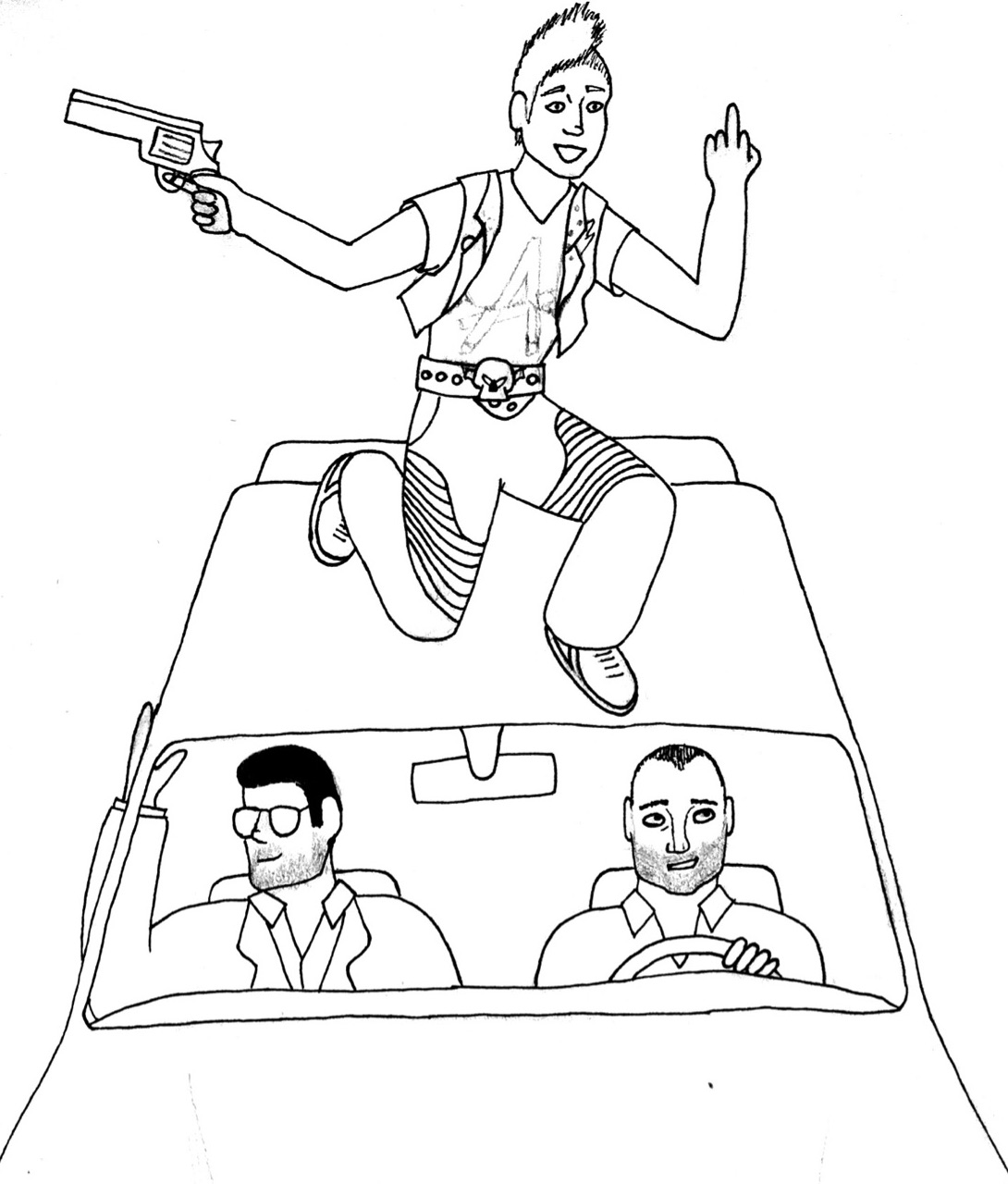
On Crank, its electric sequel, Saints Row and Sunset Overdrive

Scan SO, SR, Crank Edited 23:3:15

Late one night a few years ago I was awake with one of my sisters channel surfing, looking for something to watch. General tiredness at that moment and the passage of time now mean that I have no idea how it happened, but we ended up finding and watching through to the end Crank: High Voltage, the 2009 sequel to 2006’s original Crank, both of which starred Jason Statham as a hit man with heart problems trying to both survive and get revenge. The film was absolutely batshit crazy, with more than a few moments when my sister and I exchanged a look communicating a mutual feeling of “whaaaat the fuck?” While my sister always refers to it afterwards as “that shitty movie we watched” I quite enjoyed the fucking ridiculousness of it all. Just as importantly it was something of a bonding experience for us. So when I saw the original and the sequel recommended by Netflix nostalgia and memory meant that I had to watch both films again.

At no point am I going to call either film a great movie. The dialogue in the first film relies too much on profanity and in the second relies too much on profanity and bad cockney rhyming slang rather than anything easily defined as wit, and both films are a bit to quick to jump towards racial, sexist and homophobic slurs. The acting often swings past simply campy towards bad, the rare CGI effects are lousy (though the practical effects are fun and look great), and you are constantly required to suspend your disbelief. The plots are simplistic, predictable and far to reliant upon exposition dumps. But, throwing a constant stream of ridiculous balls-to-the-walls action at the audience, the films are ridiculous good fun. In the first movie the protagonist is told explicitly that if he stopped moving he would die and the entire film takes this advice to heart, constantly dreaming up wacky scenarios and throwing out crazy stunts to keep our attention lest we be distracted by something shiny if the action slows down.

And both movies know exactly how ridiculous they are. Jason Statham plays, well, the same character he always plays (the characters might have names in the movies he plays, but have you ever referred to them as anything other than Jason Statham?) but he plays it with a surprisingly subtle straightness. As if he, like the audience, recognises exactly how batshit crazy everything happening around him is but just rolls with it regardless, forcing us watching to do the same. In doing so both movies also show that they know exactly how much like a video game they are. In the same way that a gamer simply accepts whatever thin plot is used to justify the mechanics required to keep the game fun and interesting (if they bother with a plot justification at all), Statham’s Chev Chelios responds to the various plot points with an “alright then.”

It goes further though. There are direct allusions to video games of course (the beginning of High Voltage is an 8-Bit version of the end of the first film) but as a gamer it was within the tone and pace of the action that I noticed it most. The way that Statham realises the need to keep his adrenaline pumping in the first film (followed by a confirmation from his doctor) is reminiscent of a tutorial level, and it is not hard to imagine an ‘Adrenaline Meter’ hovering in one corner of the frame as we watch him outrun the police driving through a shopping mall, or collecting power ups as he seeks out “High Voltage” signs and stickers in the second film. His habit of cutting through levels of grunts and seriously outclassed mooks before getting into a ‘boss fight’ was choreographed in such ways that I was half expecting the button prompts of a Quick Time Event to start flashing on the screen. Then of course there’s the ‘level’ like scenes, so that across the two movies we get moments akin to the ubiquitous stealth section, driving level, rooftop level, warehouse level, nightclub level, platforming section, (a very God of War-like) romance ‘achievement’ (NSFW, neither of them), escort mission, etc. Everything except a water level (which I expect will be the focus of the eventual third film in the franchise, Crank: Dehydration). Even the opening scenes showed a striking resemblance to common video game tropes (how often has a protagonist awoken in their home – or a strange location – before being given an info dump so the player knows the basic context? Or, maybe even more commonly, woken up in a mysterious hospital bed after catching brief semi-conscious glimpses of being operated on?)

Ultimately the Crank films are movies that try to act like video games, surprising given that it is often the other way around. Even more surprising given that I’d say it’s successful. I think where Crank and High Voltage succeed where other movies meant to look or feel like video games fail is that rather than attempt to simply replicate a particular visual style or theme these two maintain a very video game like tone, pace and structure. What semi-surprised me was that, while watching both films, I thought of two games in particular: Saints Row: The Third and Sunset Overdrive. Semi-surprised because, as I thought about it before beginning writing this, I didn’t think of more ‘cinematic’ games like the Grand Theft Auto series.

But it makes sense. Like the Crank films, Saints Row and Sunset Overdrive are cartoonish, humorous, unrealistic, immature, and varying levels of self-aware. SR‘s Boss (the player character) is, like Statham, pretty relaxed about the insanity they get up to, not questioning the inherent ridiculousness of, for example, driving a tank out an airplane and landing on an island covered in zombie gas. Or discovering massive cloning facilities while fighting their way up a massive skyscraper (before riding a giant sphere down said skyscraper directly onto the head of their enemy). SR:3 is self-aware enough to know how crazy everything is, but simply goes “why the fuck not?” and rolls with it. SO takes it further, frequently breaking the fourth wall or joking about the implausibility of various game tropes like long distance communication (“Don’t question how we deliver the story!”) or death (“You might [die]. I’ll probably just respawn over there!”) or plot (“How convenient…”). Given the sorta punk rock soundtrack and focus on keeping moving or dying in SO it wouldn’t surprise me if it’s channelling a bit of Crank itself.

More importantly, both games encourage constant movement and action to remain fun and exciting. SR:3 actively encourages the player to car-surf, drive on the wrong side of the road, perform aerobatic stunts, blow up the game universe’s version of the Smart Car, and stylistically bludgeon or machine gun through anything that gets in your way. Like the original Crank, SO tells you to never stop moving, because if you stop you die. While you jump, grind, bounce and wall-run through the city you’re relatively safe, something further reinforced by the awarding the player points for travelling stylishly. Staying on the ground, attempting to stop and use cover, or some other common mechanic in more ‘realistic’ shooters is a quick way to get overwhelmed and die. Both games provide a large sandbox environment, enough plot and context to provide an excuse to go batshit crazy, then encourage you to do just that.

The result is that they hold your attention. They keep you playing, trying different things, beating scores, beating down enemies. SO was the first Triple A video game my other sister finished in years (perhaps ever), simply because it was the first game that managed to draw her full attention for long enough to complete it. She’d stopped playing SR:3 simply because SO had just come out. If I was introducing someone to gaming these two are amongst the games I would use to do so.

That’s why the two Cranks work so well in my mind, they’re films driven by the mechanics of the world, accept that fact, and see how much fun shit they can do with it. That’s why, in my mind, they might not be great films but they’re great fun and great examples of how to make a film like a video game.

Keeping faith in Dragon Age: Inquisition, Part Four: Reflecting on the story and why it matters

So the developer is god, the story appeals to the faith of the player in the game itself, when Bioware’s writers cribbed off history they did so with a deeper appreciation for the place of religious institutions within the societies it mimics.

At the end of Part Three I claimed that the most important story mechanic was the player’s control over the Inquisition, over control of the institution into which people are able to place their badly beaten faith. The game says this at times directly (there’s a line from Mother Giselle that “an army needs more than an enemy, it needs a cause”) and at other times with thinly veiled metaphors. The cut scene in which the formation of the Inquisition is announced to the world involves Commander Cullen nailing the proclamation onto the door of Haven’s Chantry in a way that is reminiscent of the popular image of Martin Luther nailing his 95 Theses to the door of the church at Wittenburg (and the popular image of the beginning of the Reformation).

While the Inquisition is initially declared to be a heretical organisation by the surviving Chantry hierarchy, it becomes more or less an institution of change and reform. While the game certainly provides the ‘evil’ option of “doing it for the [personal] power” the Inquisition still tends to provide a net positive to the world’s major institutions by simple involvement in the various conflicts going on. Following in the footsteps of other Bioware RPGs you’re given the opportunity of making decisions big and small, but almost all of the big decisions in DA:I have world shaking consequences because they effect one or more of the major institutions of Thedas. Do you choose to side with the Templars or the Circle of Magi? Whichever one you decide would have far reaching implications for the people of the land. If you choose the Templars, do you disband the centuries old organisation (removing a trusted constant from the continent) or do they become partners in an alliance? If you choose the Circle are they heavily indebted allies or prisoners (continuing the cycle of leashing magic users). Do you choose to allow the Grey Wardens the chance to atone and rebuild, or banish them from southern Thedas? Who will sit on the Orlesian throne? Who will sit beside/behind the Orlesian throne? Who will the Inquisition support as the new Divine? Cassandra the reformer, or perhaps the far more traditional Viviene?

Decisions, decisions... so many exhausting decisions.
Decisions, decisions… so many exhausting decisions.

Our decisions have (as far as the game itself tells us) long-reaching consequences for the lands and people of the Dragon Age world, how we make those decisions depends on how we interpret our characters personality and where their faith lies. My Inquisitor found herself willing to forgive the Templars who had been fooled by a demon doppelganger, but banished the Grey Wardens who had so willingly started using blood magic. She supported Empress Celene in the Orlesian Civil War but installed the elf Briala at the Empress’ right. And she honestly gave no shits about who would become the new Divine of the human Chantry, but was glad for her friend when Cassandra was named (in the epilogue).

So, why does it all matter? Because it allows for better understanding of the past, present and future by providing a reasonably understandable point of reference for people to understand. I’ve already mentioned my belief that video games provide a valuable resource for teaching today’s youth some important ideas and concepts (some educators are already doing exactly that). This falls under the same principle.

Let me use the Crusades as an example. Ask most folk for the causes of the Crusades and they’d probably respond with some combination of religious fanaticism and using religious fanaticism as an excuse for conquest. Recent arguments I’ve heard though was that it was the delayed response to centuries of Muslim conquest all the way up through Spain to the gates of Christian Europe. The release of many decades of anger after watching what had been the Christian Middle East and North Africa conquered by the heathens who were stronger and more advanced, and the feeling of impotence that would have come from being unable to halt Islam’s advance. It was a response by the faithful questioning why God was allowing the unfaithful to inherent the earth and deciding that it must have been because they had to work for it. Now when a lot of scholars talk about the roots of modern Islamic terrorism they say some very similar things, that it is a response by the weak and disempowered faithful who have spent the past four centuries watching the ascent of the Christian West, who have then proceeded to conquer, divide, puppet and generally mistreat the Muslim world which a few hundred years ago dominated the world. And if someone who’d played DA:I asked me explain the situation using a literary example, I’d talk about how easy it was for the Elder One to recruit from the disenfranchised citizens of Tevinter surrounded by decaying symbols of their own lost glory, worn down by centuries of conflict with the technologically advanced Qunari and bad blood with the rest of the continent (and their former possessions), reasonably sure that they’d understand what I’m talking about.

When discussing something as emotionally subjective as faith, being able to understand through experience is key. By appealing to the player’s faith in the game like Bioware does in DA:I, it allows the player to empathise with the character’s crises of faith better, and understand the emotional responses by those characters towards the institutions that held their faith. Understand the emotional responses to our treatment of those institutions. The faith of the player in the game, regardless of how they are playing, is both challenged and reinforced. As I said, it provides a point of reference that reflects the real world. It allows us to better empathise with people around the world and the issues that arise from their faith, treat them with the respect they deserve instead of dismissing them outright for placing that faith in something we disagree with.

Understanding all the issues and views involved in a problem is the first step in solving it. I don’t expect playing Dragon Age: Inquisition will fix the world, but anything that adds positively to the cultural zeitgeist helps. But, shit, I’m an optimist.

Alright folks, I’m gonna end it there. Thanks for reading. I’ll find something else to talk about.

Three weeks in Vancouver

The crowd is mostly silent as I watch my opponent from two feet away. The (somewhat generously titled) referee makes a joke, says “ready” and we each raise a fist. I’m a competitive bastard at the best of times and I right now I want to win. I’ve already beaten one opponent, I need to do it again. The ref raises his hand and yells into the microphone “ROCK, PAPER…” they trade the name of the bar, Beaver, for SCISSORS and we players reveal our choices. Best three out of five, and I win the first game. We repeat the process and after a few tries I take the second game, though our ref announces it to be one-one. “What?” I have time to think but not say because we’re already into the third. It’s longer than the first game but shorter than the second and I win it regardless. The referee says two-one, his associate says that I’ve just made a three game sweep. My opponent seems to agree. There’s a moment of quiet confusion, then I raise my hands regardless and cheer for my victory. Eventually everyone else runs with it and I shake hands with my opponent. I’ve made it through the first round, fought through a ‘threesome’ where everyone else only had to beat one opponent. I get a shot for my sweep win, tequila and Tabasco sauce. It tastes like victory.

It doesn’t seem to be getting any warmer, but at least the past fortnight or so has been sunnier. I’ve got a job now, and the patio’s been opened up to allow the still warmly dressed locals and occasional tourist the chance to have a beer and burger beneath a smiling sky. One customer made a comment about the risk of sun burns, and I had to bite down on my urge to check my phone for some holiday photos while growling “That’s not a sunburn…”

I might be imagining it but there seems to be fewer beggars and more buskers out on the street, though maybe that’s simply because I’m noticing more of the homeless singing for their supper (metaphorically and literally). Everyone’s an artist, or at least think they are. There’s a half-finished chalk drawing of Christ on the Cross, ironically ugly as sin in its incomplete glory, on a corner near Granville Skytrain* station. I wonder if the guy was chased off, got bored and went to a different corner, or simply thought it was done. For a few days in a row there was homeless guy strumming away on an old guitar also near the station. Every time I walked by he was playing the same tuneless melody, into which he’d ram the lyrics of different songs with a few nonsensical flourishes. His covers of Folsom Prison Blues and Sunday Bloody Sunday were particularly notable. Some of the people on the street playing guitars or selling sketches are genuinely talented and seem to have a regular, established place along the side walk. Others you see once or twice then never again.

Side note, I saw a girl wrapped in a blanket with a cardboard sign asking for spare change. Young girl, early twenties at most. Thing is she had amazing hair. Long, thick, silky, a little wavy and nicely coloured (bronze blonde layered over rose). The kind of hair that random strangers must just start brushing their fingers through. Just thought I’d mention that.

The toilets still bother me. It shouldn’t be this hard to take a quiet piss and some of them still don’t carry everything down the pipe. The cars don’t so much anymore. I don’t know if I mentioned it last time, but the fact that most pedestrian lights don’t make a sound is a bit irritating. Aside from how easy it is to look away for a few moments then look back to realise you’ve missed the white walking man and are already onto the flashing red hand, I can’t help but wonder what blind people do when they’re trying to cross the road. Something else that’s grabbed my attention has been the birds. The seagulls are substantially larger here, and there aren’t Indian Mynas scrapping for territory with magpies and lorikeets. The big difference has been the crows, loud, mean and jet black, but more easily frightened than the dumpster diving Australian White Ibis back home.

I’ve worked a lot of shifts lately, and I haven’t had as much time to do as many fun things as I’d have liked. It’s been indicated that as summer approaches and more people get hired the number of shifts will be reduced. I’ve still managed to head out on occasion, a whiskey bar on Commercial Drive or a seafood restaurant on Granville Island. The above mentioned game of Rock, Paper, Scissors. I won the second round, against my German housemate who I’d gone to the bar with. Lost in the quarter finals to a Californian. There was a bit of mockery from the guys running and I played along, swearing back merrily. At the end of the night I was surprised when they thanked me for being a good sport, though I then realised that there were likely more than a few people who’d take their ribbing far too seriously.

There are other things I still need to find the time to do. Go and see a hockey match (not hard, the Cannucks seem to play at least one local game a week), find some baklava in Northern Vancouver. Check out a bit more of the night life. Generally meet more people. Thankfully Vancouver is a very liveable city, and as the days get longer it should become easier to have a proper life outside of work. After all that’s why I’m here.

*Can I take a moment of your time to note how pretentious it is to call it a Skytrain? ‘Cause it’s pretty fuckin’ pretentious.

An icon leaves us

Lap scan edited

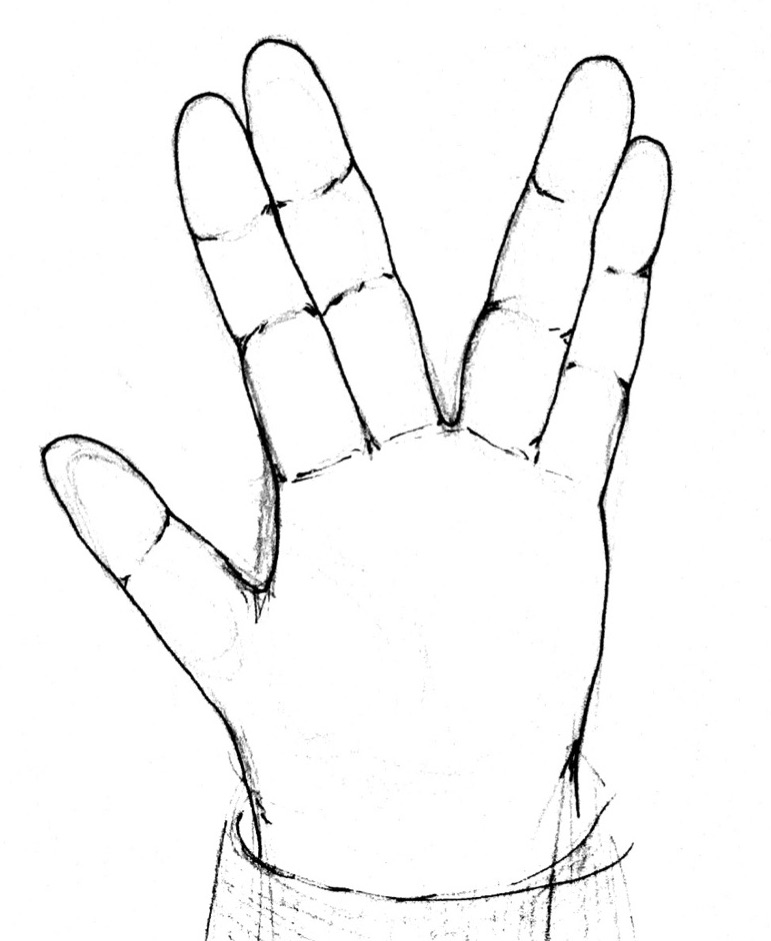
The news came through on Friday that Leonard Nimoy, the man who was and always will be Spock, died at the age of 83. News sites, Tumblr, Facebook, Twitter, and all the other places where our collective culture gets its information filled with headlines that generally were some version of “He lived long and prospered.” Forums and more artistic social media walls or feeds quickly filled with fanart, photos, quotes, tribute pieces and more than a few animated gifs. An important part of popular culture, an inspiration and mentor to millions has died, and the act of collective mourning has been amazing.

Now of the many fandoms that I might claim membership in, Star Trek was never one. I’ve seen enough episodes and know enough about the various series/characters/plots/context/surrounding-culture to be able to reasonably discuss it, but truthfully William Shatner’s role as Denny Crane on Boston Legal (particularly his platonic relationship with James Spader’s Alan Shore) had far more influence over me during my formative years than Captain Kirk ever did or ever could have. But that doesn’t change the fact that Leonard Nimoy, Mr goddamn Spock, has just died and it’s fucking hard to not feel that loss.

Mocked, parodied, tributed, influenced, referenced in. Star Trek has influenced popular culture at a level that only a handful of other franchises can claim to have reached, and the characters of its original series (movies, and to an extent the characters of the sequel series) will always be associated with the actors that played them. Try as he might in the new movies, Zachary Quinto will never be the Mr Spock (and that’s alright, let him build his own legacy). Add in his prolific career beyond Star Trek and social activism and Nimoy was, like few others, a secular saint. His death has left a grand hole in our cultural cosmology that I don’t see being filled any time soon.

It happens. People seem to have processed his death and worked, written, drawn and animated their way through it. He was an old man. He’d been sick for a while. Unlike the deaths of other icons like Robin Williams or Michael Jackson his mortality had been apparent for some time. We knew it was coming. That doesn’t make it less sad, but it does make it easier to process.

Rest peacefully Mr Nimoy. Sleep well Mr Spock.

Keeping Faith in Dragon Age: Inquisition, Part Three: So what’s it all about then?

Sorry this took so long folks, but here is Part Three. Part One can be read here, Part Two here.

So, we’ve established that the developer of DA:I is the ‘god’ of the game and that appeals to the player character’s faith in-game are also appeals to the player’s faith in the game. How does this relate to the story, politics and lore of the game and the world within? Well, let’s talk a bit about faith first more generally, in real life and in the game.

A few years ago, back at university, I found myself doing a course with the rather self-explanatory title ‘Christianity in Medieval Europe.’ It was a good course that covered everything from the iconoclastic debate, various heretical movements, the inquisition, Christianity’s evolving relationship with Islam, academia and scholarship, and of course the history of the saints. By the end of the course there were two things that really struck me, however. First was how fun it was to be able to use the word ‘flagellate’ in casual discussions (and I got to use it a lot). Say it with me, flaj-ell-ate. Fantastic. Second was that we still have a very low opinion of medieval Christians, one that comes from some very modern yet very old-fashioned misinterpretations of the reasons for faith, ritual and religious institutions in the Middle Ages. The assumption tends to be that Medieval Europeans were a bunch of ignorant flat-earthers who answered every question with “God did it!” or “because the local priest told me that’s what the scriptures said happened!” and whose lives were, as a result of this stupidity and blind piety, “violent brutish and short” (to use an overused quote). The reality was that this, for the most part, was simply not the case. Unless of course you were a Viking. Then it was a life goal.

The reality was that they either knew the world was round or would have responded to an explanation as to how we knew with the tenth century equivalent of “Well, that makes sense.” The reality was that for those Medieval Europeans the church and religion had less to do with answering how the world works in what we’d now define as a scientific sense and more to do with where their place in the world was. Categorisation instead of explanation. This is us (because we hold these beliefs to be true and perform these rituals), that is them (because they hold those beliefs to be true and perform those rituals). Social cohesion through the creation and/or enforcement of social norms. This behaviour is correct and righteous, that behaviour is wrong and sinful. The power of the church came in its power to codify or legislate the social norms affected by the belief and faith of the populace, because it controlled the rituals and ritualised elements of that faith. To take a quote from Mary Douglas’ classic book Purity and Danger (which I’ve been messily paraphrasing), “As with society, so with religion, external form is the condition of its existence… As a social animal, man is a ritual animal… Social rituals create a reality that would be nothing without them. It is not too much to say that ritual is more to society than words are to thought.” The religious institutions established a particular world view, a particular reality, and our divinely ordained place within it. This did not make Medieval Europeans stupid, it made them human.

That is what the folk over at Bioware seem to understand, so when they cribbed heavily off of Medieval European history (and they did crib heavily) they were able to do so at a very deep, conceptual level. The Qunari, for instance, may not seem superficially similar to the Islamic world in the Middle Ages (there certainly aren’t any Arishoks running about saying “there is but one God and Koslun is his prophet”), usually seeming more Asian in influence (pulling from Buddhism, Confucianism, Taoism etc), but the Qun guides all parts of life and government in a way that would have impressed Muhammad (peace be upon him). The apparent stagnation of the Qunari  (they have gunpowder, but don’t seem to have advanced beyond basic artillery and bombs for centuries) is similar to the stagnation that eventually brought down the Ottomans. Similarly, the endless war between Tevinter and the Qunari is reminiscent of the Byzantine Empire’s piecemeal conquest by the technologically superior Muslims (their frequent battles for control of Seheron remind me of the various battles for Crete). The division of the Chantry between the Tevinter Imperium’s Black Divine and the rest of Thedas’ White Divine (based in Orlais) based on different interpretations of a specific passage (regarding magic), just how divine the prophet Andraste was, and a refusal to accept each other’s authority resembles the divisions between the Eastern Orthodox Church (and the Patriarch of Constantinople) and the Western Catholic Church (and the Bishop – Pope – of Rome). And of course Fereldan and Orlais are very obvious analogies of England and France (and their respective relationship with each other). Antiva is Italy, Nevarra is Spain, the Anderfels are Germany or Switzerland.

But all this is on a Macro level. On a micro level, they understand how people’s faith in god or the institutions that call upon his/her authority can be harnessed for good or ill. A lack of faith in the Chantry to protect them from the abuses of the Templars led to the Mage Rebellion. A feeling that the Chantry was taking them for granted led to the Templar Order also rebelling. Disillusionment amongst the soldiers fighting for the Empress or Duke in the Orlesian Civil War led to the rebellious ‘Freemen of the Dales’. The game’s main villain is able to gain so much support from Tevinter’s fringe nobility because he promised to halt centuries of decline and return the Imperium to its glorious and glorified past. It is understandable for Iron Bull to be a little disillusioned with the certainty of the Qun, even at one point joking about their religious leaders had been trying to explain why the Qunari hadn’t been able to conquer Thedas for centuries. Sera despises the institutions of the nobility and priests, and acts to get even with those who step on the little people, but recognises the futility of some grand revolution. Cassandra’s discovery of the Seekers’ secret history rocks her world view so severely because it disrupts her faith in the institution she’d pledged her life to. History is full of the disenfranchised striking out against the forces that had previously controlled their faith, and almost by default their lives.

The power given to the player in DA:I, the core story mechanic for much of the game, is not the magical Anchor on their hand but their control of the titular Inquisition. The Inquisition fills a vacuum of power, seeks to actually re-establish order and stability, and fix apocalyptic hole in the sky. It provides a new institution into which people are able to place their severely shaken faith. The player is able to then influence how that faith is harnessed, and shift the order of the world.

How this works in the story and why it all matters will be explained in Part IV. Just one more, than I’ll talk about a different game guys. Promise it won’t be as long coming.

Three nights in Vancouver

It was a little bit past 9 o’clock in the evening when I found myself walking awkwardly beneath the picturesque streetlamps and fairy-light covered trees that line the streets of historic Gastown in Vancouver. Awkward because I was increasingly desperate for a piss. Really desperate, pounding the pavement with a short, angry strut and swearing at myself for failing to go before I left the bar. I still had the presence of mind to pull out my phone and take a quick snap of a particularly pleasant stretch of streetlamps and trees for an aunt back home. It was my second night in Vancouver, and Sydney so far is still home.

I arrived at around 8am local time on Tuesday morning, having managed to nap for just half of one in a fourteen hour turbulent flight straight from Sydney to Van. The Skytrain (unfortunately not what it sounds like) ride to a few blocks from my hotels filled up very suddenly after three stops. Everyone was polite, silent, a little suspicious, mostly avoiding eye contact, same as other commuters around the world. I decided the best way to deal with the jet lag was to just stay awake, explored a little during the day, went to a bar in the evening for a burger and far too many beers. Nearing forty hours without anything resembling a proper sleep I finally managed to drag my drunken arse into bed. Slept for eleven hours, lacked the strength to get out of bed for another two. Hangovers and jetlag are a potent combination. Three nights into my adventure and my body is slowly catching up. Sydney is nineteen hours ahead, which makes Vancouver five hours ahead yesterday. It feels like I’m going to sleep at 7pm and waking up at 2am. That’s not too bad. What’s really got me fucked is that my eating patterns are just as broken, which is leaving me hungry at 1am and isn’t helping the lethargy. I’d guess that doesn’t sound like much, but I’m better tired than I am hungry. I’ll get over it in time, but still.

By the time I left Gastown I was seriously wondering what the opinion in Vancouver was for people who piss in alleys. Honestly amongst the youth in Sydney it’s not a big deal, you just find somewhere secluded and everyone looks the other way. I know that sounds disgusting, but when you’re desperate you’re desperate. I had tried taking my attention off my screaming bladder by admiring the light works casting conflicting shadows across the shop fronts. Half a dozen glowing orbs growing from long black stalks like the well-ordered fruit of the gods, I’d think later pseudo-poetically. This became more difficult when I left the picturesque streets of Gastown and began my ascent into the working streets of Downtown.

The weather the past two days has been damp and grey. As I stare out the window towards a wet sky I feel like I should be a depressed European writer, taking slow drags on a cigarette while staring into the middle distance and trying to work out how my great novel will explain the meaning of existence. That’s probably because it’s colder then I’m used to and I don’t know how to react to that beyond ‘wearing a jacket’ so I’m projecting. It’s just one of the things reminding me that I’m not in Oz anymore (see what I did there). Almost every taxi I’ve seen in Vancouver is a Prius, as opposed to a Commodore or Falcon. The complete absence of any Holdens or the Fords I know best is also weird, and I’ve never seen so many Chryslers in my life (they were briefly popular in Sydney because the sedans looked like a Bentley if you squinted). The number of ‘medicinal marijuana dispensaries’ surprised me (I’ve recently learnt what “420 friendly” means), as well as the frequent wiffs of recently smoked pot (it’s neither legal nor open in Australia). The toilets are filled with too much water (seriously, it’s so fucking wasteful), the beers are unfamiliar (but still pretty tasty), the young and full-of-themselves walk with a hip-rolling swagger instead of the chest-thrusting strut of back home (like a bird displaying its plumage). While walking I saw bunch of used needles discarded on the street. I haven’t seen that many discarded needles in Sydney for years. Not because there aren’t any, just because you don’t see them. Again that probably sounds pretty minor, but it’s the minor things that reinforce change the most.

I’ve finally had enough. I turn into a side street with a couple of dumpsters only to discover an occupied car idling with its lights off. I decide to keep walking, a decision that is immediately proved correct when a bloke steps into the alley with two full garbage bags, heading for those dumpsters I’d been so keen on marking. Back onto the main street, full to burst. I walk another two blocks before I find another dark, empty street with another dumpster. I’m there for a good, long, undisturbed while, and finish walking back to my hotel much happier and much more comfortable at a much more normal pace.

There have been a few things that have surprised me about Vancouver. The number of people from Asia or of Asian descent for one. It makes sense in hindsight – after all, Vancouver sits on the Pacific coast and probably relaxed its more racist immigration laws a few decades before Australia did – but my knowledge of Canadian film and television had led me to a stereotype of the local minorities being a lot more African than I’ve seen so far. Funny how that works. I wonder if new arrivals in Sydney are surprised by our vibrant Asian community, since God knows it doesn’t appear in our movies and shows. Similarly I was shocked by the homeless population on the street. Not that Oz doesn’t have plenty of homeless it’s just that, again, we have a certain image of what Canada is like and part of that involves comprehensive social security nets and a can-do attitude towards fixing social problems. I partly blame Michael Moore for this stereotype. Third, personal banking is shockingly backwards. Compared to Australia it’s expensive, ponderous and overly reliant on archaic methods of payment. I’m a former bank teller, I know. But we work with what we’ve got.

It was a little past 9 o’clock last night when I found myself walking awkwardly beneath the picturesque streetlamps and fairy-light covered trees that line the streets of historic Gastown in Vancouver. Awkward because I was increasingly desperate for a piss. I swore at myself for not going before I left the bar and worried that a pattern was beginning to emerge.

It might not sound it, but I’m liking this new city. The differences, the beauty and the flaws give it a personality that a real living city needs. It’s not home yet, and it might never be. But I can live here. Yes I can.

What’s happening in the near future with me and this site.

Six days to go. Six days ’til I climb onto a 777 with whatever worldly belongings I can stuff into my backpack. Six and a half ’til I climb off the plane in a new city, in a new country, and see how hard it is to try and make a life somewhere completely different. Six days. That’s not bloody long, is it?

Honestly, I’ve been trying not to think about it too much. Or at all. That’s how I cope. I procrastinate. I’m still procrastinating (still haven’t booked a hostel to stay at when I initially land, while I look for more permanent accommodation). But it’s really hitting me now. The going away party has been partied. Friends and loved ones are vying for my time. The doubts are starting to build up. The stress is taking its toll. Y’know how people stress-eat? I stress-un-eat, lose my usually impressive appetite. I’m not panicking ’cause I’m not one to panic unnecessarily, I just become a shitload more temperamental, more easily frustrated and angered. That might be worse.

Six days. Christ, not long at all. Then I’ll be in Vancouver, British Columbia, Canada instead of Sydney, New South Wales, Australia. Watching hockey instead of cricket. Hunting down late night poutine instead of kebabs. Getting drunk in ‘historic’ Gastown instead of ‘hipster’ Newtown. Drinking shit North American coffee instead of amazing Australian coffee. Doesn’t sound too bad, aside from that last part. Still, six days. Fuckin’ terrifying.

As for the site, well I’m going to try very, very hard to keep it from turning into yet another travel blog. God knows the only thing the internet needs less is food blogs. I am also going to try very, very hard to get into regular updates. That might be a little while coming, what with the massive transitional phase and unknown access to the internet, but I’ll try to do it sooner, rather than later. I’ve slowed down a bit lately as well, because as much as I like writing, the stress has made it feel too much like work. So I’ve been procrastinating over posts. I’ll stop that. Promise. Tomorrow.

Got some plans for the future. Going to finish what I want to write about DA:I, vent some issues with CoD: Advanced Warfare, enjoy the political situation a bit more (it’s become pretty hilarious lately), try and stay a bit more current and topical. I’m also gonna do some changes to the lay-out (getting a bit tired of the grey), get some more regular sketches up, maybe fork out for a proper domain name etc, etc.  So keep an eye on this space, yeah?

Six days. Goddamn. Thanks for reading folks, wish me luck.

Knights and flags and anthems and Taylor Swift on the radio. Happy Australia Day!

Australia Day Sketch - Edited

Seriously, Happy fuckin’ Australia Day. That weird holiday when people across the country are able to cover themselves in the Jack and Cross (a slang term for the Australian flag I just invented at this moment) without automatically being judged as racist bogans, parading how fair dinkum Aussie they are in a bizarre parody of national pride ripped heavily from July 4th episodes of American television.  Ozzie! Ozzie! Ozzie! and all that. I’d sooner deck myself in the green and gold, but that’s me.

The lead-up’s been a particularly strange one this year. It’s always a bit of a political wank, as both sides of whatever line you happen to be watching cloak their own ideas of “what it means to be Australian” (or some such crap) within the language of patriotism and nationalism. There were the usual articles about how for the Indigenous community Australia Day, the anniversary of the convicts being disembarked from the First Fleet (and, in the mature-rated history books, the crazy, drunken orgy that followed), is also the anniversary of the beginning of the bloody White European conquest of the continent. Some better (passionate arguments made quite reasonably, by members of the Indigenous community and supporters with proven records fighting for aboriginal rights, for a less culturally insensitive date), some worse (social media hipster liberals ’embarrassed’ by displays of national affection on a culturally insensitive date). But a lot of the air time seems to have been taken up by other controversies (loosely using the word here) this year.

Opposition Leader Bill Shorten raised the old Republican debate in an Australia Day eve speech, reckoning that it’s about time we thought about cutting ties with the English Royal Family and figuring things out for ourselves. This is at odds with Prime Minister Tony Abbott’s reintroduction of rewarding people the government likes with knight and damehoods. One winner was (now) Sir Angus Houston, former Air Chief Marshall of the RAAF and Chief of the ADF, recently in charge of the search for MH370 (by all accounts a top bloke deserving of the right to put ‘Sir’ in front of his name). Another winner? Prince Philip. I shit you not, Prince Philip, the goddamn Duke of Edinburgh is now a Knight of the Order of Australia. ‘Cause he served in the Royal Navy and is the titular Duke of Edinburgh of the Duke of Edinburgh Award. I’m not saying he doesn’t deserve to be a Knight of the Order of Australia, it just seems like pretty small change compared to some of his other titles. Given His Lordship’s (or is it His Majesty’s? Royal Highness’?) sense of humour, I’d like to know what his reaction was when he was informed. Apparently it hasn’t gone down well with Mr Abbott’s own government who, aside from not all sharing his monarchist leanings, are upset that he’s disregarded his own word to use the honour to award prominent Australians (rather than foreign royals).

At the same time, the old argument about the need to change the flag to one that doesn’t give prime position to that of a foreign country did the rounds (as it always does this time of year). While I’m partial to switching to some version of the Eureka Flag, a pattern with some real history and meaning beyond ‘won a magazine competition about a century ago,’ but I don’t expect we’ll see a change any time soon. Unless the Kiwis change there’s first. Fun stuff.

Then of course there was the joy that came from a proposal by the National Australia Day Council encouraging all Aussies to get up at noon (Eastern Daylight Savings Time I’m assuming) and sing the two official verses of the national anthem. Personally, I wanted to kick the shins of whoever came up with that jingoistic tripe. Not only do Australians have a long, storied history of disrespect, flippancy and irreverence for such displays (the ANZACs of the First World War, for example, had a reputation for refusing to salute no matter how hard their British officers tried), but we had to endure the long-winded complaints by pseudo-intellectual lefties like myself telling people exactly why it was such an un-Australian suggestion. We needn’t have bothered worrying. Nobody gave a shit, and nobody sang the anthem.

But the real controversy, the real issue that rocked the nation, was Taylor Swift’s inclusion then exclusion from Triple J’s Hottest 100 list. The Hottest 100 is an annual cultural phenomenon in Australia, receiving millions of votes and listened to at any party, pub or gathering worth a damn. Run by the major public youth broadcaster, it tends to act as a cultural litmus test of what is relevant that extends across genres, leaping from punk and heavy metal to dance and hip hop. Given that the Js are listened to by the kind of folk who eschew commercial radio for being too commercial (and are unable to recognise a tautology when they say one) there was plenty of anguish over a campaign started on Buzzfeed to get Shake it Off by Swift onto the list. Seriously, people were not fuckin’ happy, which only fuelled the anti-hipster fires. Triple J remained relatively mum over the issue, finally announcing before the broadcast that she had been disqualified because of the Buzzfeed campaign (and a social media bandwagon jump by KFC). And again, people were not fuckin’ happy. It was probably the right decision by Triple J, who couldn’t let the lovers and haters get away with “troll[ing] the polls” lest it set a precedent. I don’t imagine Swift is shedding any tears over her disqualification, she certainly doesn’t need the press like so many of the other artists on the Hottest 100 list, and it really was an act of trolling. Still, while I wouldn’t call myself a fan of Tay Tay I don’t hate her, and it would have been a bit of a laugh if she managed to win. It certainly wouldn’t have been as bad as last year when Royals by Lorde was beaten for the top spot by Riptide by Vance Joy. Lorde was bloody robbed.

Christ, are other countries’ national days like this?

Keeping Faith in Dragon Age: Inquisition, Part Two: a question raised, perhaps answered.

So, continuing on from last week, there is a god and its name is Bioware. At least as far the world within Dragon Age: Inquisition (and the other titles made by this particular developer) is concerned. What does this mean?

At a glance, not a lot. On one hand, academically, the idea of audience participation as an act of ritual or faith is not a new one, nor is the idea of art creator as god of that particular work. Just look at the cultural treatment of the Star Wars franchise and George Lucas’ role over it. I once heard the Original Trilogy compared to the Qur’an and the Extended Universe and Sequel Trilogy compared to the Hadiths. Not the best analogy in the world, but not the worst either. On the less academic hand, as I said last week, we tend to spend most of that glance slaying bears, wolves, demons and dragons. ‘Cause slaying dragons is fuckin’ wonderful.

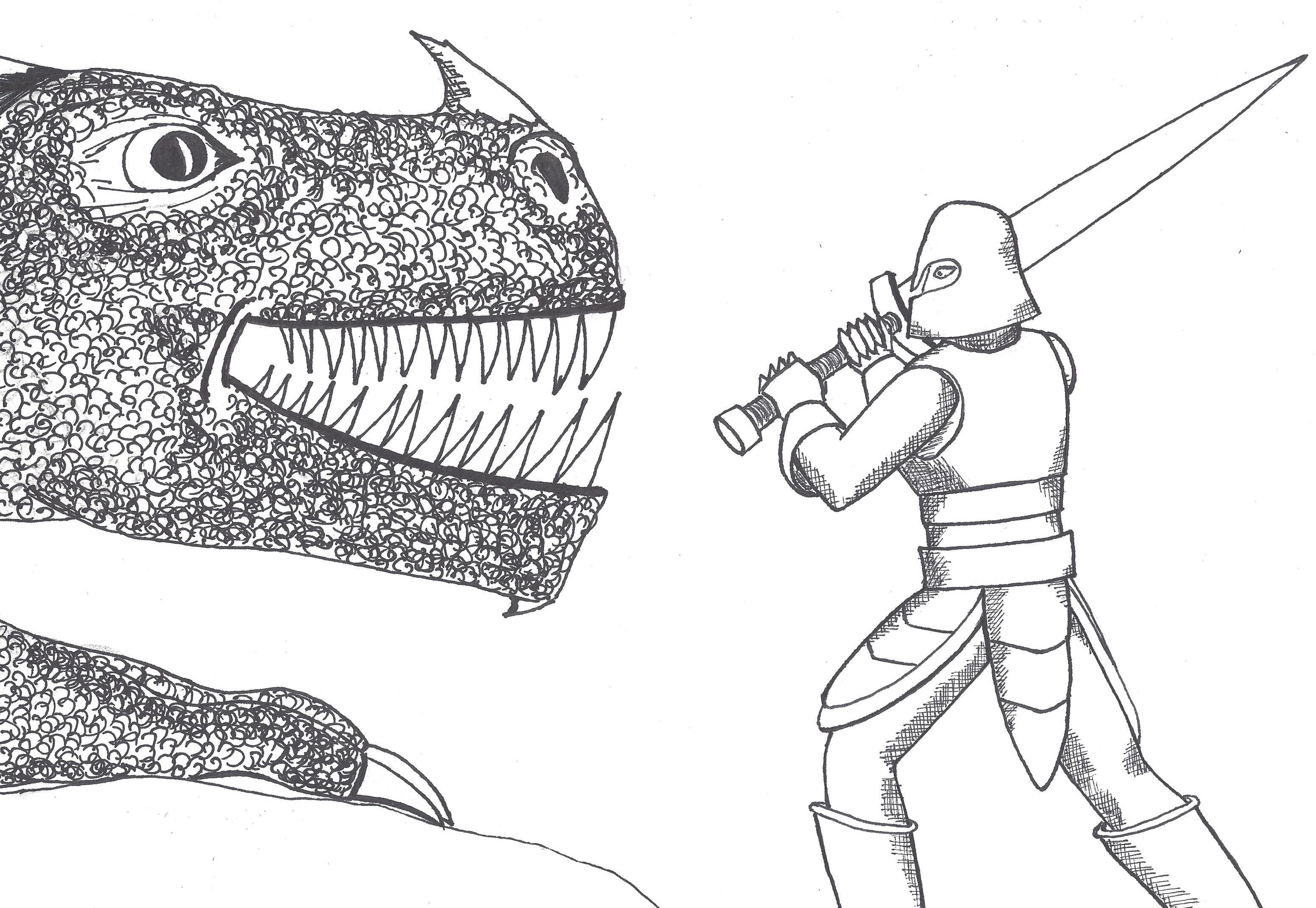
The Inquisitor did raise her mighty sword, and with a lion-hearted roar did issue her challenge, "Come at me bro!" And lo, the dragon came at her.
The Inquisitor did raise her mighty sword, and with a lion-hearted roar did issue her challenge, “Come at me bro!”
And lo, the dragon came at her.

But one of the things I’ve loved about DA:I‘s portrayal of belief has been the subversive* way that it compares the faith of its characters in the guiding hand of “the Maker” with the faith of gamers in the guiding hand of the developers. Let’s think about it this way: there are certain expectations that we as audience and participants have of the media that we consume, and we have faith that these expectations will be met. Within the above mentioned passive media these expectations can be as simple as expecting action in an action movie, singing and dancing in a Bollywood film, and spectacularly shot images meant to convey how depressing and meaningless humanity really is in anything by Lars von Trier. In superhero comics and cartoons we expect the villain to get away at the end of the episode (not least so the series can continue). In detective fiction we expect an answer as to “who’dunnit?” (even if we don’t always expect justice). When watching a horror movie we expect the protagonists (for want of better word) to do stupid things like split up, forget to charge their phones and generally not seek help from anyone useful so that the villain has the opportunity to pick them off in whatever gruesome manner they prefer. Our expectations are used by creators as shorthand to avoid lengthy and unnecessary exposition, and as tropes to drive the narrative forward. Video games have an additional layer of expectations laid on top of them, again often separated by genre and developer, in the form of mechanics.

In RPGs like DA:I (and other games by Bioware for that matter), we have certain expectations about how the mechanics will deliver the narrative. We expect an antagonist with impossible power and dreams of conquering/destroying the world. We expect a number of companion characters and allies who fill out certain archetypes and react accordingly to the story and the player’s decisions. We expect our avatar to either be given some power or weapon that for some reason is the only method of defeating the antagonist, or given the task of achieving/retrieving said weapon or power, through happenstance, destiny or the will of god. But Bioware’s writers were aware of this and used it to further drive the narrative.

Most self aware games, like most self aware media in my experience, tend to be examples of satire, mockery, or (at their artistic best) deconstruction. Horror films have Scream. Video games have the Saints Row franchise, which revels in the inherent ridiculousness inherent in common video game tropes with a straight face and the occasional knowing wink. Or Sunset Overdrive, which openly points out and laughs at the flaws of video game logic. DA:I isn’t satire, and I wouldn’t call it a deconstruction without some serious mental gymnastics, but it is fairly self-aware. Your avatar is given a mark, ‘the anchor’, right at the beginning of the game, that is the only threat to the game’s villain. Even when you learn that the anchor is just old magic, and that the reason it fused with you was simple accident and happenstance, the characters most defined by their faith (such as Cassandra) point out how convenient it was that you just happened to be in the exact right spot at the exact right time to become exactly what was needed. So convenient that it’s not a particularly difficult leap to assume that some divine planning was in play. Because it was.

I know I’m starting to sound repetitive right now, but I can’t stress the fact enough. The writers planned every twist, every coincidence and the consequences of every choice. The lore, the history, the rules, the science of the world. The artists designed and drew, the programmers made it a virtual reality. No matter the details of my character’s history that I’ve ‘headcanoned’ it is still limited by the decisions and narrative given by the game’s designers. Her destiny is still predetermined. We, the players, know that. We have faith in that. So when the characters and story appeals to our character’s faith in a fictional god or religion, they are in fact appealing to the player’s faith in the game. Exhausted and wounded (spoiler alert) after your first encounter with the game’s antagonist, the Elder One, your army defeated and your camp at Haven destroyed, the character Mother Giselle tells your character to have faith that all is not lost, to have faith that things will get better. She is also telling you, the player, to have faith in the game and its designers. Of course they aren’t going to end it there, of course you’re going to get stronger and wiser and ultimately defeat the villain of the piece. That’s how linear video game story mechanics work.

So, again, what does this mean? It makes the game’s narrative more compelling, whether we roleplay a religious character or not, since it compares our faith in the game with the faith of the NPCs driving the narrative. It makes the characters and their struggles more relatable, since their faith in the Maker’s plan is reflected by our own. It makes for a strong, compelling story that explores themes like the place of institutionalised religion in politics and power, race relations, and, of course faith, with confidence that everyone understands exactly what they’re trying to get across.

If I can string together a coherent post on the subject, there might be a part three next week.


*I’ve been trying to cut down on using that word, but I can’t think of a better one at this exact moment.

Keeping faith in Dragon Age: Inquisition, Part one: Let me frame the discussion

How would you react if you knew for certain that god existed? Or destiny? Let’s say a god that doesn’t care whether you’re moral or immoral, faithful or unfaithful, sing its praises or curse its name, you’ve received its mark regardless and you have a destiny in front of you. Would you piously tell anyone who asked or listened about your knowledge and faith? Would you simply shrug your shoulders and give an inconclusive, agnostic non-answer? Or would you loudly tout your ‘atheism’, laughing behind your eyes at those that agree or disagree alike? It’s a question that comes up often in Role Playing Games (RPGs) like Dragon Age: Inquisition. It’s part of the fun though we rarely put it that way, at least partly because over-thinking the philosophical implications of such a decision takes up time that could be better spent slaying cultists, giants and dragons. I do love slaying dragons.

DA-I Lana drawing 1 edited
“Right, who’s next?”

Faith is a key theme running throughout the game, being a major motivating factor for many of the main characters (unsurprising given that the Inquisition of the title is an offshoot of the world’s major religious institution populated primarily by the faithful). Cassandra is a holy warrior whose faith in her god (the Maker) is strong, but her faith in his Chantry is shaken. Leliana struggles to reconcile her belief (so strong in Dragon Age: Origins) in a loving Maker with the fact that he has allowed so much chaos and destruction loose on those loyal to him (including the death of her friend and mentor, the Divine). The Iron Bull’s faith in the Qun is already shaken before he meets the Inquisitor from having lived outside of its teachings for so long, and if certain choices are made he doubts his own ability to keep from becoming a mindless savage without it, losing faith in himself. Sera, Varric and Dorian’s lack of faith in the old institutions of their respective governments, class systems and religions drove them to join and remain with the Inquisition, a catalyst of change, but their views and certainties of the world are rocked by the truths revealed by the identity of the game’s overarching antagonist (effectively a powerful mage who became Satan). The player character him or herself spends what can be defined as the extended prologue with everyone assuming he/she was personally saved from a cataclysmic death by blessed Andraste, god’s missus. Even after we find out that the glowing green mark on our avatar’s hand is due to magic and coincidence rather than overt divine intervention many of our followers make the rather valid point that covert divine intervention is not ruled out, since you just happen to be exactly what is needed when it is needed. Several outright ask the player what they believe is on their hand and what they believe exists in the DA:I equivalent of heaven. How the player responds to this is up to them.

The first thing you do in DA:I is pick your race (elf, human, dwarf, Qunari), your class (warrior, rogue or mage) and your appearance. You are given the barest outline of a personal history to explain how you happen to be at the centre of a magically exploding temple. It is assumed you either know the game world’s law or will be paying close attention to the codex entries you find. After that, it’s up to you to decide the personality of your avatar, your Inquisitor, how they act and react, how they get along with the other characters in the game, and what they believe. The characters are left purposely blank for this exact reason, so that the player can fill in the spaces.

Take my Inquisitor pictured above (badly, I stuffed up the shadowing and drew the eyes too high, but that is why we practice). Lana is a Dalish elf warrior who prefers swords to axes, and axes to hammers or mauls. She has a scar over her left eye from a fight with a Tal-Vashoth bandit in which she almost lost it. She generally tries to get along with people, but her attempts at diplomacy often come off as clumsy or ill-thought, not helped by the fact she has a fierce temper with little mercy for those that cross her. Regardless Lana gets along with her companions well enough. There were a few tensions initially with Dorian, the Tevinter mage, after a few ignorant comments got her Dalish blood boiling. She does her very best to stay on Sera’s good side, seeing the playful city elf as a sort of little sister. She does her very best to try and like Solas with his large head full of dreams, but finds his pseudo-intellectual condescension irritating. She finds some of Cole’s actions worrying, but appreciates good intentions. The two that she understands best however (at least at this point in the game), are Cassandra and Leliana, whose crises of faith perhaps best reflect her own as she struggles to reconcile her proud beliefs in the gods of the Dalish with what she has seen and been told about the circumstances of the mark on her hand (the anchor), which indicates at least some truth to the stories the Chantry tells about the Maker (who is perhaps not so different from the Dalish Creator god).

But that’s me filling in the blanks. Jump onto Tumblr or any other similar website and punch in the right search terms and you’re bound to see stories, comics, other fan-fiction and reviews where people have filled in their own. Some are militantly atheist, some are calmly agnostic, others have declared themselves arbiters of the Maker’s will.

Here’s the thing though: we as players know for a fact that god exists and has a plan for our characters. That god’s name is Bioware.