Kill the Moon? Not like we’ve been given anything better to do

There was a lot wrong with last week’s episode of Doctor Who, from its title (Kill the Moon) to its science to its plot to its moral dilemma. The Doctor takes Clara and a school girl we met the episode before named Courtney to the moon, where they hook up with a trio of (“third-hand”) astronauts in a (“second-hand”) shuttle investigating why the moon has suddenly put on enough mass to give it the same gravitational pull as earth. Spoiler alert! The moon is a giant bloody egg that’s about to hatch and they want to blow it up before that happens. Sort of. One of them wants to. Because tides and stuff. Oh and there’s space spiders that are apparently just giant bacteria but still have mouths, fangs and spin webs.

Alright, proper explanation. The Doctor, Clara and Courtney land the TARDIS on a space shuttle loaded with nuclear bombs and three astronauts (one of whom is played by the actress that was Ros on Spooks. Loved that show) crash-landing on the moon, which has gained 1.3 billion odd tonnes and has messed with Earth’s tides so bad that they “drown whole cities.” The astronauts are there to find out what’s wrong and… blow a chunk off it I guess? That’s never entirely explained. They visit a Mexican (really? Mexican? not, say, Chinese?) mineral survey station covered in cobwebs with a dead crew, fight a couple of spiders (that are just bacteria with very spider-like qualities), kill two out of three astronauts (thankfully not Space-Ros) and briefly let us believe this might be a horror episode. After another space walk the Doctor figures out that the moon is an egg containing a giant life-form, the source of the extra mass and gravity, which is about to hatch breaking the moon in the process. Space-Ros asks how to kill it. The Doctor says with all those nuclear bombs they brought along. Clara and Courtney aren’t keen on “blaming a baby for kicking.” The Doctor says it’s your moon you decide and disappears with his TARDIS, leaving the other three to argue it out. And there’s this week’s moral dilemma. Clara calls it an impossible choice between an innocent life and the future of all of humanity. I’d call it bullshit.

As stupid as the plot, premise and pseudo-science were (really, really fucking stupid) it was the pseudo-philosophical drama that left a bad taste in my mouth. It was a play on the pretty standard “would you take a life to save a life/lives?” trope that pops up in any literature where the protagonist/s have an issue with killing, used to build artificial tension and establish the protagonists’ moral superiority over everyone who’d answer with a “yep.” Then again there wasn’t any reason given as to why the answer should have been “nope” beyond “it’s wrong to nuke a giant baby squid/insect/thing” and quite frankly I just didn’t find that particularly convincing. They should have blown up the moon. They don’t and everything works out fine, but they should have.
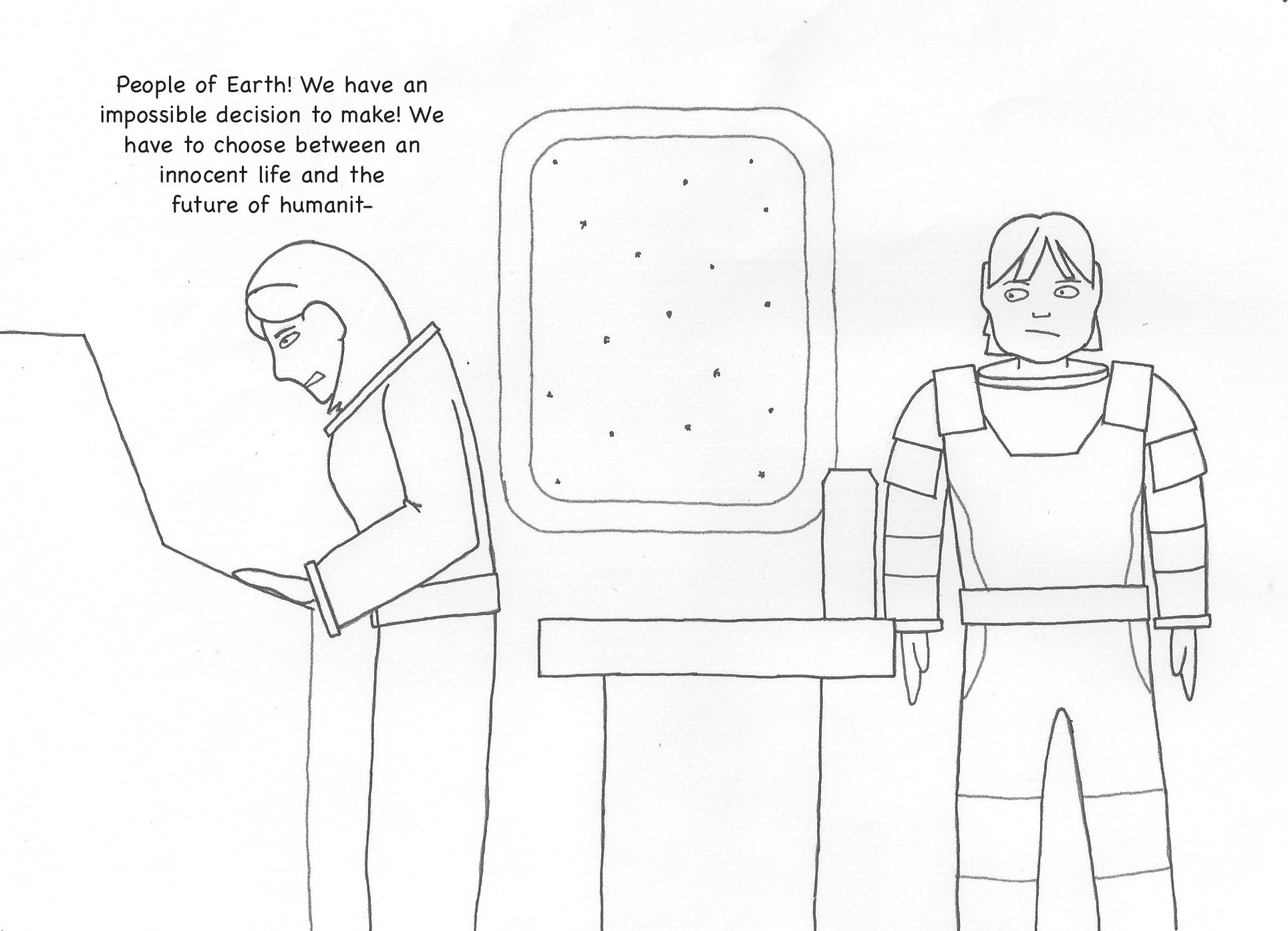
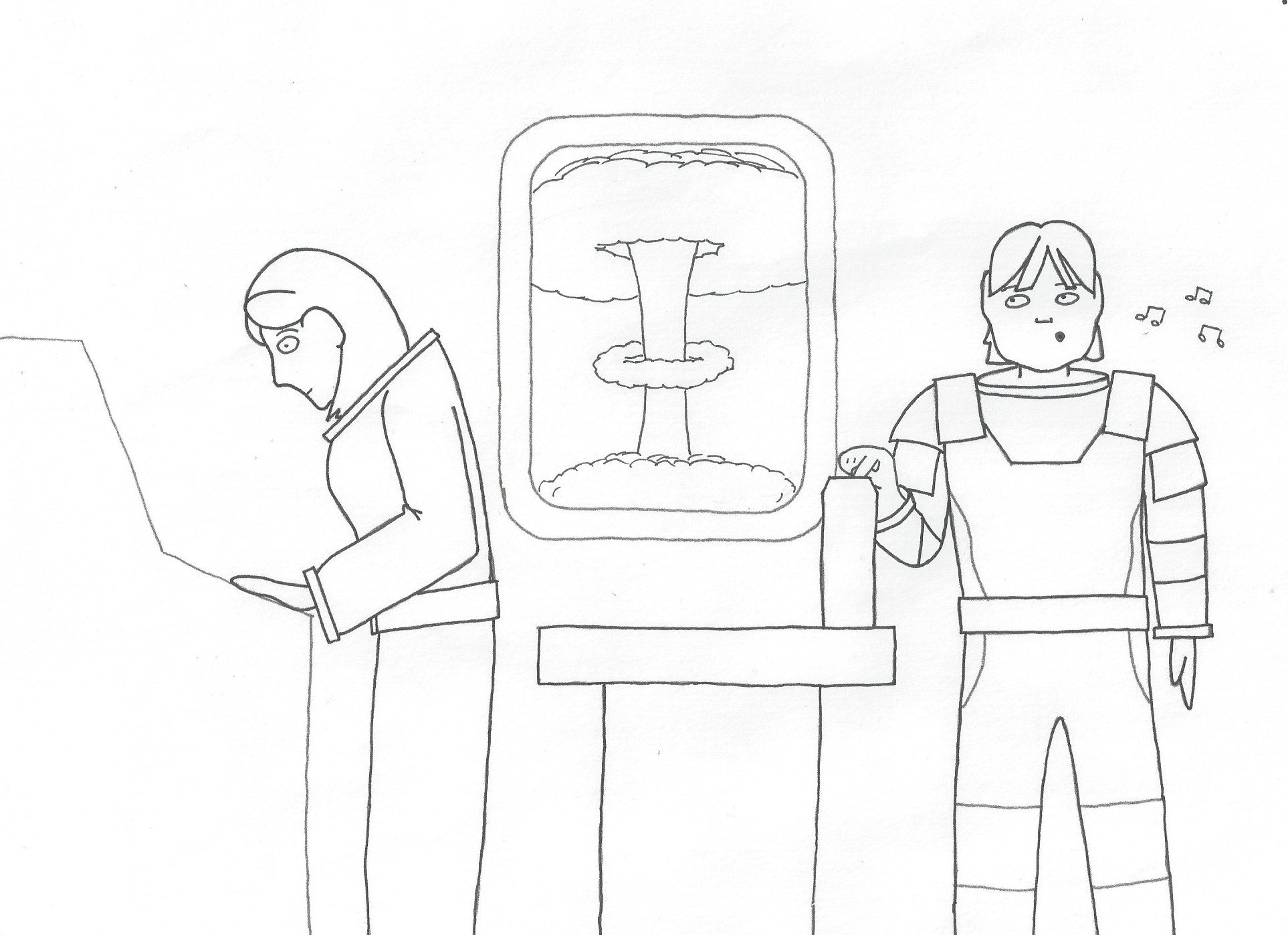
Kill the moon panel 1 - edited

Kill the moon panel 2 - edited
Decision made!

Philosophically I understand the argument against killing the creature, even if my utilitarian sensibilities disagrees. It’s a question (to butcher and simplify some pretty complex ideas) of whether or not you’re responsible for the consequences of your inactions as well as your actions. If it’s just the latter than ending a life is morally wrong regardless of how many other lives it might save (in my experience Immanuel Kant is the bloke most cited when making this argument). As a trope in fiction I don’t have a particular problem with it being used and I’ve seen it used in other mediums, stories and contexts pretty effectively. We see it all the time in superhero stories, where a Thou shall not kill clause keeps the all-powerful beings on the right side of the moral line. More than a few good stories examine how easy it is to stay on the other side of that line once it’s crossed (like the ‘A Better World episodes in the Justice League animated series or a few key arcs in the police procedural comic series Powers). Funny thing about a lot of those superheroes though is they don’t have much of an issue with regular law enforcement officers using lethal force, since regular police aren’t bullet-proof, super strong or the goddamn Batman but still have a right to defend themselves. Following that, Batman (depending on the writer) uses his unwillingness to kill to place himself morally above the rogues of his gallery, assassins with ‘codes of honour,’ and lethal vigilantes, but not morally above the cops of Gotham. He then has to deal with the consequences of his non-lethal actions. And there lies my biggest issue with Kill the Moon.

You see, the Doctor doesn’t provide any information to Clara, Courtney and Space-Ros with any information beyond “it’s an egg and it’s hatching in an hour and a half” before he buggers off in the TARDIS. It’s not surprising that Space-Ros is worried about pieces of egg shell the size of small countries raining down upon earth (though detonating a bunch of nuclear bombs inside the moon’s crust might have similar results, I’m no scientist) and is concerned that a space creature that ways at least 1.3 billion tonnes might be a dangerous thing to have waking up next door to the planet we all live on. The people of Earth, who have so far spent the past ten years dealing with the cataclysmic results of this creature’s growth spurt, agree that a preventative strike might be a good idea and indicate this by switching off their lights. Despite some brief second thoughts, Clara ignores the majority opinion and aborts the detonation. Because this is Doctor Who. This turns out to be the right move because at that moment the Doctor picks up and takes them to a beach to watch the hatching. The ‘shell’ disintegrates (I don’t think that’s how billions of tonnes of rock would work), the creature flies away after laying a fresh moon and even Space-Ros is grateful. Everything works out. Because this is Doctor Who.

They should have blown up the moon.

Standing on the beach watching the creature fly away the Doctor announces that it marks a turning point towards a new age of human space exploration because for once the humans turned towards the sky, saw something scary and didn’t blow it up. Which is patronising as balls. Humanity had good reason to want to blow it up given the information available and would have merely been exorcising their right to self-defence against an extraterrestrial threat. By ignoring the decision of the people of Earth, who were just thinking of the children (won’t someone please think of the children?), the show places Clara and (by proxy) the Doctor on some sort of higher moral plane since they would never cross that line (unless they’re Daleks, Sontarans, Cybermen or plenty of other villains) unlike the rest of us short-sighted, selfish bastards. Worse than that though is that the problem solves itself. The old moon dissolves, a new moon is laid and the giant space thing flies away. There is no negative consequence for inaction, no negative consequence for not blowing up the moon. Without negative consequence for both the yes or no camps it ceases to be a moral dilemma and merely becomes artificial tension based on misinformation. With the information they had, they should have blown up the fucking moon. For the children.

I know I’m sounding like a broken record at this point, and you may not be totally convinced that blowing up the moon would be the right thing to do, but without knowing the ending or without being genre savvy enough to know that everything works out alright in Doctor Who what would you have done?

The one good thing about this episode comes at the end when the Doctor drops Clara and Courtney back at their school and Clara emotionally calls him in his shit and announces that she’s “done.” I’m not sure if this is the writers being self-aware enough to recognise when they stick a middle finger up at their audiences and characters, but I really hope so. Otherwise we might be seeing more crappy episodes like this.

Seasonal conversation cycles

Last week I went out to dinner with some good mates at a nice place in Croydon Park. Well less dinner and more coffee and knafeh (a Middle Eastern desert that’s just fantastic). It was a good night, but I still found myself drifting off fairly early and was one of the first to call it quits. As I leant across the table and shook hands with an old mate, who I’ve really only been seeing regularly for the past year or so, he asked if I was cycling with him a few of the others on the weekend. I didn’t have to answer since just about everyone else at the table knew it already.

“Nope. Tom doesn’t cycle.”

I don’t. Simple as that. It’s still something that many people seem to find difficult to comprehend, and I found myself running through a familiar conversation last week as the gears ground to a halt inside the questioner’s head. It’s a conversation I’ll probably find myself in more often than not as the southern hemisphere shifts into spring and summer, and the people I know for whom cycling is more lifestyle choice than legitimate transportation alternative begin planning day trips and coastal rides.

My mate looked at me in confusion for a moment, then asked if it was because I didn’t own a bike (followed by an offer to borrow his old one). Nope, I answered, I just don’t cycle. He then threatened to buy me a bike, since then I’d have to use it. I said that if he did I’d cut off the handlebars and leave them in his bed. As a warning.

Bicycle and circular saw - edited 3:10:14
I’ve been told I shouldn’t take life advice from Al Pacino characters. Can’t for the life of me figure out why.

At that point I finished my goodbyes and did a runner before he got the chance to ask the all important question. Why? For some reason a lot of people assume that it’s because I had some sort of bad experience on the back of a bike and I did have a nasty crash or two when I was younger, dumber and still rode. Truthfully I just didn’t like it, so I stopped and let the old set of wheels rust away. These days it’s just a matter of pride (and if I’m going to be honest probably always has been at least a little). The whole culture surrounding grown-apparently-mature-adults cycling irritates me and I by and large try and avoid it.

That’s not to say I have issue with the handful of people I know who cycle for actual exorcise and transport reasons, since they aren’t the problem. They’re pleasant and recognise that not everyone gives a shit about how much their bike costs. It’s the folks for whom cycling is essentially just a passing fad (appearing with the Tour de France and disappearing when they realise that riding 50km in 35 degree Celsius weather goddamned sucks) that are the problem. The folks who’ll spend forty minutes talking about the carbon fibre wheels or carbon fibre brakes or carbon fibre underwear or carbon fibre whatever-the-useless-fuck that they last spent an obscene amount of their hard-earned money on. Or the folk who dawdle along the narrow streets of Balmain, Newtown and Surry Hills on their fixed-gear bikes in Ray Bans and/or flowing summer dresses blocking traffic then lamenting how bicycle-unfriendly Sydney is compared to Europe (don’t even get those guys started on Australian helmet laws, they never shut up).

But they’re my mates. They put up with me when I begin ranting about movies and anime and video games and the geopolitical ramifications of Australian military intervention in Iraq and Syria, so it’s only right that I just I grin and politely nod when they talk about how they need new road tires or bitch about the lack of bike lanes around the city. Most of them know better than to bring up the subject of new tires, day-trips and the importance of their upcoming court battle appealing a hundred dollar fine received for not wearing a helmet (seriously, don’t get them started on bloody Australian bloody helmet laws). Same as I know not to start talking about how Sons of Anarchy has shifted from a Hamlet to Macbeth cover whenever we’re out clubbing. But not all of them and not all the time. So, as happens with the changing of the seasons I sit back and contemplate whether it might be more efficient to just tattoo my side of the conversation onto some easily visible part of my body.

“Nope. I don’t cycle. Because I don’t.”

No more point to this post than that. Just figured I’d write something up while I think of something more interesting to talk about.

Is that the best you can do? How insulting.

What’s the worst English language word you can think of? That word that you only pull out to express your displeasure at the very worst of traffic jams or to describe some self-important waste of skin trying to cut the queue at the bank. Maybe that word that gets your blood boiling and everyone knows never to say whenever you’re within earshot. Personally I shudder whenever I hear the word yummy spoken aloud, but I expect most people would cite more extreme examples. F-bombs, Sugar Honey Iced Tea, the odd bit of blasphemy, both the clinical and slang terms for reproductive organs and, of course, the big C. That’s the one I think we need to talk about internet, because that’s the one I’ve been seeing a lot of lately.

Earlier this week I read an article by Zoe Quinn on Cracked.com about her recent experiences as the internet’s most hated person. If you don’t know anything about the recent GamerGate controversy (or the Quinnspiracy or whatever else they were calling it), lucky you. Because it’s bloody stupid. Just another chapter of gamer culture’s ridiculously misogynistic treatment of women, with the key difference this time being that they tried to use ‘concern over journalistic ethics’ to lend credibility to their anger that women don’t want to sleep with them. It’s not an issue I can write about with a perspective worth reading. I’m a young, straight, white male who’s not part of the industry and never been subjected to the kind of stupidity that women (and racial/sexual minorities) have to deal with beyond a few high-pitched voices back when I still tried playing CoD online. But I kept track of the … debate … as did many others. As I did when the internet’s wrath was focused on Anita Sarkeesian and Jennifer Hepler, (hell, Sarkeesian is still under attack). Amongst all the rape-threats and poorly spelt character-attacks there’s a word I keep seeing, and quite frankly think a lot of people need to get over using.

Right, before this continues I’d like to put a great big warning here. While I have nothing against a bit of profanity I do understand that not everyone wants to read it (especially in bulk), and it’ll probably get heavy in the next few paragraphs (since it’s hard to talk about using a word without, well, using it) so: Language Warning.

Continue reading “Is that the best you can do? How insulting.”

Can I still listen to their music?

I hate it when an artist I like does something I don’t.

Last week Max MacKinnon, also known as MC Eso of Australian hip hop act Bliss n Eso, came under fire after posting three misogynistic photos to Instagram with equally misogynistic tags taken during his visit to Madame Tussauds (a wax museum) in Beverley Hills, L.A. The worst was arguably a picture of him posting with an ‘angry’ expression and raised fist towards a wax statue of Rihanna with the caption “Where did ya throw those fucking car keys woman!?! #smackmybitch #shelovesthewayithurts.” (Haha, it’s funny because Chris Brown beat the crap out of her. Wait, no it fucking isn’t, and never will be). The other pictures were of him with his hand by the wax Lady Gaga’s crotch and crawling beneath Raquel Welch with a club, both with pretty bad captions. Outrage was inevitable, an apology was given, then another one on their Youtube channel (what I found most notable was that it condemned the threats and abuse that fans began throwing against the people upset by the pictures). Their management said it was a stupid lapse of judgement.

As far as this kind of scandal goes, it’s pretty small-time. Bliss n Eso have managed some international success but this is really only news-worthy down here in Oz, and even then hasn’t exactly been filling the front pages. Then of course by most standards Eso’s actions (to be clear, not defending him here) aren’t even close to as bad as what some celebrities have gotten away with, or things that have been said and done that are ignored and forgotten. Repeatedly.

For the vast majority of people I expect it’s a bit of a “who cares?” moment. Well, I care, because Bliss n Eso’s particular message of peace and love (delivered with enough aggression and profanity to strongly imply an “or else we’ll break your face”) has had a spot on my playlists since high school. And as I read some of the better articles commenting on the inherent issues raised by Eso’s pictures (those issues being the fact that people find it socially acceptable to joke about domestic abuse and that others dismissed the outrage as simply “not having a sense of humour”) I began asking myself the question: at what point do you stop listening (watching/reading/paying-attention-to) an artist that has done something wrong?

It’s a subjective question with a lot of answers, but I think it roughly comes down to whether you can separate artist, art and action. Or, ’cause I’m starting to feel pretentious, can you separate the crap they do from the crap they make?

This is more difficult when the art in question is part of the problem. Take the music of everyone’s favourite chauvinistic punching bag, at least for a while, Robin Thicke (I’m using the word ‘art’ very loosely and Thicke because he’s a recent mainstream example). Blurred Lines, his hit song (for some god-forsaken reason I cannot fathom, since it’s a crap song even if you ignore the lyrics) garnered a whole lot of controversy, rightly or wrongly depending on who you listen to (as long as you don’t listen to Thicke himself). His following album Paula, an attempt to woo back his now ex-wife Paula Patton, didn’t fare particularly well either.

But where Eso and so many other artists are different is that it is not their creations that are problematic but their lives outside of it. Take for example Orson Scott Card, a man who’s Ender Saga books (the first of which, Ender’s Game, recently became a movie) is an incredibly well-regarded and influential piece of modern science fiction, but who is also a (now at least) very loud bigot. A lot of people I’ve known and a lot more people I’ve read who have loved Ender’s Game now refuse to buy his books any more (and warned me off buying them), with one of the key reasons being that they don’t want to give him any more money to spend on anti-gay campaigns. An alternate example is Roman Polanski, who fled to France rather than face sentencing for sexually assaulting a 13 year old girl, though that doesn’t seem to have hurt his career beyond needing to avoid countries with US extradition deals (for instance there’s cinematic classic the Pianist, which won 3 out of 7 Oscars it was nominated for including a Best Director for Polanski). Similar statements can be made about Woody Allen, without the conviction.

I suppose a key point here is that there aren’t any new albums due any time soon, nor are there any concerts that I know about or that I’m likely to buy a ticket for. I already own all of their music I’m going to listen to and I don’t expect I’ll be playing it where other people are going to hear it (I often seem to be one of those very rare people who actually admits to enjoying Aussie rap… probably for good reason), and none of that music to my knowledge condones violence against women (as above, peace and love or else). So surely it’s alright if I keep listening to the music I enjoy?

But.

There had been calls last week for Triple J, the big public youth station in Oz, to ban Bliss n Eso from their playlists similar to how commercial rock station Triple M (we love our triplets) removed KISS from their playlists after Gene Simmons told depression sufferers “Fuck you, then kill yourself.” Some news articles actually claimed the station has already done so, prompting the trio to denounce those articles on Twitter and Facebook, in a move that I expect was to prevent or limit some likely attacks by supporters against the station that has in the past ten years given them a great deal of airtime. I supported the Triple M KISS ban (’cause that kind of attitude towards mental illness is wrong), and if Triple J decided to ban Bliss n Eso I’d support that too (so is that kind of attitude towards domestic abuse). I don’t expect them to do it officially, just quietly keep them off the airwaves until the people that care don’t anymore. But I’d support a ban if it did happen.

I still wanna listen to them though.

Bugger it, I’ll just listen to some Seth Sentry instead.

First impressions of the new Doctor Who

Tardis sketch 2:8:14 Edited

It’s that time of the… year? Has it been a year since the end or beginning of the last season of Doctor Who? Hold on a second, I’m gonna check… Season 7 started in September 2012 and ended December 2013. Christ almighty, even if you don’t include both the Christmas specials and 50th anniversary thing it didn’t end til May 2013. That’s ten months to air 13 goddamn episodes! Did they plan to string it out for almost a year or was it just good luck? How long does it take to make one episode? What, did they spend four months arguing over exactly what shade of red his bloody bow tie was? Deep breath (topical). Moving on, starting with: Spoiler warnings.

The stars have aligned properly and the new season of Doctor Who has started. We’ve had two episodes thus far with Peter Capaldi as the 12th Doctor so I figure it’s a decent time to give some highly opinionated first impressions. I’m liking his performance so far, which seems understated yet animated, and I yet live in hope he’ll go all Malcolm Tucker (NSFW) on some poor bastard. Probably make a Cyberman cry. That would be awesome.

As for the episodes themselves? Well the first one (Deep Breath) didn’t blow me away and the second one (Into the Dalek) was better, but still not spectacular. Perhaps the biggest flaw for both was that they’d already been done better in previous seasons with The Christmas Invasion (S2E1, the introduction of David Tenant) and Dalek (S1E6, an episode about a crippled Dalek and the Doctor’s hatred of the species being overcome) respectively.

But I’m hopeful. While Deep Breath didn’t grab me aside from the best description of facial features I’ve heard in a while (“These are attack eyebrows!”) and the always chuckle-worthy Strax (I can’t stand Madame Vastra and Jenny anymore), Into the Dalek was a little more interesting and his attempt to bring the Dalek to the light side at the end felt a lot less contrived then some of the pseudo-philosophical monologues that poor Matt Smith had to deliver. They also seem to be going back to more self-contained ‘monster of the week’ stories with an underlying narrative that I’ll guess will come together in the last episodes of the season (like the appearance of the words “Bad Wolf” were for David Tennant and Christopher Eccleston’s Doctors), instead of the extended story-arcs of Matt Smith’s tenure (and thank God for that).

So yeah, hopeful enough to keep me watching for at least the first half of the season. I am praying that they get past the whole ‘Is the Doctor a good man?’ moralising that they seem to be leaning towards. Because it’s Doctor Who. The people who care about that kind of unnecessary characterisation (including myself) need less free time, and the target audience is too young to care.

Bitcoins are not going to be considered foreign currency

Bitcoin is an asset, not a foreign currency

Bitcoin had a bit of play in the Aussie news this week when the Australian Taxation Office (ATO) decided that it would be considered an ‘intangible asset’ instead of foreign currency for taxation purposes, so subject to capital gains and the Goods and Service Tax (GST), not surprising since it follows similar decisions by the USA and Singapore (but different to the UK which treats Bitcoin as currency). What does this mean? For individuals buying Bitcoins or products with Bitcoins for personal purposes (less than ten thousand dollars and not to make a profit), not a lot. But the 10% Goods and Services Tax would affect exchanges, mining Bitcoins for profit and business purposes, and make tax time a lot more complicated for businesses that accept Bitcoin payments (who might have to pay GST twice).

This has led to a whole lot of collective groaning by Bitcoin enthusiasts (Bitcointhusiasts?) who are concerned that an overcomplicated and expensive tax regime will push new Bitcoin businesses off-shore (though why they think the ATO would give a shit about that I cannot fathom), while others think that any ruling at all will give legitimacy to a product (tool/asset/I-don’t-like-calling-it-a-currency-myself) that suffers some serious image problems. Y’know, because it’s a largely unregulated and incredibly volatile speculative product synonymous with buying drugs on the internet. Those image problems.

Sorry. Bitcoin’s one of those areas where I find it harder to bite back the bias. Because I’m cynical (and not the only one).

Honestly though the decision to treat Bitcoin as an asset rather than a foreign currency isn’t much of a surprise, and the ATO are accepting public comment on the policies (that might not noticeably change anything, but they aren’t completely deaf). While a lot of people are obviously unhappy that government regulators (not just Australian) are starting to look at how to restrict, regulate and worst of all tax Bitcoins and other cryptocurrencies, it’s gonna keep happening and it’s got to keep happening before they can achieve any mainstream success.

After all given the volatility in the value of Bitcoin’s price, because of lack of accountability and regulation or because of heavy-handed and reactive government regulation (due to perfectly reasonable fears of a speculative bubble), why would major corporations like Google or Amazon start accepting it as a method of payment? Even imperfect regulations and taxation by enough nations, provided they’re relatively measured (so not what China did) and coherent, will go a long way towards stabilising the price and people will feel better about using Bitcoins if they don’t have to worry that the real world value of their funds will suddenly drop.

A bit of inspiration from the Candy Kingdom’s power couple

If you asked me to name my favourite current TV shows, the awesome Adventure Time would be somewhere near the top of the list. Aside from the fact that it’s bloody hilarious for all ages in a way that’s reminiscent of Rocko’s Modern Life (a show I grew up watching and still as far as I’m concerned the best example of a well-rounded Australian character to have yet appeared on TV), it’s an absurdist deconstruction of the child hero/fantasy genre, a frequently heartbreaking depiction of loneliness and trauma in a post-apocalyptic world, and a discussion on the nature of power, heroism, prophecy and purpose. It’s stuff that I’d like to go into in more detail in the future, but today I’d like to talk about a vampire and a princess.

The thing I love most about this show is the characters. Finn the Human is good-natured and well-intentioned (he’s a hero in the most idealistic sense of the word) but makes frequent mistakes and has suffered some heavy trauma. The Ice King goes from the series’ primary and frankly ridiculous antagonist in the first seasons to a victim isolated from society because of mental illness. Supporting character Peppermint Butler is a demon-summoning dark magician who’s close friends with the show’s version of death. And we discovered this week that Princess Bubblegum and Marceline the Vampire Queen (two fantastic examples of well-written, deep and powerful female characters) used to date when Olivia Olsen (the actress who voices Marceline) informed a crowd at a book-signing.

Well, ‘discovered’ might be the wrong word to use here. ‘Confirmed’ would probably be better, since their shared history was implied a few times and it wasn’t hard to pick up on the subtext of a pair of exes who at the very least still cared about each other. It doesn’t look like this will be displayed in the show any time soon, however, with the apparent official reason being “it’s illegal” in several of the countries the show airs in (though you can’t help but wonder if it’s also to avoid the attention of certain pundits who like to get up in arms about all this homosexual propaganda that those damn lefties keep trying to feed to our children). It should also be remembered that the only overt romantics we’ve seen either character involved in have been straight (eg. there’s an episode when Marceline’s chauvinistic ex-boyfriend tricks Finn and Jake into removing her memory of their break-up). Regardless, thousands of fan fiction artists and authors whether they be weird or wonderful felt vindicated… then immediately scrambled to their tumblrs, deviant art pages and whatever else to flood the internet with even more. Some of it is great. Some of it is… well fan fiction… yeah… not to be talked about in polite company. Or within two hundred metres of any schools. Moving on.

Really it won’t have any noticeable effect on the show since it’s more confirming the canon rather than adding to it, and most of the show’s viewers are either to young to care or not the sort of folks who keep track of this sort of news (y’know, like parents). But I like to think this sort of acknowledgement is a positive thing. It might mean a few people feel more confident about themselves . It might mean that a few kids who don’t understand things now will find life easier later, having grown up with great characters that they can relate to. It increases the representation of the bi/same-sex community within popular culture. Every gain no matter how small is an achievement. It might mean that a few authors are a bit more confident in the strength of their own characters, are given ideas on how to make them better, or how to make the relationships between their characters more nuanced and real.

Hopefully we’ll see more.

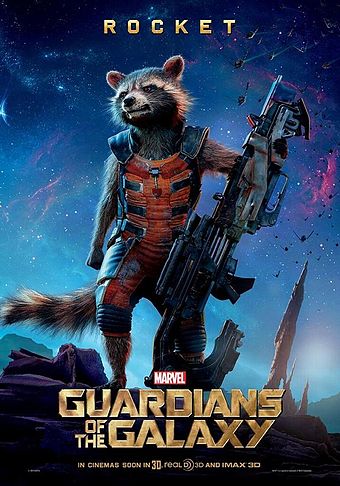
Rocket Raccoon, or why I loved Guardians of the Galaxy

Okay, before we begin SPOILER ALERT! I’ll try not to give anything major away but mistakes happen and I’m talking about what was for me a character defining moment, so fair warning. Alright? Alright. Also, if you haven’t seen Guardians of  the Galaxy yet, it’s awesome. Go see it if for no other reason so you know what the hell people are talking about when they say “I am Groot” in their most Vin-Dieselly voice. On to the matter at hand.

I knew before I walked into the cinema that I was going to like Rocket Raccoon (voiced by Bradley Cooper). From what I understood about the character he was a short, angry, hard-drinking, hard-swearing, sarcastic smartarse, all of whose friends are taller than him. Let’s just say I can relate.

Like staring at a goddamn mirror

The film was a lot of fun, from a prison break that needs the prosthetic leg of a fellow prisoner (for some unspecified reason), to what can essentially be boiled down as bumper cars in space (with LASERS!), to the epic final battle that all good sci-fi/superhero films require (y’know, fate of billions in their hands, seemingly unstoppable enemy etc). But for all the badass and batshit moments that the genetically modified mammal and the rest of Starlord’s (played by Chris Pratt) crew get up to, the moment of the film that really struck me was in a bar a little before the climax of the second act.

Starlord/Peter Quill is sharing one of those inevitably romantic moments with Gamora (played by Zoe Saldana), which is (just as inevitably) interrupted by the sounds of fighting. They enter the bar to find Groot and a drunken Drax the Destroyer (Dave Bautista) punching up while an also drunk Rocket pulls out his machine gun to join in (and those are the titular Guardians of the Galaxy). As Quill places himself between the raccoon and Drax, Rocket tearfully vents his frustration at the way he’s been treated by the others.

“Well I didn’t ask to get made! I didn’t ask to be torn apart and put back together over and over and turned into some little monster!” Quill tries to placate him but all Rocket does is point at Drax, “He called me vermin!” and point at Gamora “She called me rodent! Let’s see if you can laugh after five or six good shots in your face!”

It’s a surprisingly poignant moment for a character that is for the most of the film brash, blunt, aggressive and assertively self-confident, and I found myself nodding along and thinking (since people look at me funny when I talk out loud to movie characters) “I hear you mate.” Rocket (in the movie at least) is an insecure character, particularly about how others view him. Hell, if you watch those Youtube videos of the cast talking about the characters the common theme for Rocket is some take on “lonely.” He hides it behind a loud voice, a mocking sense of humour and a short fuse. Let’s say I can relate.

Fact is though all of the Guardians of the Galaxy are if not exactly relatable than certainly appealing and understandable, probably because they can all put ‘traumatic history’ on their resumes. Drax’s wife and child were murdered by movie villain Ronan the Accuser (played by Lee Pace). Gamora was orphaned, enslaved and turned into a weapon by big baddie Thanos (Josh Brolin). Starlord/Peter Quill was kidnapped from Earth right after watching his mother succumb to cancer. Groot… I’m not sure about Groot (he doesn’t talk about his past much) but I’m sure his history is just as tragic (at the very least he’s as unique as Rocket). They can also all hold their own in a fire/fist/dog/sword/giant-hammer/glowing-purple-rock fight, come to terms with their respective issues (or have already before the film starts), and have more than a little fun while they’re at it.

The result is a bunch of awesome characters whose motivations make sense. As much as I love Batman, I find it easier to understand Peter Quill’s need to protect the last memories of his mother (in the form of the mix-tape that provides the fantastic soundtrack) or his waiting twenty-six years to open a present that would force him to admit she was dead, more than I understand how Bruce Wayne’s grudge turned him into a vigilante in Batman Begins or why at the beginning of The Dark Knight Rises he’d stopped being Batman (because… reasons?) Gamora’s desire to escape her war-criminal father, prevent a genocide and generally not be a bad person was a lot more straightforward and sensible than whatever the fuck Superman’s motivations were in Man of Steel, or whatever the lesson was that Thor learnt in the movie of the same name that got his hammer back at the end (humility? self-sacrifice? his brother’s a charismatic arsehole?).

So far, the people I’ve talked to who have seen the movie have had differing opinions on who is the most awesome. I’ll take the talking space raccoon with a machine gun any day. My brother placed Starlord and Gamora and the top of his list. One of my younger sisters told me with great certainty “I am Groot.” A mate of mine was very quick to quote Drax the Destroyer’s inability to understand metaphor (“it’ll just go straight over his head.” “Nothing goes over my head. I have very fast reflexes, I would catch it.”). Who’s your favourite?

Talking About the First World War

This week has seen the 100th anniversary of the Great War, that huge bloody turf fight between the great European powers and their respective empires (and Japan), which cost millions of lives, toppled kings and set the stage for an even bigger, bloodier conflict twenty-odd years later. Being someone with an interest in history, and given the nature of the dates, I found myself looking through a few of the books I have on the First World War where I came across my old copy of Erich Maria Remarque’s All Quiet on the Western Front. It is a book that, in my very humble opinion, is one of the greatest pieces of antiwar fiction ever written and should be required reading in every school on the planet. It also got me thinking about video games. Because that is how my mind works. Heads up, there are spoilers coming for the book and a few games.

There is a lot that can be said about the novel and its depiction of the cold, brutal, boring reality of the First World War, and it makes for a definite contrast with the depictions of conflict in most games. Remarque’s scenes of rat-killing, delousing, the joy of extra rations and the mind-numbing luck involved in not having an artillery shell land on your head are far removed from the canyon gliding in Call of Duty: Black Ops II, the saving of priceless art from scorched-earth-inclined Nazis in the original Medal of Honour, or essentially using a crashing satellite as a missile in Battlefield: Bad Company 2. Yes, those are more extreme examples of tonal difference than I could have used. But damn it, I’m making a point!

Tone and context are a big part of the difference (to be clear, I’m going to use both terms very broadly in the next few paragraphs) and often a big part of the problem. The need for games ‘to be fun’ is something that often at best creates a level of cognitive dissonance between what the narrative (again, using the term broadly) is trying to achieve and the gameplay. When talking about Call of Duty 4: Modern Warfare (I’d argue the highpoint of the series single-player campaign-wise), you can discuss how it is a stark statement about the nature of contemporary conflict, placing you in the centre of a US intervention in an unnamed Middle Eastern country and brutal civil war in the former Soviet Union, then punctuating acts of traditional movie heroism (saving a downed, female helicopter pilot and stopping nuclear missiles) with a good dose of futility (achieving the objective but failing to escape). Or you can talk about how much fun it was blasting terrorists from an AC-130 gunship and sneaking through Pripyat, next to Chernobyl, dodging or sniping enemy patrols. Medal of Honour: Allied Assault in one level drops the player character into the bloody battle for Omaha beach ala the opening scene of Saving Private Ryan. Of course you also single-handedly scuttle a u-boat and destroy a dangerous prototype ‘radar detector’, and end the game by destroying a German facility with a name that translates literally to ‘Fort Pain.’ The recently released adventure(?) game Valiant Hearts: The Great War (which I haven’t played yet but am planning to) is one of those very rare games actually set in the First World War (which is why I’m mentioning it), and has received high praise for its gut-wrenching story and characters. But it is not without criticism, because of tonal inconsistency (the villain is a caricature of an evil German baron, German flame-thrower tanks that didn’t exist, etc.) in the name of gameplay.

These are just a few examples and the issue of tone is well known in the industry and community, something that is effectively de-constructed in critical darling Spec Ops: The Line, which itself follows Joseph Conrad’s book Heart of Darkness and Francis Ford Coppola’s Apocalypse Now. But the reason we haven’t really seen a gaming equivalent of All Quiet on the Western Front is not just problems with tone, it is also context.

To be blunt, the Germans lost the First World War. Yes, yes, I know the whole ‘everybody lost’ cliché, and generally agree, but for all their losses and the massive, senseless cost for no real gain the remaining Entente powers could at least claim that the Germans broke first, that the Germans surrendered. It was Germany that had to disarm, cede territory, pay reparations and bear the guilt of starting the war in the first place. That is what is most striking about the book, the defeatism. Remarque wrote the book after the war was lost, knew why it was lost, knew that all the heroic sacrifice was ultimately meaningless, and knew the sense of isolation from the generation before that had proudly sent them to the mud and blood, and the generation after that would grow up in peace without being able to understand just how senseless it all was. The final chapter is of a man sitting in a garden hoping beyond hope not for news of a victory but for an end, any end, that he might survive and live a life beyond the numb violence he has known so long. Ultimately it is fool’s hope, as we learn in the final two paragraphs when we are told Paul Baumer, our narrator through the whole ordeal, succumbed to his wounds on an ordinary day on the front with nothing new to report.

If you’ll excuse the language, how the flying fuck do you turn that into gameplay? Games from the survival and horror genres probably come closest, unsurprisingly, but even then the objective based gameplay (kill x amount of zombies, sneak from point a to point b, find shelter for the night, avoid monster while looking for clues etc.) and the consequence of action or inaction gives the player a sense of control over their circumstances and survival (even in situations where defeat is inevitable) Baumer never felt he had. His life is controlled by the army, his survival is dictated entirely by chance, even his decision to join the army before being conscripted is forced by the expectations of society and figures of authority.

Maybe that old arcade game Missile Command did it best, a simple game about holding off wave after wave of nuclear warheads until, inevitably, your launchers and the cities you are meant to protect are destroyed. It is not a game you can win, only prolong. (I won’t go into to much more detail since the folks at Extra Credits already have). But while it makes for an incredibly powerful statement about nuclear warfare it might be harder for some to apply it to conventional conflicts. Perhaps we’ll see it in the upcoming title This War of Mine, which will be about civilians, non-combatants, surviving a war zone. It’s something that needs to be done, a question that needs to answered if it hasn’t already, because getting it right matters.

I suppose I need to now say why this matters. Well, there are two reasons I can think of.

The first is that I firmly believe that games are a narrative medium with an incredible power to deliver story and message, and this is a story worth telling and re-telling.

The second is that my younger brother doesn’t read a lot. Until recently he’s spent almost all his free time in two ways, playing soccer or playing video games. Over the past month I’ve forced him to start reading, buying him books and denying him access to the Xbox unless he reads at least a little every day, but I don’t think I’ll get him reading Remarque’s novel any time soon. The same goes for a lot of his friends, whose interest lay in sports and blockbusters, as I imagine has been the case since the invention of language. Thing is though, a lot of these kids are playing some very smart games. Bioshock Infinite dealt with class, racism, nationalism and religious fundamentalism within a smart science fiction setting of parallel universes and infinite possibility (hence the title). Red Dead Redemption is a story about the death of the frontier and an end to the mythical west beneath the inevitable, brutal march of progress. My brother’s played both of these games, and he’s asked questions about some of the topics portrayed in them. If we’re going to educate this generation about the horrors of the Great War, the wastefulness, and make them understand why it should never be repeated, it may as well be through a medium they’ll actually pay attention to.

There we are. I’ll post something more fun next week.

Gladiator is not an appropriate metaphor for the welfare state

For the past couple of weeks my sister has been writing an essay about one of the most quotable blockbusters of the turn of the century, Gladiator. The assignment’s one of those standard “let’s make learning fun and cool… er… bro” that any high school history student knows and loves, where you ‘analyse’ primary and secondary sources and write what’s historically accurate and what’s not. Anyway, one of her friends sent a bunch of links to websites that may or may not have been useful in her search for the truth behind the fiction, and I went through them quickly to sort through what she could use and what she couldn’t. Amongst the links was this one here that gave me a good chuckle, then annoyed me.

Now, there’s a lot wrong with this article. The long and short of it is that when you say Gladiator, the author says an understated but truthful depiction of the ‘depravity and corruption’ that characterised the centralised welfare state and redistributive nature of ancient Rome and led to the empire’s inevitable downfall. I’m paraphrasing his arguments of course, and given the nature of his article it’s not a bad read. It’s conceptually flawed, of course, from the somewhat bizarre claims about historical Rome to the application of modern ideas to a society fifteen centuries before anyone had thought of them. Calling the Republic a representative democracy with free enterprise and a respect for life and property is ridiculous, as is claiming that the later Empire was a welfare state brought down by poor monetary policy and wealth redistribution.

Yeah, probably not what historians should focus on...
Yeah, probably not what historians should focus on…

Believe it or not this isn’t the point I want to make. The issue I have with an article written in 2001 about a movie from 2000 (I am somewhat behind the times) is this: what the bloody hell does a movie about a bloke with a talent for decapitation getting revenge on a bloke with unsettled daddy issues and funny feeling for his sister have to do with how fixing the price of wheat, currency devaluation and centralised bureaucracies brought down the Roman Empire? Oh, right, second paragraph says it depicts depravity and corruption. And what does this have to do with the price of grain in Gaul?

Now when it comes to the study of literature I am all for the  pulling of themes, morals, messages, ideas and subtext out of the figurative arse (you should hear me talk about underlying feminism of AC/DC sometime), but this is just lazy. The title of the article is Truth in ‘Gladiator’, but the movie doesn’t exist after the second paragraph. Instead of commenting on how Gladiator demonstrates the populist tactics of the emperors and leadership (“ARE YOU NOT ENTERTAINED?”) or the insanity and depravity traditionally attributed to Roman Emperors as seen in the Freudian caricature of Commodus, the author gives us an Alexander Hamilton quote and Emperor Diocletian’s narcissism.

If you’re going to use piece of pop-culture to make a point, then use it. If I was going to write about how the movie Titanic is a Marxist depiction of the structural deficiencies inherent in pre-Depression capitalist society, I wouldn’t just say that “Early twentieth century capitalism was like the Titanic until it hit the iceberg of the Great Depression,” and then never mention the film again. I would use Jack and whatever the girl’s name is (let’s call her Linda) to lead into an argument about class warfare, the faith in the design of the ‘unsinkable ship’ to discuss the feeling of the growing middle class in the post-war boom, how the officers on the Titanic’s crew compare to the reckless drive of many early industrialists, bankers and stockbrokers that led to disaster… Huh, this isn’t bad. Someone should totally write about how Titanic is a Marxist depiction of the structural deficiencies inherent in pre-Depression capitalist society, if someone hasn’t already. I’m not going to, since I’d have to watch the damn film again, but someone else totally should.

Anyway, back on point. I said at the beginning of this post that my sister’s essay was one of those attempts to make learning fun and cool that the old folks who design the syllabus insist on trying. Articles like this are similar, attempting to seem topical in order to draw in a new audience for their old lessons. And it works for a time. You can bet that even in 2001 when the piece was posted there would have still been people searching the internet for information about ancient Rome, Marcus Aurelius and Gladiator. But it’s lazy click-baiting that, on the one hand robs what you’re writing of any credibility as pop-culture study or analysis (because it isn’t), and on the other hand robs you of any credibility on the topics you actually want to discuss because they’re not what was promised.

So an article from 2001 written about a movie from 2000, that the author probably doesn’t remember or care about, that I honestly had no reason to read or link to, or that I don’t particularly not like (as I said, for what it is it’s not bad) but disagree with nonetheless, has annoyed me. Because it invoked the name of Gladiator but did not use it beyond click bait, something I consider intellectually lazy.

Yeah, I know I need a life.

(In fairness here’s the URL for the article/post/blog/opinion piece again: http://mises.org/daily/639/Truth-in-Gladiator I didn’t ask the author’s or the host website’s (http://bastiat.mises.org) permission to link it or discuss it. I’ll also mention that while, as I said, this piece irritated me I’ll not pass further judgement on the rest of the site).